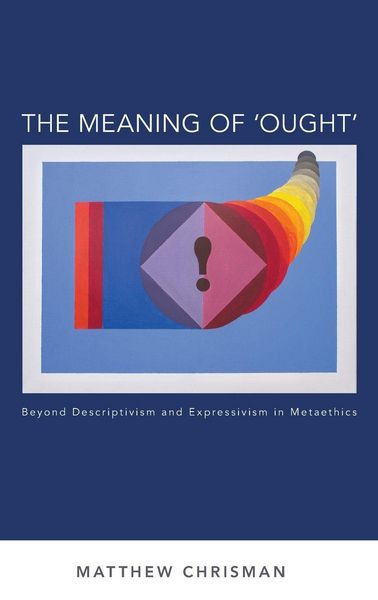
Meaning of 'ought' Beyond Descriptivism and Expressivism in Metaethics
125,99 €
inkl. gesetzl. MwSt.,
Beschreibung
Produktdetails
Einband
Gebundene Ausgabe
Erscheinungsdatum
01.10.2015
Verlag
Oxford University PressSeitenzahl
278
Maße (L/B/H)
24/16,1/2 cm
Gewicht
584 g
Sprache
Englisch
ISBN
978-0-19-936300-1
The word 'ought' is one of the core normative terms, but it is also a modal word. In this book Matthew Chrisman develops a careful account of the semantics of 'ought' as a modal operator, and uses this to motivate a novel inferentialist account of why ought-sentences have the meaning that they have. This is a metanormative account that agrees with traditional descriptivist theories in metaethics that specifying the truth-conditions of normative sentences is a central part of the explanation of their meaning. But Chrisman argues that this leaves important metasemantic questions about what it is in virtue of which ought-sentences have the meanings that they have unanswered. His appeal to inferentialism aims to provide a viable anti-descriptivist but also anti-expressivist answer to these questions. "This is a remarkably bold and interesting book. Chrisman challenges nothing less than the entire conceptual framework within which most previous metaethics (and indeed, much other contemporary philosophy) has been done, and advances a very ambitious rethinking of the theoretical space. It's not only ambitious, but also extremely imaginative and smart, and Chrisman's scholarship is at a rare level, as he has assimilated a literature that is unusually broad both in terms of field and historical scope."-Stephen Finlay, Professor of Philosophy, University of Southern California
Noch keine Bewertungen vorhanden
Verfassen Sie die erste Bewertung zu diesem Artikel
Helfen Sie anderen Kundinnen und Kunden durch Ihre Meinung.
Kurze Frage zu unserer Seite
Vielen Dank für Ihr Feedback
Wir nutzen Ihr Feedback, um unsere Produktseiten zu verbessern. Bitte haben Sie Verständnis, dass wir Ihnen keine Rückmeldung geben können. Falls Sie Kontakt mit uns aufnehmen möchten, können Sie sich aber gerne an unseren Kund*innenservice wenden.
zum Kundenservice