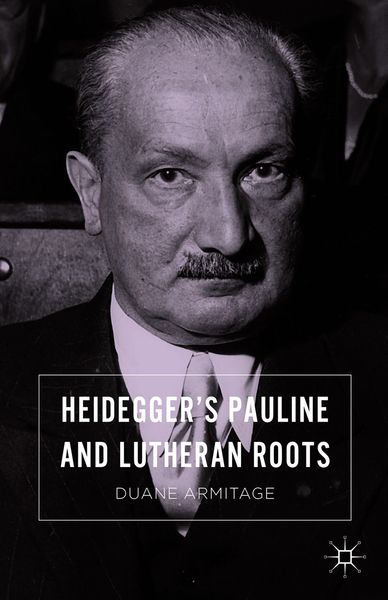
Produktbild: Heidegger’s Pauline and Lutheran Roots
- 13%

Heidegger’s Pauline and Lutheran Roots

13% sparen

101,99 € UVP 117,69 €

inkl. gesetzl. MwSt., Versandkostenfrei


Beschreibung

Produktdetails

Einband

Gebundene Ausgabe

Erscheinungsdatum

15.02.2016

Verlag

Palgrave Macmillan US

Seitenzahl

199

Maße (L/B/H)

22,2/14,5/1,7 cm

Gewicht

3698 g

Auflage

1st edition 2016

Sprache

Englisch

ISBN

978-1-137-57745-0

Beschreibung

Rezension

1. Short Outline of Project: The project examines Heidegger's theological thinking and its influences via a close reading of his lectures on the Phenomenology of Religious Life and his recently published text Contributions to Philosophy. The first part of the manuscript lays out the existing readings of Heidegger's philosophy of religion and articulates a different position (chapter 1). It also articulates the elements of Luther's theology necessary for showing how Heidegger might have been influenced by him (chapter 2) and how Lutheran concepts are at work in Heidegger's interpretation of Paul's letters or his philosophy more generally (chapter 3). It goes on to provide an exegesis of Heidegger's early lectures on Paul (chapter 4) and sets the insights gained into the context of Heidegger's magnum opus Being and Time, showing that similar structures are at work in both sources (chapter 5). The second part of the project, after providing some context (chapter 6) engages in a close reading of Heidegger's Contributions (chapters 7 & 8) and articulates the notion of the 'last God' put forward in that text and in Heidegger's later work more generally (chapter 9). The manuscript as a whole articulates Heidegger's theological project, its 'Pauline' inspiration (in a Lutheran mode), and engages with competing interpretations to show their shortcomings and misinterpretations (the latter most fully in chapter 10).

2. Contribution to Field: The manuscript makes an important contribution to the field. While it focuses primarily on the work of one thinker, it seeks to be not merely explicative, but tries to show connections between Heidegger's works and to set out his theological project in comprehensive fashion. It thus crosses disciplinary lines between philosophy and theology. The manuscript focuses on a recent text by Heidegger, to which almost no scholarship has been devoted so far, but also sets this text in context of Heidegger's larger corpus and its theological inspiration. It promises to provide not only a close reading of that particular text, but also articulates Heidegger's philosophy of religion and his stance on the divine more broadly. It hence makes a useful and original contribution.

3. Engagement with recent Scholarship: The proposal engages recent scholarship and takes it forward-that is one of its explicit intents. More specifically, the author responds to four readings of Heidegger in the recent literature and refutes each of these interpretations of Heidegger's theological project. As the proposal currently stands, these readings are laid out in the first chapter (which also serves as introduction) and then the author returns to them in the final chapter (the conclusion). (I think it would be even better to engage them more fully throughout the manuscript instead of lumping them together at beginning and end.)

4. Strengths and Weaknesses of the Proposal:

Strengths: The manuscript's strengths are its focus on Heidegger's theological project as a whole, its close reading of several texts (among them the very early lectures and the comparatively late Contributions), its engagement with the Lutheran 'inspiration' of Heidegger's work (who converted to Lutheranism around the time of writing the earlier texts), and its response to several prominent readings of Heidegger's thinking about God. It also frequently refers to the German texts.

Weaknesses/Suggestions for Changes:
- Some of the chapters provided sound a bit too much like a dissertation. Although one of the strengths of the manuscript lies in its close reading of key or relatively unknown texts, the manuscript could engage in a bit more interpretation and analysis than it does so far. Some of it reads a bit too much like straight-forward summary.
- It might also be good to work out even more fully the implications of the 'theological project' identified in Heidegger and possibly to engage more explicitly with contemporary philosophy or phenomenolog

Produktdetails

Einband

Gebundene Ausgabe

Erscheinungsdatum

15.02.2016

Verlag

Palgrave Macmillan US

Seitenzahl

199

Maße (L/B/H)

22,2/14,5/1,7 cm

Gewicht

3698 g

Auflage

1st edition 2016

Sprache

Englisch

ISBN

978-1-137-57745-0

Herstelleradresse

Palgrave Macmillan
Tiergartenstr. 17
69121 Heidelberg
DE

Email: ProductSafety@springernature.com

Kundinnen und Kunden meinen

0 Bewertungen

Informationen zu Bewertungen

Zur Abgabe einer Bewertung ist eine Anmeldung im Konto notwendig. Die Authentizität der Bewertungen wird von uns nicht überprüft. Wir behalten uns vor, Bewertungstexte, die unseren Richtlinien widersprechen, entsprechend zu kürzen oder zu löschen.

Die Bewertungen sind nach Format, Anzahl Sterne und Datum sortiert.

Verfassen Sie die erste Bewertung zu diesem Artikel

Helfen Sie anderen Kund*innen durch Ihre Meinung

Kundinnen und Kunden meinen

0 Bewertungen filtern

  • Produktbild: Heidegger’s Pauline and Lutheran Roots
  • Introduction1. Martin Luther  2. Heidegger’s and St. Paul’s The Phenomenology of Religious Life 3. Being and Time and St. Paul  4. Framing Contributions to Philosophy: Deconstructing Deconstruction 5. Where Does Contributions to Philosophy Begin?6. The Last God  7. Heidegger and Postmodern Philosophy of Religion