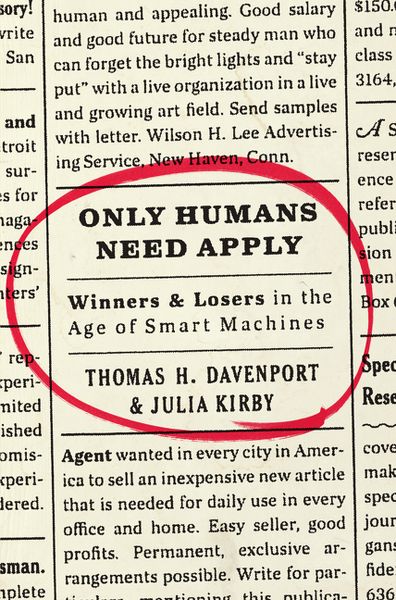
Only Humans Need Apply Winners and Losers in the Age of Smart Machines
28,99 €
inkl. gesetzl. MwSt.,
Beschreibung
Produktdetails
Einband
Gebundene Ausgabe
Erscheinungsdatum
24.05.2016
Verlag
Harper Collins (US)Seitenzahl
288
Maße (L/B/H)
23,6/16,2/3 cm
Gewicht
442 g
Sprache
Englisch
ISBN
978-0-06-243861-4
An invigorating, thought-provoking, and positive look at the rise of automation that explores how professionals across industries can find sustainable careers in the near future.
Nearly half of all working Americans could risk losing their jobs because of technology. It's not only blue-collar jobs at stake. Millions of educated knowledge workers-writers, paralegals, assistants, medical technicians-are threatened by accelerating advances in artificial intelligence.
The industrial revolution shifted workers from farms to factories. In the first era of automation, machines relieved humans of manually exhausting work. Today, Era Two of automation continues to wash across the entire services-based economy that has replaced jobs in agriculture and manufacturing. Era Three, and the rise of AI, is dawning. Smart computers are demonstrating they are capable of making better decisions than humans. Brilliant technologies can now decide, learn, predict, and even comprehend much faster and more accurately than the human brain, and their progress is accelerating. Where will this leave lawyers, nurses, teachers, and editors?
In Only Humans Need Apply, Thomas Hayes Davenport and Julia Kirby reframe the conversation about automation, arguing that the future of increased productivity and business success isn't either human or machine. It's both. The key is augmentation, utilizing technology to help humans work better, smarter, and faster. Instead of viewing these machines as competitive interlopers, we can see them as partners and collaborators in creative problem solving as we move into the next era. The choice is ours.
Only Humans Need Apply provides a clear framework for the future of work, revealing five unique strategies for success:
- Stepping Up: Move above automated systems to focus on big-picture insights and strategic decisions that smart machines can’t handle.
- Stepping Aside: Leverage your uniquely human strengths—like empathy, creativity, and communication—in roles that computers aren’t built to perform.
- Stepping In: Become the essential human expert who monitors, explains, and improves automated systems, making them better and more effective.
- Stepping Narrowly: Master a deep and narrow specialty that is too niche for automation to be economically viable, securing your role as the go-to expert.
- Stepping Forward: Join the creators and builders of the next generation of cognitive technologies and artificial intelligence, shaping the future of automation itself.
Noch keine Bewertungen vorhanden
Verfassen Sie die erste Bewertung zu diesem Artikel
Helfen Sie anderen Kundinnen und Kunden durch Ihre Meinung.
Kurze Frage zu unserer Seite
Vielen Dank für Ihr Feedback
Wir nutzen Ihr Feedback, um unsere Produktseiten zu verbessern. Bitte haben Sie Verständnis, dass wir Ihnen keine Rückmeldung geben können. Falls Sie Kontakt mit uns aufnehmen möchten, können Sie sich aber gerne an unseren Kund*innenservice wenden.
zum Kundenservice