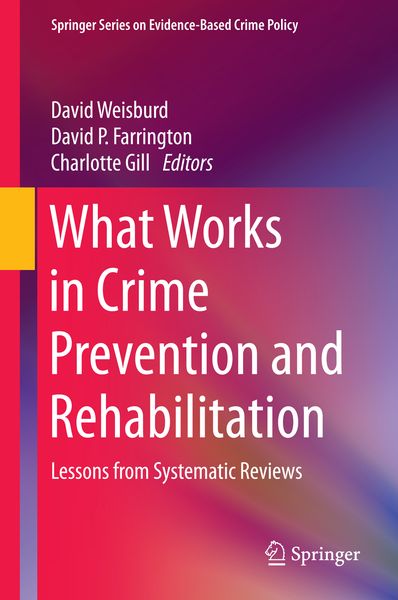
What Works in Crime Prevention and Rehabilitation Lessons from Systematic Reviews
-
- Hardcover ausgewählt
- Taschenbuch
- eBook
-
Sprache:Englisch
148,99 €
UVP
171,19 €
inkl. gesetzl. MwSt.,
Beschreibung
Produktdetails
Einband
Gebundene Ausgabe
Erscheinungsdatum
15.04.2016
Abbildungen
XII, 331 p. 18 illus., 6 illus. in color.
Herausgeber
David Weisburd + weitereVerlag
Springer UsSeitenzahl
331
Maße (L/B/H)
24,1/16/2,3 cm
Gewicht
693 g
Sprache
Englisch
ISBN
978-1-4939-3475-1
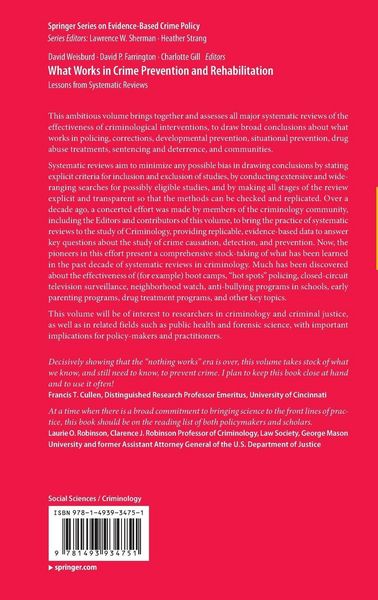
This ambitious volume brings together and assesses all major systematic reviews of the effectiveness of criminological interventions, to draw broad conclusions about what works in policing, corrections, developmental prevention, situational prevention, drug abuse treatments, sentencing and deterrence, and communities.
Systematic reviews aim to minimize any possible bias in drawing conclusions by stating explicit criteria for inclusion and exclusion of studies, by conducting extensive and wide-ranging searches for possibly eligible studies, and by making all stages of the review explicit and transparent so that the methods can be checked and replicated. Over a decade ago, a concerted effort was made by members of the criminology community, including the Editors and contributors of this volume, to bring the practice of systematic reviews to the study of Criminology, providing replicable, evidence-based data to answer key questions about the study of crime causation, detection, and prevention. Now, the pioneers in this effort present a comprehensive stock-taking of what has been learned in the past decade of systematic reviews in criminology. Much has been discovered about the effectiveness of (for example) boot camps, “hot spots” policing, closed-circuit television surveillance, neighborhood watch, anti-bullying programs in schools, early parenting programs, drug treatment programs, and other key topics.
This volume will be of interest to researchers in criminology and criminal justice, as well as in related fields such as public health and forensic science, with important implications for policy-makers and practitioners.
Decisively showing that the “nothing works” era is over, this volume takes stock of what we know, and still need to know, to prevent crime. I plan to keep this book close at hand and to use it often!
Francis T. Cullen, Distinguished Research Professor Emeritus,
At a time when there is a broad commitment to bringing science to the front lines of practice, this book should be on the reading list of both policymakers and scholars.
Laurie O. Robinson, Clarence J. Robinson Professor of Criminology, Law Society, George Mason University and former Assistant Attorney General of the U.S. Department of Justice
Noch keine Bewertungen vorhanden
Verfassen Sie die erste Bewertung zu diesem Artikel
Helfen Sie anderen Kundinnen und Kunden durch Ihre Meinung.
Kurze Frage zu unserer Seite
Vielen Dank für Ihr Feedback
Wir nutzen Ihr Feedback, um unsere Produktseiten zu verbessern. Bitte haben Sie Verständnis, dass wir Ihnen keine Rückmeldung geben können. Falls Sie Kontakt mit uns aufnehmen möchten, können Sie sich aber gerne an unseren Kund*innenservice wenden.
zum Kundenservice