• Produktbild: Energy Solutions to Combat Global Warming
  • Produktbild: Energy Solutions to Combat Global Warming
Band 33 - 10%

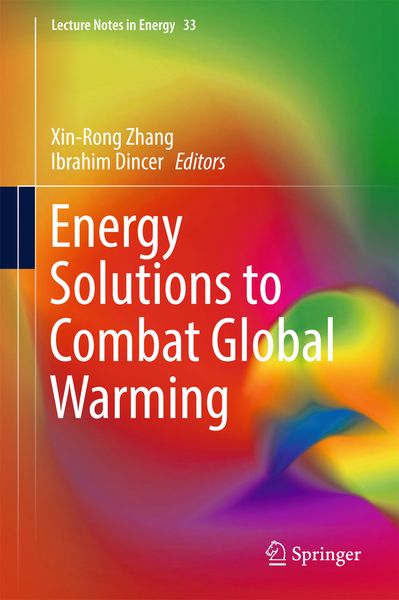
Energy Solutions to Combat Global Warming

Aus der Reihe Lecture Notes in Energy
10% sparen

191,99 € UVP 213,99 €

inkl. gesetzl. MwSt., Versandkostenfrei


Beschreibung

Produktdetails

Einband

Gebundene Ausgabe

Erscheinungsdatum

18.10.2016

Abbildungen

XX, 389 illus., 268 illus. in color., farbige Illustrationen, schwarz-weiss Illustrationen

Herausgeber

XinRong Zhang + weitere

Verlag

Springer

Seitenzahl

855

Maße (L/B/H)

24,1/16/5,2 cm

Gewicht

1490 g

Auflage

1st ed. 2017

Sprache

Englisch

ISBN

978-3-319-26948-1

Beschreibung

Portrait

Dr. Xin-Rong Zhang works intensively at the interdisciplinary academic and engineering areas of thermal sciences. He has made significant contributions to the low-grade heat area through numerous conceptual innovation, methodology development and technical inventions. Particularly, he proposed the concept of low-grade heat source driven transcritical CO2 power generation cycle for a better environmental protection and a higher energy utilization efficiency. Through 15 year’s continuous efforts, his invention on the CO2 vapor compression heat pumps and low- grade transcritical CO2 power generation systems have been translated into engineering application. Dr. Zhang’s other noteworthy contribution include new solar thermal, new thermal energy storage technology, new heat transfer optimization method and low-grade heat drying and dehydration etc..

    For the recent years, Dr. Zhang’s academic career mainly focused on the following, renewable thermal energy (solar,waste heat, geothermal, nuclear thermal...), refrigeration, heat pump, advanced energy conversion, energy efficiency improvement, phase change, multi-scale heat transfer etc. He published more than 120 International Journal papers. More than 50 patents have been authorized. He has graduated more than 30 Ph.D or master degrees students in the energy and the related areas. 


Dr.Ibrahim Dincer is a full professor of Mechanical Engineering in the Faculty of Engineering and Applied Science at UOIT. He is Vice President for Strategy in International Association for Hydro Energy (IAHE) and works in the area of sustainable energy technologies he has authored and co-authored numerous books and book chapters, more than 1000 refereed journal and conference papers, and many technical meetings. He has chaired many national and international conferences, symposia, workshops and technical meetings. He has delivered more than 250 keynote and invited lectures. He is an active member of various international scientific organizations and societies, and serves as editor-in-chief, associate editor, regional editor, and editorial board member on various prestigious international journals. He is a recipient of several research, teaching and service awards, including the Premier’s research excellence award in Ontario, Canada in 2004. He has made innovative contributions to the understanding and development of sustainable energy technologies and their implementation. He has actively been working in the areas of hydrogen and fuel cell technologies, and his group has developed various novel technologies/methods/etc.

Produktdetails

Einband

Gebundene Ausgabe

Erscheinungsdatum

18.10.2016

Abbildungen

XX, 389 illus., 268 illus. in color., farbige Illustrationen, schwarz-weiss Illustrationen

Herausgeber

Verlag

Springer

Seitenzahl

855

Maße (L/B/H)

24,1/16/5,2 cm

Gewicht

1490 g

Auflage

1st ed. 2017

Sprache

Englisch

ISBN

978-3-319-26948-1

Herstelleradresse

Springer-Verlag GmbH
Tiergartenstr. 17
69121 Heidelberg
DE

Email: ProductSafety@springernature.com

Noch keine Bewertungen vorhanden

Verfassen Sie die erste Bewertung zu diesem Artikel

Helfen Sie anderen Kundinnen und Kunden durch Ihre Meinung.

Kundinnen und Kunden meinen

Bewertungen (0)

  • Produktbild: Energy Solutions to Combat Global Warming
  • Produktbild: Energy Solutions to Combat Global Warming
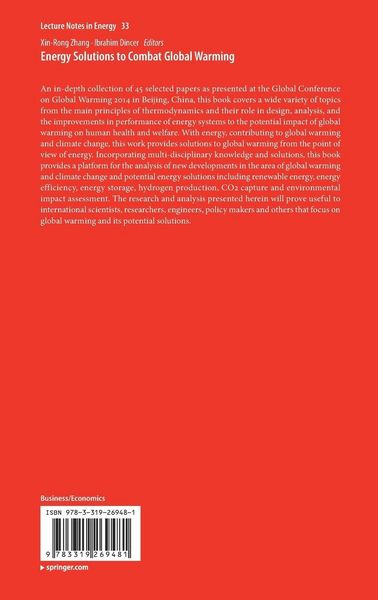
  • Renewable Energy.- Energy Efficiency.- New Energy Conversion and System.- Energy Storage.- Efficient Energy Conversion by Utilizing CO2.- Heat Transport.- Carbon Control.- Resource recovery by low grade energy.