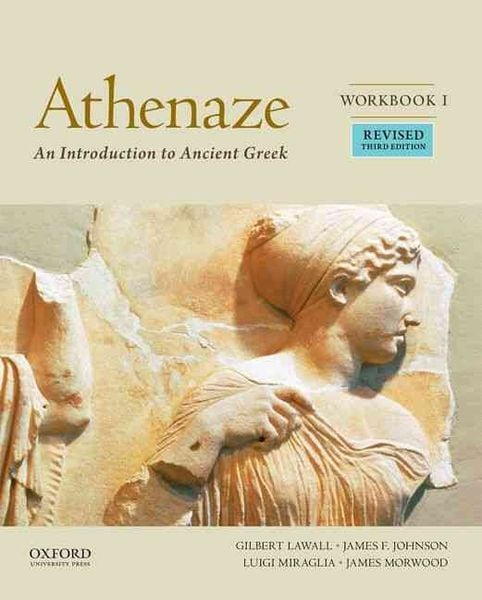
Produktbild: Athenaze, Workbook I

Athenaze, Workbook I An Introduction to Ancient Greek

60,99 €

inkl. gesetzl. MwSt., Versandkostenfrei


Beschreibung

Produktdetails

Einband

Taschenbuch

Erscheinungsdatum

18.02.2016

Verlag

Oxford University Press Inc

Seitenzahl

240

Maße (L/B/H)

23,3/18,9/1,5 cm

Gewicht

432 g

Auflage

3 Revised edition

Sprache

Englisch

ISBN

978-0-19-060768-5

Beschreibung

Produktdetails

Einband

Taschenbuch

Erscheinungsdatum

18.02.2016

Verlag

Oxford University Press Inc

Seitenzahl

240

Maße (L/B/H)

23,3/18,9/1,5 cm

Gewicht

432 g

Auflage

3 Revised edition

Sprache

Englisch

ISBN

978-0-19-060768-5

Herstelleradresse

Libri GmbH
Europaallee 1
36244 Bad Hersfeld
DE

Email: gpsr@libri.de

Kundinnen und Kunden meinen

0 Bewertungen

Informationen zu Bewertungen

Zur Abgabe einer Bewertung ist eine Anmeldung im Konto notwendig. Die Authentizität der Bewertungen wird von uns nicht überprüft. Wir behalten uns vor, Bewertungstexte, die unseren Richtlinien widersprechen, entsprechend zu kürzen oder zu löschen.

Die Bewertungen sind nach Format, Anzahl Sterne und Datum sortiert.

Verfassen Sie die erste Bewertung zu diesem Artikel

Helfen Sie anderen Kund*innen durch Ihre Meinung

Kundinnen und Kunden meinen

0 Bewertungen filtern

  • Produktbild: Athenaze, Workbook I
    • Preface

    • List of Historical Essays

    • List of Maps

    • List of Color Plates

    • About the Authors

    • Introduction

    • Map of Greece and the Aegean Sea

    • 1. O ¿IKAIO¿O¿I¿ (a)

    • Grammar

    • 1. Verb Forms: Stems and Endings

    • 2. Nouns: Genders, Stems, Endings, Cases, and Agreement

    • 3. U se of the Definite Article

    • Reading

    • The Athenian Farmer

    • O ¿IKAIO¿O¿I¿ (ß)

    • Grammar

    • 4. Accents

    • Readings

    • O K¿HPO¿

    • Classical Greek: Heraclitus

    • New Testament Greek: Title page of the Gospel of Luke

    • 2. O ¿AN¿IA¿ (a)

    • Grammar

    • 1. Verb Forms: Indicative Mood; 1st, 2nd, and 3rd Persons Singular

    • 2. Proclitics

    • 3. The Imperative

    • Readings

    • Slavery

    • Greek Wisdom: Cleobulus of Lindos

    • O ¿AN¿IA¿ (ß)

    • Grammar

    • 4. Articles, Adjectives, and Nouns; Singular, All Cases

    • 5. U ses of the Cases

    • 6. Persistent Accent of Nouns and Adjectives

    • 7. Recessive Accent of Verbs

    • Readings

    • O ¿O¿¿O¿

    • Classical Greek: Callimachus

    • New Testament Greek: Luke 3.22

    • 3. O APOTO¿ (a)

    • Grammar

    • 1. Verb Forms: 3rd Person Plural, Imperatives, and Infinitives

    • Reading

    • The Deme and the Polis

    • O APOTO¿ (ß)

    • Grammar

    • 2. Articles, Adjectives, and Nouns; Singular and Plural, All Cases

    • 3. Accent Shifting

    • Readings

    • OI ßOE¿

    • Classical Greek: Menander

    • New Testament Greek: Luke 6.46

    • 4. ¿PO¿ THI KPHNHI (a)

    • Grammar

    • 1. Verb Forms: All Persons, Singular and Plural

    • 2. Declensions of Nouns and Adjectives

    • 3. Feminine Nouns and Adjectives of the 1st Declension

    • Readings

    • Women

    • Greek Wisdom: Pittacus (of Mitylene)

    • ¿PO¿ THI KPHNHI (ß)

    • Grammar

    • 4. Masculine Nouns of the 1st Declension

    • 5. Feminine Nouns of the 2nd Declension

    • 6. 1st and 2nd Declension Adjectives

    • 7. Two Irregular Adjectives

    • 8. Formation of Adverbs

    • 9. The Definite Article as Case Indicator

    • Readings

    • AI ¿¿NAIKE¿ TO¿¿ AN¿PA¿ ¿EI¿O¿¿IN

    • Classical Greek: Callimachus

    • New Testament Greek: Luke 6.45

    • 5. O ¿¿KO¿ (a)

    • Grammar

    • 1. Contract Verbs in -a-

    • 2. Recessive Accent of Finite Verbs

    • 3. Article at the Beginning of a Clause

    • 4. Elision

    • Readings

    • Gods and Men

    • Greek Wisdom: Chilon of Sparta

    • O ¿¿KO¿ (ß)

    • Grammar

    • 5. Agreement of Subject and Verb

    • 6. Personal Pronouns

    • 7. Attributive and Predicate Position

    • 8. Possessives

    • 9. The Adjective ä¿¿¿, -¿, -¿

    • Readings

    • O AP¿O¿ TA ¿POßATA ¿¿IZEI

    • Greek Wisdom: The Seven Wise Men

    • Classical Greek: Anacreon

    • New Testament Greek: Luke 4.22 and 24

    • 6. O M¿¿O¿ (a)

    • Grammar

    • 1. Verb Forms: ¿¿¿¿

    • 2. Verbs: Voice

    • 3. Verb Forms: Middle Voice

    • 4. Deponent Verbs

    • Reading

    • Myth

    • O M¿¿O¿ (ß)

    • Grammar

    • 5. Middle Voice: Meaning

    • 6. Some Uses of the Dative Case

    • 7. Prepositions

    • Readings

    • O ¿H¿E¿¿ THN APIA¿NHN KATA¿EI¿EI

    • Classical Greek: Marriage

    • New Testament Greek: Luke 13.10-16

    • 7. O K¿K¿¿¿ (a)

    • Grammar

    • 1. Substantive Use of Adjectives

    • 2. Nouns: Declensions

    • 3. 3rd Declension Consonant Stem Nouns: Velar and Dental Stems

    • 4. Reflexive Pronouns

    • Reading

    • Homer

    • O K¿K¿¿¿ (ß)

    • Grammar

    • 5. 3rd Declension Consonant Stem Nouns: Nasal Stems

    • 6. 3rd Declension Consonant Stem Nouns: ß, ¿, ¿ (Labial) and ¿, p

    • (Liquid) Stems

    • 7. A 3rd Declension Adjective: ¿¿¿p¿v, ¿¿.¿pov, of sound mind;

    • prudent; self-controlled

    • 8. The Interrogative Pronoun and Adjective

    • 9. The Indefinite Pronoun and Adjective

    • Readings

    • O TO¿ ¿H¿E¿¿ ¿ATHP A¿O¿NHI¿KEI

    • Classical Greek: Sophocles

    • Greek Wisdom: Thales of Miletus

    • 8. ¿PO¿ TO A¿T¿ (a)

    • Grammar

    • 1. Participles: "Present" or Progressive: Middle Voice

    • Readings

    • Athens: A Historical Outline

    • Classical Greek: Archilochus

    • New Testament Greek: Luke 5.20-21

    • ¿PO¿ TO A¿T¿ (ß)

    • Grammar

    • 2. 3rd Declension Consonant Stem Nouns: Stems in -p-

    • 3. Two Important Irregular Nouns: ¿ ¿¿v¿, ¿H.¿ ¿¿väK¿¿, woman; wife,

    • and ¿ ¿¿¿p, ¿H.¿ ¿¿¿p¿¿, hand

    • 4. 1st/3rd Declension Adjective: ¿a.¿, ¿a.¿a, ¿a.v, all; every; whole

    • Reading

    • Greek Wisdom: Periander of Corinth

    • Grammar

    • 5. Numbers

    • 6. Expressions of Time When, Duration of Time, and Time Within Which

    • Readings

    • O O¿¿¿¿E¿¿ KAI O AIO¿O¿

    • Classical Greek: Sappho: The Deserted Lover: A Girl's Lament

    • 9. H ¿ANH¿¿PI¿ (a)

    • Grammar

    • 1. Participles: Present or Progressive: Active Voice

    • Reading

    • The City of Athens

    • H ¿ANH¿¿PI¿ (ß)

    • Grammar

    • 2. 3rd Declension Nouns with Stems Ending in -v¿-

    • 3. 3rd Declension Nouns with Stems Ending in a Vowel: ¿ ¿¿¿¿¿ and ¿¿ ¿¿¿¿

    • 4. 3rd Declension Nouns with Stems Ending in Diphthongs or Vowels:

    • ¿ ßä¿¿¿¿¿ and the Irregular Nouns ¿ vä.¿ and ¿ ßo¿.¿

    • 5. U ses of the Genitive Case

    • 6. Some Uses of the Article

    • Readings

    • O O¿¿¿¿E¿¿ KAI H KIPKH

    • Classical Greek: Simonides

    • New Testament Greek: Luke 6.31-33: The Sermon on the Mount

    • REVIEW OF VERB FORMS

    • PREVIEW OF NEW VERB FORMS

    • 10. H ¿¿M¿OPA (a)

    • Grammar

    • 1. Verb Forms: Verbs with Sigmatic Futures

    • 2. Verb Forms: The Asigmatic Contract Future of Verbs in -¿¿¿

    • 3. Verb Forms: The Sigmatic Future of Contract Verbs

    • 4. Verb Forms: Verbs with Deponent Futures

    • Readings

    • Festivals

    • Classical Greek: Theognis

    • New Testament Greek: Luke 6.35-36: The Sermon on the Mount

    • H ¿¿M¿OPA (ß)

    • Grammar

    • 5. Verb Forms: The Asigmatic Contract Future of Verbs with

    • Liquid and Nasal Stems

    • 6. The Irregular Verb ¿¿¥¿¿

    • 7. Future Participle to Express Purpose

    • 8. Impersonal Verbs

    • 9. Review of Questions

    • Readings

    • O O¿¿¿¿E¿¿ TO¿¿ ETAIPO¿¿ A¿O¿¿¿¿IN

    • Classical Greek: Menander and Archilochus

    • New Testament Greek: Luke 5.30-32

    • 11. O IATPO¿ (a)

    • Grammar

    • 1. Verb Forms: Past Tense: The Aorist

    • 2. Verb Forms: The Thematic 2nd Aorist

    • 3. Aspect

    • 4. Thematic 2nd Aorist Active and Middle Participles

    • 5. Verb Forms: Common Verbs with Thematic 2nd Aorists

    • Readings

    • Greek Science and Medicine

    • Classical Greek: Theognis

    • New Testament Greek: Luke 6.20-21: The Beatitudes

    • O IATPO¿ (ß)

    • Grammar

    • 6. Verbs with Thematic 2nd Aorists from Unrelated Stems

    • 7. Accents on Thematic 2nd Aorist Active Imperatives

    • 8. Augment

    • Readings

    • O ¿HMOKH¿H¿ TON ßA¿I¿EA IATPE¿EI

    • New Testament Greek: Luke 6.27-29: The Sermon on the Mount

    • 12. ¿PO¿ TON ¿EIPAIA (a)

    • Grammar

    • 1. Verb Forms: Past Tense: The Sigmatic 1st Aorist

    • 2. Sigmatic 1st Aorist Active and Middle Participles

    • Readings

    • Trade and Travel

    • Classical Greek: Scolion: The Four Best Things in Life

    • New Testament Greek: Luke 15.3-7: The Parable of the Lost Sheep

    • ¿PO¿ TON ¿EIPAIA (ß)

    • Grammar

    • 3. Verb Forms: The Asigmatic 1st Aorist of Verbs with Liquid and Nasal Stems

    • 4. Irregular Sigmatic 1st Aorists

    • 5. Verb Forms: Augment of Compound Verbs

    • Readings

    • O K¿¿AIO¿ TON TAPTH¿¿ON E¿PI¿KEI

    • Greek Wisdom: Bias of Priene

    • 13. ¿PO¿ THN ¿A¿AMINA (a)

    • Grammar

    • 1. Verb Forms: The Imperfect or Past Progressive Tense

    • 2. Aspect

    • Reading

    • The Rise of Persia

    • ¿PO¿ THN ¿A¿AMINA (ß)

    • Grammar

    • 3. Relative Clauses

    • 4. 3rd Declension Nouns and Adjectives with Stems in -¿¿-

    • 5. 1st/3rd Declension Adjective with 3rd Declension Stems in -¿- and -¿-

    • Readings

    • O ¿EP¿H¿ TON E¿¿H¿¿ONTON ¿IAßAINEI

    • Greek Wisdom: Solon of Athens

    • Classical Greek: Archilochus

    • New Testament Greek: Luke 21.1-4: The Widow's Mite

    • 14. H EN TAI¿ ¿EPMO¿¿¿AI¿ MA¿H (a)

    • Grammar

    • 1. Comparison of Adjectives

    • 2. Irregular Comparison of Adjectives

    • 3. Comparison of Adverbs

    • 4. U ses of Comparatives and Superlatives

    • Readings

    • The Rise of Athens

    • Classical Greek: Archilochus

    • New Testament Greek: Luke 10.25-29: The Good Samaritan (concluded 14 (B))

    • H EN TAI¿ ¿EPMO¿¿¿AI¿ MA¿H (ß)

    • Grammar

    • 5. Demonstrative Adjectives

    • 6. Interrogative and Indefinite Pronouns, Adjectives, and Adverbs

    • Readings

    • OI ¿EP¿AI TA ¿¿EP ¿EPMO¿¿¿¿N ¿TENA AIPO¿¿IN

    • Classical Greek: Theognis

    • New Testament Greek: Luke 10.30-37: The Good Samaritan (concluded)

    • 15. H EN THI ¿A¿AMINI MA¿H (a)

    • Grammar

    • 1. Athematic 2nd Aorists

    • 2. More 3rd Declension Nouns with Stems in -¿¿-

    • Readings

    • Aeschylus's Persae

    • New Testament Greek: Luke 2.1-14: The Birth of Jesus

    • H EN THI ¿A¿AMINI MA¿H (ß)

    • Grammar

    • 3. Contract Verbs in -o-

    • 4. Contract Nouns of the 2nd Declension

    • 5. More Numbers

    • 6. U ses of ¿¿ and Its Compounds

    • Reading

    • OI ¿EP¿AI TA¿ A¿HNA¿ AIPO¿¿IN

    • 16. META THN EN THI ¿A¿AMINI MA¿HN (a)

    • Grammar

    • 1. The Passive Voice

    • Reading

    • The Athenian Empire

    • META THN EN THI ¿A¿AMINI MA¿HN (ß)

    • Grammar

    • 2. Verbs with Athematic Presents and Imperfects: ¿¿vää, K¿¿.¿ä,

    • and ¿¿¿¿¿ää

    • Readings

    • O ¿EP¿H¿ ¿PO¿ THN A¿IAN ANA¿¿PEI

    • Classical Greek: Sappho: Love's Power

    • Classical Greek: Simonides

    • New Testament Greek: Luke 2.15-20: The Birth of Jesus (concluded)

    • Verb Charts

    • Syllables and Accents

    • Enclitics and Proclitics

    • Forms

    • Forms of Definite Article, Nouns, Adjectives, and Pronouns Laid Out in

    • Case Order N, V, A, G, D

    • Index of Language and Grammar

    • Greek to English Vocabulary

    • English to Greek Vocabulary

    • General Index

    • Acknowledgments

    • Credits