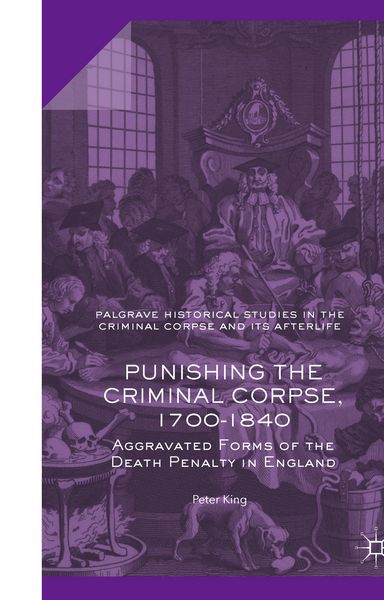

Punishing the Criminal Corpse, 1700-1840 Aggravated Forms of the Death Penalty in England
-
- Englisch ausgewählt
29,99 €
inkl. gesetzl. MwSt.,
Beschreibung
Produktdetails
Einband
Gebundene Ausgabe
Erscheinungsdatum
16.12.2015
Abbildungen
XV, 212 p. 3 illus.
Verlag
Palgrave Macmillan UKSeitenzahl
212
Maße (L/B/H)
21,6/15,3/1,7 cm
Gewicht
413 g
Auflage
1st ed. 2017
Sprache
Englisch
ISBN
978-1-137-51360-1
This book is open access under a CC BY 4.0 licence.
This book analyses the different types of post-execution punishments and other aggravated execution practices, the reasons why they were advocated, and the decision, enshrined in the Murder Act of 1752, to make two post-execution punishments, dissection and gibbeting, an integral part of sentences for murder. It traces the origins of the Act, and then explores the ways in which Act was actually put into practice. After identifying the dominance of penal dissection throughout the period, it looks at the abandonment of burning at the stake in the 1790s, the rapid decline of hanging in chains just after 1800, and the final abandonment of both dissection and gibbeting in 1832 and 1834. It concludes that the Act, by creating differentiation in levels of penalty, played an important role within the broader capital punishment system well into the nineteenth century. While eighteenth- and early nineteenth-century historians have extensively studied the ‘Bloody Code’ and the resulting interactions around the ‘Hanging Tree’, they have largely ignored an important dimension of the capital punishment system – the courts extensive use of aggravated and post-execution punishments. With this book, Peter King aims to rectify this neglected historical phenomenon.
Noch keine Bewertungen vorhanden
Verfassen Sie die erste Bewertung zu diesem Artikel
Helfen Sie anderen Kundinnen und Kunden durch Ihre Meinung.
Kurze Frage zu unserer Seite
Vielen Dank für Ihr Feedback
Wir nutzen Ihr Feedback, um unsere Produktseiten zu verbessern. Bitte haben Sie Verständnis, dass wir Ihnen keine Rückmeldung geben können. Falls Sie Kontakt mit uns aufnehmen möchten, können Sie sich aber gerne an unseren Kund*innenservice wenden.
zum Kundenservice