Produktbild: Social Factors and Community Well-Being

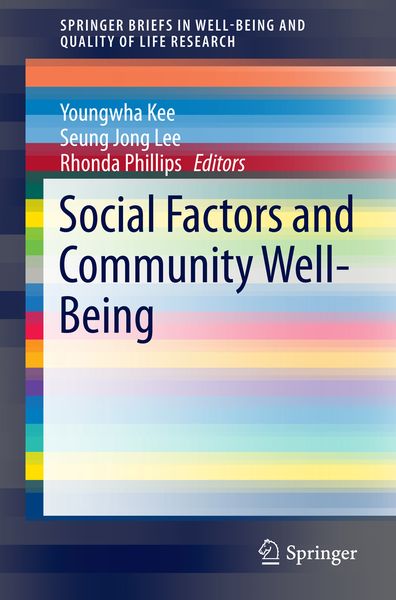
Social Factors and Community Well-Being

49,99 €

inkl. gesetzl. MwSt., Versandkostenfrei


Beschreibung

Produktdetails

Einband

Taschenbuch

Erscheinungsdatum

13.04.2016

Abbildungen

XV, 99 p. 9 illus.

Herausgeber

Youngwha Kee + weitere

Verlag

Springer

Seitenzahl

99

Maße (L/B/H)

23,5/15,5/0,7 cm

Gewicht

189 g

Auflage

1st ed. 2016

Sprache

Englisch

ISBN

978-3-319-29940-2

Beschreibung

Rezension

“This book fulfills the purpose of spurring the need for more research on the subject of social factors and their impact on community well-being. … the book is definitely a step towards operationalizing the fluid concept of community well-being by the use of theories such as social capital, human capital, needs theory, and community development. The book should have a wide appeal to researchers, and graduate and undergraduate students in the field of community studies.” (Karim W. F. Youssef, Journal of Community Safety & Well-Being, Vol. 1 (3), November, 2016)

Portrait

Youngwha Kee is a professor of the Department of Lifelong Education at Soongsil 156 University and the president of the National Institute of Lifelong Education. She 157 currently serves as the director of the Korea Institute of Local Development 158 Education. Previously, Dr. Kee was president of the Association of Adult and 159 Continuing Education of Korea and researcher of Korea Association for Commu- 160 nity Education. She has served on several advisory committees in relation to 161 educational policies and has been deeply involved with community education 162 among multicultural families and education for the disadvantaged. She serves on 163 the editorial board of the International Journal of Continuing Education and Life- 164 long Learning (Hong Kong) ) and the Lifelong Education Magazine (Taiwan). Her research interests include older adult learning, community education, civic education, and community development. 

Seung Jong Lee is a professor at the Graduate School of Public Administration, Seoul National University and president of the Korea Research Institute for Local Administration. Previously, he served as the president of the Korean Association for Public Administration and chief editor of several academic journals in related fields. He has frequently advised local and national governments through such positions as chairman of the Local Government Administration Joint Evaluation Committee, vice chairman of the Presidential Committee on Local District Reorganization Plans, and member of the presidential transition committee.

Rhonda Phillips is a Professor in the Agricultural Economics Department and Dean of Purdue University’s Honors College. Rhonda's honors include serving as a Fulbright UK Ulster Policy Fellow in Northern Ireland at the University of Ulster, and a Senior Specialist to Panama. She is author or editor of eighteen books, including Introduction to Community Development and Community Development Indicators Measuring Systems. She is editor for the Community Quality of Life and Well-Being series with Springer.


Produktdetails

Einband

Taschenbuch

Erscheinungsdatum

13.04.2016

Abbildungen

XV, 99 p. 9 illus.

Herausgeber

Verlag

Springer

Seitenzahl

99

Maße (L/B/H)

23,5/15,5/0,7 cm

Gewicht

189 g

Auflage

1st ed. 2016

Sprache

Englisch

ISBN

978-3-319-29940-2

Herstelleradresse

Springer-Verlag KG
Sachsenplatz 4-6
1201 Wien
AT

Email: ProductSafety@springernature.com

Noch keine Bewertungen vorhanden

Verfassen Sie die erste Bewertung zu diesem Artikel

Helfen Sie anderen Kundinnen und Kunden durch Ihre Meinung.

Kundinnen und Kunden meinen

Bewertungen (0)

  • Produktbild: Social Factors and Community Well-Being
  • Preface.- Chapter 1. Conceptualizing a Community Well-Being and Theory Construct; Heekyung Sung and Rhonda Phillips.- Chapter 2. An Exploratory Study of the Relationship between Community Well-being, Individual Well-being, and Local Public Services; Seung Jong Lee and Yunji Kim.- Chapter 3. Does Sense of Community Really Matter in Community Wellbeing?; Youngwha Kee and Chaebong Nam.- Chapter 4. The Development and Production of Local, National, and international State of Children’s Wellbeing Report Cards; Geoff Woolcock and Jeanette Pope.- Chapter 5. An Exploration of the Relationship Between Gender Equity and Community Wellbeing; Sharan Merriam.- Chapter 6. Crime and Community Wellbeing: The Role of Social Capital and Collective Efficacy in Increasing Safety; David Sloane.- Chapter 7. Relationships between Social Policy Factors and National Competitiveness and Happiness; Young-Chool Choi and Ji-Hyun Jang.