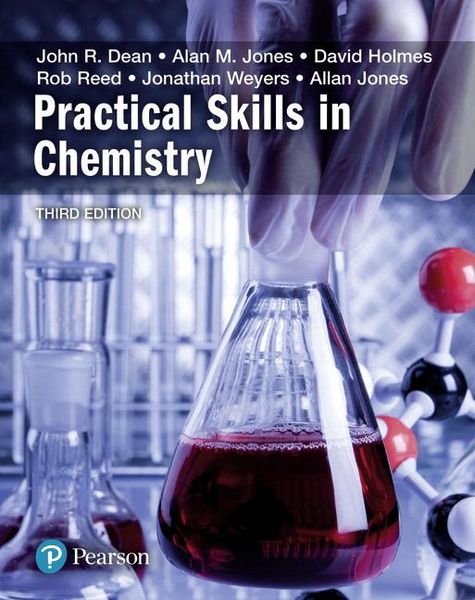
Produktbild: Practical Skills in Chemistry

Practical Skills in Chemistry

Aus der Reihe Practical Skills

79,99 €

inkl. gesetzl. MwSt., Versandkostenfrei


Beschreibung

Produktdetails

Einband

Taschenbuch

Erscheinungsdatum

21.09.2017

Verlag

Pearson Academic

Seitenzahl

656

Maße (L/B/H)

27,7/22/3,8 cm

Gewicht

1606 g

Auflage

3. Auflage

Sprache

Englisch

ISBN

978-1-292-13992-0

Beschreibung

Produktdetails

Einband

Taschenbuch

Erscheinungsdatum

21.09.2017

Verlag

Pearson Academic

Seitenzahl

656

Maße (L/B/H)

27,7/22/3,8 cm

Gewicht

1606 g

Auflage

3. Auflage

Sprache

Englisch

ISBN

978-1-292-13992-0

Herstelleradresse

Libri GmbH
Europaallee 1
36244 Bad Hersfeld
DE

Email: gpsr@libri.de

Noch keine Bewertungen vorhanden

Verfassen Sie die erste Bewertung zu diesem Artikel

Helfen Sie anderen Kundinnen und Kunden durch Ihre Meinung.

Kundinnen und Kunden meinen

Bewertungen (0)

Die Leseprobe wird geladen.
  • Produktbild: Practical Skills in Chemistry
  • Contents


    List of boxes viii
    Preface to the second edition xi
    Guided tour xii
    For the student xiv
    Acknowledgements xv
    List of abbreviations xvi


    Study and examination skills
    1. The importance of transferable skills
    2. Managing your time
    3. Working with others
    4. Taking notes from lectures and texts
    5. Learning and revising
    6. Curriculum options, assessments and exams
    7. Preparing your curriculum vitae


    Information technology and library resources
    8.  Finding and citing published information
    9.  Evaluating information
    10. Using online resources
    11. Internet resources for chemistry
    12. Using spreadsheets
    13. Word processors, databases and other packages


    Communicating information
    14. Organising a poster display
    15. Giving a spoken presentation
    16. General aspects of scientific writing
    17. Writing essays
    18. Reporting practical and project work
    19. Writing literature surveys and reviews


    Fundamental laboratory techniques
    20. Your approach to practical work
    21. Health and safety
    22. Working with liquids
    23. Basic laboratory procedures I
    24. Basic laboratory procedures II
    25. Principles of solution chemistry
    26. pH and buffer solutions


    The investigative approach
    27. Making and recording measurements
    28. SI units and their use
    29. Scientific method and design of experiments
    30. Project work


    Laboratory techniques
    31. Melting points
    32. Recrystallisation
    33. Solvent extraction
    34. Distillation
    35. Reflux
    36. Evaporation
    37. Inert atmosphere methods
    38. Combinatorial chemistry


    Classical techniques
    39. Qualitative techniques for inorganic analysis
    40. Gravimetry
    41. Procedures in volumetric analysis
    42. Acid–base titrations
    43. Complexometric titrations
    44. Redox titrations
    45. Precipitation titrations


    Instrumental techniques
    46. Fundamental principles of quantitative chemical analysis
    47. Calibration and quantitative analysis
    48. Basic spectroscopy
    49. Atomic spectroscopy
    50. X-ray fluorescence spectroscopy
    51. Chromatography – basic principles
    52. Gas and liquid chromatography
    53. Electrophoresis
    54. Electroanalytical techniques
    55. Radioactive isotopes and their uses
    56. Infrared spectroscopy
    57. Nuclear magnetic resonance spectroscopy
    58. Mass spectrometry
    59. Thermal analysis


    Analysis and presentation of data
    60. Using graphs
    61. Presenting data in tables

    62. Hints for solving numerical problems
    63. Descriptive statistics
    64. Choosing and using statistical tests
    65. Drawing chemical structures
    66. Chemometrics
    67. Computational chemistry


    Answers to study exercises
    Index