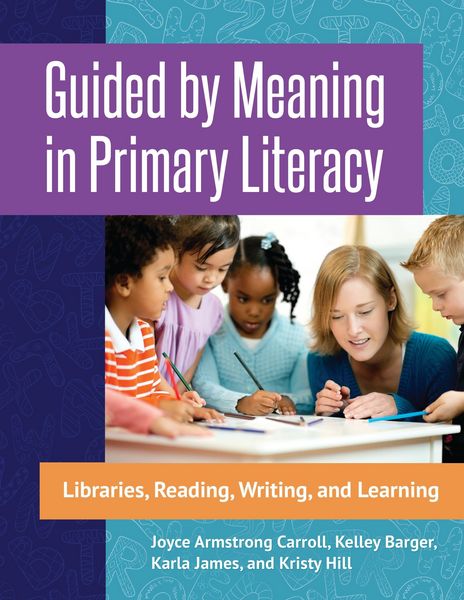
Produktbild: Guided by Meaning in Primary Literacy

Guided by Meaning in Primary Literacy Libraries, Reading, Writing, and Learning

59,99 €

inkl. gesetzl. MwSt., Versandkostenfrei


Beschreibung

Produktdetails

Einband

Taschenbuch

Erscheinungsdatum

30.12.2016

Abbildungen

119 bw illus

Verlag

Bloomsbury USA

Seitenzahl

320

Maße (L/B/H)

28/21,6/1,7 cm

Gewicht

809 g

Sprache

Englisch

ISBN

978-1-4408-4398-3

Beschreibung

Produktdetails

Einband

Taschenbuch

Erscheinungsdatum

30.12.2016

Abbildungen

119 bw illus

Verlag

Bloomsbury USA

Seitenzahl

320

Maße (L/B/H)

28/21,6/1,7 cm

Gewicht

809 g

Sprache

Englisch

ISBN

978-1-4408-4398-3

Herstelleradresse

Libri GmbH
Europaallee 1
36244 Bad Hersfeld
DE

Email: gpsr@libri.de

Noch keine Bewertungen vorhanden

Verfassen Sie die erste Bewertung zu diesem Artikel

Helfen Sie anderen Kundinnen und Kunden durch Ihre Meinung.

Kundinnen und Kunden meinen

Bewertungen (0)

Die Leseprobe wird geladen.
  • Produktbild: Guided by Meaning in Primary Literacy
  • Foreword
    Kathi Appelt

    Introduction
    Joyce Armstrong Carroll

    PART I: TRUE LITERACY
    Joyce Armstrong Carroll

    1 Play and Literacy for the Young Learner
    Play in the Growth of Literacy
    To Recap

    2 Books and the Growth of Literacy
    Reading Guided by Meaning
    The Evidence
    Further Evidence
    Books as Foundational
    To Recap

    3 Writing Guided by Meaning
    The Delight to Write
    Why Children Write
    To Recap

    4 The History of the Alphabet
    From the Beginning
    From Caves to Classrooms
    The Wonder of Symbolic Language: The Alphabet
    A Visual History of the Alphabet
    To Recap

    5 Literacy in Schools
    To Recap
    Part I References

    PART II: WHY WRITE IN THE LIBRARY?
    Kristy Hill

    6 What Does the Teacher Librarian Have to Offer?
    Advocating for Writing Instruction in the Library
    Integrating Technology
    Becoming a Champion of Writing
    Making Literacy Fun
    Creating a Space That Promotes Literacy

    7 Librarians Can Teach Literacy
    Sight Word Games
    Genres
    Grammar Integration
    Model Reading and Writing

    8 Library Notebooks
    Getting Started
    Managing Journals

    9 Library Minilessons for Reader's Response
    Scaffolding One Lesson Across Grade Levels
    Using Mentor Texts
    Minilessons and Informational Text
    Minilessons and Narrative Text

    10 Making Reading and Writing Connections in the Library
    Model Thinking
    Making Connections
    Reader's Response

    11 Modifying Hexagonal Writing in the Library
    Modeling the Hexagonal Strategy
    Time Management
    Notecard Houses

    12 Establishing a Writer's Workshop in the Library
    Managing Materials
    Making Time for Writing
    Prewriting Activities
    Publishing

    13 Research Should Not Be an End-of-the-Year Lesson
    The Question Jar
    Method
    Resources

    14 Give Students a Voice
    No More Quiet Libraries
    Promoting Collaboration and Communication
    Conclusion
    Part II References

    PART III: GUIDED BY MEANING THROUGH EARLY LITERACY
    Kelley Barger

    15 Balanced Literacy
    Prescriptive Approach
    Basal Reading
    Leveled Readers
    Language Experience Approach and Workshop
    Literature-Based Instruction
    Analogy-Based Instruction
    Embedded Phonics
    Whole Language
    Balanced Literary
    Reading: Independent Reading
    Reading: Guided Reading
    Reading: Shared Reading
    Reading: Read Aloud
    Writing: Independent Writing
    Writing: Guided Writing
    Writing: Shared Writing
    Writing: Interactive Writing

    16 Components of Literacy
    Reading
    Writing
    Viewing
    Speaking and Listening

    17 How the Emergent Learner's Brain Works

    18 Phonemic Awareness
    Phonological Awareness: The Deep-Seated Tradition of Oral Language and Scaffolds in the Sounds of Language
    Phonemic Awareness: How Phonemes Make Sounds That Blend to Make Words
    Phonics Awareness and Mastery: Manipulating Sounds and Symbols to Make Words and Meaning
    Cueing Systems of Reading

    19 Sight Word Development
    Instant Words
    High-Frequency Words Inside Word Walls
    High-Interest Words Inside Word Banks

    20 Literacy Lesson Development
    Scaffolding Literacy Experiences with Children's Literature
    Experiencing Children's Literature in All Facets of Literacy: Priming the Students and the Text
    Extending the Story Experiences
    Debriefing the Learning and Fostering Connections

    21 Reaching All Learners
    Reading and Writing Benchmarks
    Developing Authentic Assessment
    Lessons to Reach Out to ELL Students
    Family Literacy: Inviting the Family into the Literacy Journey
    Part III References

    PART IV: GUIDED BY MEANING IN TEACHING LESSONS
    Karla James

    22 The Arenas of Writing and Spelling: A Gradual Progression of Writing and Spelling Development
    An Overview of the Arenas of Writing and Spelling
    Application
    The Progression
    Consider This

    23 Ready, Set, Go! Practical Lessons to Engage, Explore, and Execute the Writing Process
    Getting Started with Writing Workshop
    The Launch
    What Is Writing Workshop?
    Interactive Writing
    Oral Storytelling
    Consider This

    24 The Writing Process
    Prewriting
    Drafting
    Revising
    Editing
    Publishing
    Self-Reflection
    Consider This

    25 Units of Study
    Personal Narrative Unit of Study
    How-To Unit of Study
    Poetry Unit of Study
    Consider This
    Part IV References

    Epilogue
    Joyce Armstrong Carroll
    To Recap

    Appendix A: Mentor Texts for Library Lessons
    Appendix B: Abydos Customized Book Bundle List of Titles for Grades PreK-2
    Index