
Produktbild: Laterality in Sports
- 14%

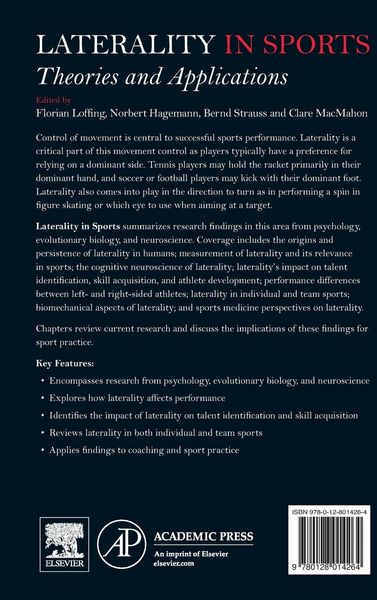
Laterality in Sports Theories and Applications

14% sparen

77,99 € UVP 91,00 €

inkl. gesetzl. MwSt., Versandkostenfrei


Beschreibung

Produktdetails

Einband

Gebundene Ausgabe

Erscheinungsdatum

25.08.2016

Abbildungen

black & white illustrations

Herausgeber

Florian Loffing + weitere

Verlag

Elsevier Science & Technology

Seitenzahl

380

Maße (L/B/H)

23,6/15,6/2,5 cm

Gewicht

750 g

Sprache

Englisch

ISBN

978-0-12-801426-4

Beschreibung

Rezension

"...an extremely well-written and thought-provoking book that explains more complex issues in sports performance, rehabilitation, injury prevention, and neurocognition in a very readable format...While the book is geared toward individuals in an academic setting, it can be useful for individuals in a variety of fields such as kinesiology, physical therapy, rehabilitation, neuropsychology, and sports performance." --PsycCRITIQUES

Portrait

Dr. Florian Loffing is a senior lecturer at the German Sport University Cologne. He obtained his PhD in Sports Psychology and is a sports scientist with interest in laterality and perceptual-cognitive expertise. Dr. Loffing utilizes mixed methodological approaches including lab-based experiments, interviews, and archival studies to understand sports performance psychology. He brings 16 years of experience to the project.

Norbert Hagemann is currently Full Professor for Sport Psychology at the University of Kassel (Germany). He received his PhD from the University of Muenster for his thesis “Heuristic problem solving strategies of team coaches”. Prof. Hagemann is studying the cognitive processes underlying how athletes perform in training and competitive situations. The focus is particularly on their perception and attention processes. Prof. Hagemann has been working on the topic of laterality for several years. This research has been supported by several research grants from the German Research Foundation. He publishes and reviews regularly papers in high-impact international peer-reviewed Journals.

Bernd Strauss, born 1959, is currently Full Professor for Sport Psychology at the University of Muenster, Germany (since 1998). He obtained his PhD from the University of Kiel (Germany) in 1992 with a thesis about complex problem solving. He had been the former president of the German Society of Sport Sciences (2003-2009). Currently he is president of the German Sport Psychology association. Bernd Strauss published more than 20 books, and more than 70 peer-reviewed papers. Currently he is Editor-in-chief (in collaboration with Nikos Ntoumanis, AUS) of the Journal “Psychology of Sport and Exercise” published by Elsevier. His main research interests are focused on expertise in sports (perception, attention, laterality), social psychology (self concept, influence of audiences on performances, sports spectators) and research methodology.

Clare MacMahon is a senior lecturer and Head of Sports Science at Swinburne Institute of Technology in Melbourne, Australia. She has an undergraduate degree in Psychology from McGill University, and post graduate degrees in Human Kinetics and Human Biodynamics from the University of Ottawa, and McMaster University. In her work on sport expertise, with an interest in decision making and the cognitive components of performance, Clare has conducted research in labs in Canada, the US, Belgium, Germany and Australia, working alongside world leaders in the area. Her work has been funded by the Social Sciences and Humanities Research Council of Canada, and the Australian Research Council.

Produktdetails

Einband

Gebundene Ausgabe

Erscheinungsdatum

25.08.2016

Abbildungen

black & white illustrations

Herausgeber

Verlag

Elsevier Science & Technology

Seitenzahl

380

Maße (L/B/H)

23,6/15,6/2,5 cm

Gewicht

750 g

Sprache

Englisch

ISBN

978-0-12-801426-4

EU-Ansprechpartner

Zeitfracht Medien GmbH
Ferdinand-Jühlke-Straße 7
99095 Erfurt
DE
produktsicherheit@zeitfracht.de

Herstelleradresse

Elsevier Science & Technology
125 London Wall
EC2Y 5AS London
GB
tradeorders@elsevier.com

Kundinnen und Kunden meinen

0 Bewertungen

Informationen zu Bewertungen

Zur Abgabe einer Bewertung ist eine Anmeldung im Konto notwendig. Die Authentizität der Bewertungen wird von uns nicht überprüft. Wir behalten uns vor, Bewertungstexte, die unseren Richtlinien widersprechen, entsprechend zu kürzen oder zu löschen.

Die Bewertungen sind nach Format, Anzahl Sterne und Datum sortiert.

Verfassen Sie die erste Bewertung zu diesem Artikel

Helfen Sie anderen Kund*innen durch Ihre Meinung

Kundinnen und Kunden meinen

0 Bewertungen filtern

Die Leseprobe wird geladen.
  • Produktbild: Laterality in Sports
  • 1. Laterality in Sports: More Than Two Sides of the Same Coin

    Section A. Laterality - An Important and Often Disregarded Topic
    2. Origins, Development, and Persistence of Laterality in Humans
    3. In Fencing, Are Left-Handers Trouble for Right-Handers? What Fencing Masters Said in the Past and What Scientists Say Today
    4. Measurement of Laterality and Its Relevance for Sports
    5. Laterality and Its Role in Talent Identification and Athlete Development
    6. Perspectives From Sports Medicine

    Section B. Motor Control and Learning
    7. What Can We Learn About Cognition From Studying Handedness? Insights From Cognitive Neuroscience
    8. Laterality of Basic Motor Control Mechanisms: Different Roles of the Right and Left Brain Hemispheres
    9. Effector Transfer
    10. Near Misses and the Effect of Attentional Asymmetries on Sporting Performance

    Section C. Performance in Sports
    11. Laterality in Individualized Sports
    12. Performance Differences Between Left- and Right-Sided Athletes in One-on-One Interactive Sports
    13. Biomechanical Considerations of Laterality in Sport
    14. Laterality Effects on Performance in Team Sports: Insights From Soccer and Basketball
    15. Skill Acquisition in Left- and Right-Dominant Athletes: Insights From Elite Coaching