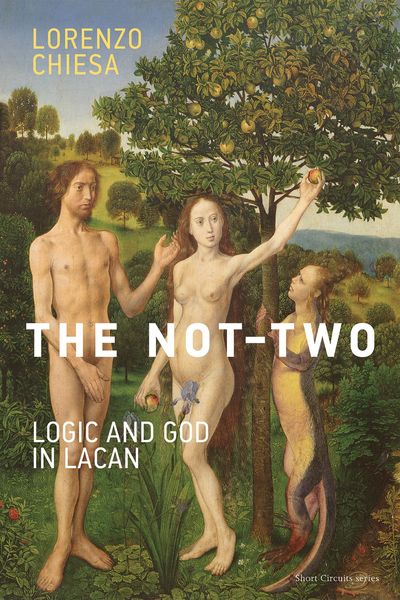
The Not-Two Logic and God in Lacan
-
- Taschenbuch
- eBook ausgewählt
-
Form:Einzelkauf Download
-
Sprache:Englisch
38,99 €
inkl. gesetzl. MwSt.Beschreibung
Produktdetails
Format
ePUB 3
Kopierschutz
Ja
Family Sharing
Ja
Text-to-Speech
Ja
Erscheinungsdatum
08.04.2016
Verlag
Mit PressSeitenzahl
280 (Printausgabe)
Dateigröße
1267 KB
Sprache
Englisch
EAN
9780262335041
In The Not-Two, Lorenzo Chiesa examines the treatment of logic and God in Lacan's later work. Chiesa draws for the most part from Lacan's Seminars of the early 1970s, as they revolve around the axiom There is no sexual relationship. Chiesa provides both a close reading of Lacan's effort to formalize sexual difference as incompleteness and an assessment of its broader implications for philosophical realism and materialism.
Chiesa argues that There is no sexual relationship is for Lacan empirically and historically circumscribed by psychoanalysis, yet self-evident in our everyday lives. Lacan believed that we have sex because we love, and that love is a desire to be One in face of the absence of the sexual relationship. Love presupposes a real not-two. The not-two condenses the idea that our love and sex lives are dictated by the impossibility of fusing man's contradictory being with the heteros of woman as a fundamentally uncountable Other. Sexual liaisons are sustained by a transcendental logic, the so-called phallic function that attempts to overcome this impossibility.
Chiesa also focuses on Lacan's critical dialogue with modern science and formal logic, as well as his dismantling of sexuality as considered by mainstream biological discourse. Developing a new logic of sexuation based on incompleteness requires the relinquishing of any alleged logos of life and any teleological evolution.
For Lacan, the truth of incompleteness as approached psychoanalytically through sexuality would allow us to go further in debunking traditional onto-theology and replace it with a para-ontology yet to be developed. Given the truth of incompleteness, Chiesa asks, can we think such a truth in itself without turning incompleteness into another truth about truth, that is, into yet another figure of God as absolute being?
Noch keine Bewertungen vorhanden
Verfassen Sie die erste Bewertung zu diesem Artikel
Helfen Sie anderen Kundinnen und Kunden durch Ihre Meinung.
Kurze Frage zu unserer Seite
Vielen Dank für Ihr Feedback
Wir nutzen Ihr Feedback, um unsere Produktseiten zu verbessern. Bitte haben Sie Verständnis, dass wir Ihnen keine Rückmeldung geben können. Falls Sie Kontakt mit uns aufnehmen möchten, können Sie sich aber gerne an unseren Kund*innenservice wenden.
zum Kundenservice