Gutscheinbedingungen

Gültig bis 19.08.2026 | Gültig für Spielzeug, Filme, Musik, Software, Games, Elektronik, Geschenke & Trends, Schreibwaren, Hörbücher und Hörbuch-Downloads (außer Abo & Shelfies), gebrauchte Bücher, nicht preisgebundene Bücher und Kalender | Einlösbar unter osiander.de und in der Osiander App | Click & Collect nur mit Online-Zahlung (Paypal/Kreditkarte) vorab | Einzelne Artikel können ausgeschlossen sein | Nicht kombinierbar mit anderen Gutscheinen oder Preisaktionen | Nur einmal pro Einkauf einlösbar | Gutschein wird auf max. 500€ Bestellwert angerechnet | Keine Barauszahlung | Digitale Hörbücher nur für Android  | Nicht gültig für preisgebundene Artikel (aufgrund der Buchpreisbindung sind Gutscheine nicht auf Bücher, eBooks, Presse einlösbar), tolino eReader & Zubehör, Abonnements & Flatrates, Geschenkkarten, Versandkosten und Services

  • Produktbild: Using Robots in Hazardous Environments
  • Produktbild: Using Robots in Hazardous Environments

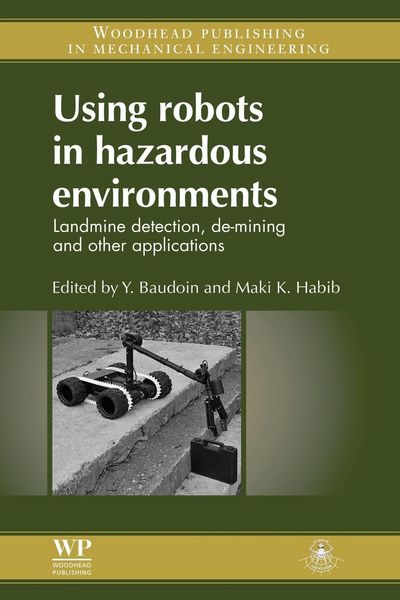
Using Robots in Hazardous Environments Landmine Detection, de-Mining and Other Applications

273,99 €

inkl. gesetzl. MwSt., Versandkostenfrei


Beschreibung

Produktdetails

Einband

Taschenbuch

Erscheinungsdatum

03.01.2011

Herausgeber

Y. Baudoin + weitere

Verlag

Elsevier Science & Technology

Seitenzahl

700

Maße (L/B/H)

23,4/15,6/3,6 cm

Gewicht

966 g

Sprache

Englisch

ISBN

978-0-08-101503-2

Beschreibung

Produktdetails

Einband

Taschenbuch

Erscheinungsdatum

03.01.2011

Herausgeber

Verlag

Elsevier Science & Technology

Seitenzahl

700

Maße (L/B/H)

23,4/15,6/3,6 cm

Gewicht

966 g

Sprache

Englisch

ISBN

978-0-08-101503-2

EU-Ansprechpartner

Zeitfracht Medien GmbH
Ferdinand-Jühlke-Straße 7
99095 Erfurt
DE
produktsicherheit@zeitfracht.de

Herstelleradresse

Elsevier Science & Technology
125 London Wall
EC2Y 5AS London
GB
tradeorders@elsevier.com

Noch keine Bewertungen vorhanden

Verfassen Sie die erste Bewertung zu diesem Artikel

Helfen Sie anderen Kundinnen und Kunden durch Ihre Meinung.

Kundinnen und Kunden meinen

Bewertungen (0)

Die Leseprobe wird geladen.
  • Produktbild: Using Robots in Hazardous Environments
  • Produktbild: Using Robots in Hazardous Environments
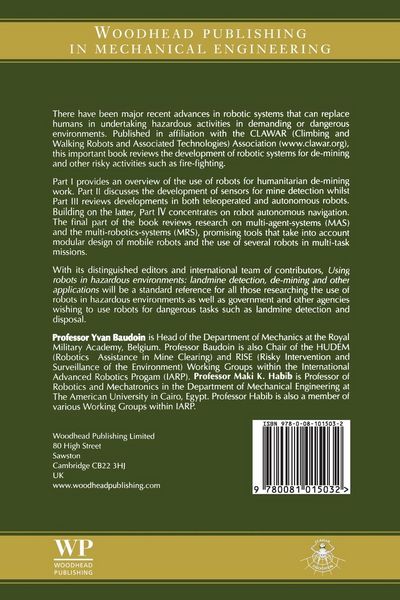
  • Part 1 Humanitarian demining: The evolution of robots and the challenges: Introduction: Mobile robotics systems for humanitarian de-mining and risky interventions; Robot for non-conventional demining process: From remote control to autonomy; Locomotion and localisation of humanitarian demining robots; Sustainable and appropriate technologies for humanitarian demining; Some problems of robotic humanitarian demining evolution. Part 2 Sensors for mine detection and robotics: Sensing capabilities for mobile robotics; Sensor fusion for automated landmine detection on a mobile robot; Relating soil properties to performance of metal detectors and ground penetrating radars; Contribution of geophysics for landmines and UXO detection: Case study in the Egyptian environment; Detecting landmine fields from low-resolution aerial infrared images; GPS data correction using encoders and INS sensors. Part 3 Autonomous and teleoperated robots for humanitarian demining: Environment-adaptive antipersonnel mine detection system: Advanced mine sweeper; Mechanical mine clearance: Development, applicability and difficulties; Robotic tools for demining and risky operations; RAVON - The robust autonomous vehicle for off-road navigation; Computer training in handling with ground teleoperated robots for demining. Part 4 Robot autonomous navigation and sensors: A fuzzy-genetic algorithm and obstacle path generation for walking robot with manipulator; Synthesis of a sagittal gate for a biped robot during single support phase; Fuzzy logic control in support of autonomous navigation of humanitarian demining robots; Human victim detection and stereo-based terrain traversability analysis for behavior-based robot navigation; Simulation of a mobile multilink robot with vision virtual reality system; Estimation of the distance by using the signal strength for localization of networked mobile sensors and actuators. Part 5 Multi robotics systems: Navigation and cooperation; Experimental study on the effects of communication on cooperative search in complex environments; Mobile ad-hoc networking supporting multi-hop connections in multi-robot scenarios; A decentralized planification architecture for a swarm of mobile robots; Using the NVIDIA CUDA application in the cognitive supervision and control of the multi robot system methodology for the supervision and control of the multi robotic system with CUDA application; Laser based cooperative multi-robot map building for indoor environments; Heterogeneous multi-agent system behaviour patterns for robotics applications; A light-weight communication protocol for tele-operated Robots in risky emergency operations.