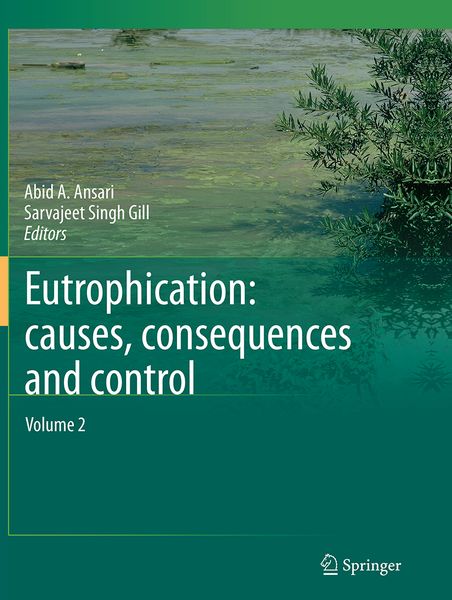
Eutrophication: Causes, Consequences and Control Volume 2
-
- Hardcover
- Taschenbuch ausgewählt
- eBook
-
Sprache:Englisch
-
Auflage:1. Auflage
- 2011 138,99 €
- 1. Auflage 97,99 € ausgewählt
97,99 €
inkl. gesetzl. MwSt.,
Beschreibung
Produktdetails
Einband
Taschenbuch
Erscheinungsdatum
18.09.2016
Abbildungen
XI, 262 p. 90 illus., 29 illus. in color.
Herausgeber
Abid A. Ansari + weitereVerlag
Springer NetherlandSeitenzahl
262
Maße (L/B/H)
27,9/21/1,6 cm
Gewicht
680 g
Auflage
1. Auflage
Sprache
Englisch
ISBN
978-94-024-0772-3
Eutrophication continues to be a major global challenge and the problem of eutrophication and availability of freshwater for human consumption is an essential ecological issue. The global demand for water resources due to increasing population, economic developments, and emerging energy development schemes has created new environmental challenges for global sustainability. Accordingly, the area of research on eutrophication has expanded considerably in recent years. Eutrophication, acidification and contamination by toxic substances are likely to pose increasing threats to freshwater resources and ecosystems. The consequences of anthropogenic-induced eutrophication of freshwaters are severe deterioration of surface waters and growing public concern, as well as new interest among the scientific community. “Eutrophication: causes, consequences & control” provides the latest information on many important aspects of the processes of natural and accelerated eutrophication in major aquatic ecosystems around the world.
This book offers a cutting-edge resource for researchers and students alike who are studying eutrophication in various ecosystems. It presents the latest trends and developments in the field, including: global scenarios and local threats to the dynamics of aquatic ecosystems, economics of eutrophication, eutrophication in the great lakes of the Chinese pacific drainage basin, photoautotrophic productivity in eutrophic ecosystems, eutrophication’s impacts on natural metal remediation in salt marshes, phytoplankton assemblages as an indicator of water quality in seven temperate estuarine lakes in southeast Australia, biogeochemical indicators of nutrient enrichments in wetlands – the microbial response as a sensitive indicator of wetland eutrophication, and ultraviolet radiation and bromide as limiting factors in eutrophication processes in semi-arid climate zones. Written by respected experts and featuring helpful illustrations andphotographs, “Eutrophication: causes, consequences & control” provides a concise and practical update on the latest developments in eutrophication.
Noch keine Bewertungen vorhanden
Verfassen Sie die erste Bewertung zu diesem Artikel
Helfen Sie anderen Kundinnen und Kunden durch Ihre Meinung.
Kurze Frage zu unserer Seite
Vielen Dank für Ihr Feedback
Wir nutzen Ihr Feedback, um unsere Produktseiten zu verbessern. Bitte haben Sie Verständnis, dass wir Ihnen keine Rückmeldung geben können. Falls Sie Kontakt mit uns aufnehmen möchten, können Sie sich aber gerne an unseren Kund*innenservice wenden.
zum Kundenservice