Rezension
From the book reviews:
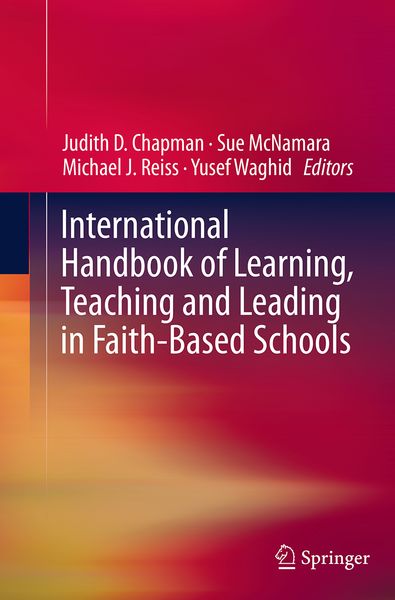
“Every dimension of this handbook speaks to its breadth and depth. At 670 pages, it is truly encyclopedic. … The editors are clear about their wish to conduct a rigorous analysis of historical developments in faith-based education, to cast it as a work in progress, and to explore what the future may hold. Without a doubt, they have accomplished this goal. … researchers and libraries should purchase International Handbook of Learning, Teaching and Leading in Faith-Based Schools.” (Ken Badley, Journal of Education and Christian Belief, Vol. 18 (2), 2014)
Portrait
Professor Judith Chapman AM began her career as a teacher in secondary schools in Australia and Europe before undertaking post-graduate studies in the USA. She was formerly Dean of the Faculty of Education at Australian Catholic University (1998-2003), where she is currently Professor of Education and formerly Professor of Education and Associate Dean (Teaching and Learning) of the combined Faculties of Economics, Commerce, Education and Law at The University of Western Australia (1993-1998) and Director of the Centre for School Decision Making and Management at Monash University (1979-1993). From 2007 she spent periods of leave as a Visiting Fellow of St Edmunds College, Cambridge University. She has undertaken extensive research and consultancy for international and national authorities, including OECD, UNESCO, the World Bank, I.D.P. and the Australian Commonwealth Government. Her edited publications for Springer include: The Second International Handbook on Lifelong Learning (2012); Values Education and Lifelong Learning (2007); and Lifelong Learning, Participation and Equity (2006). Judith has been awarded a Member of the Order of Australia for services to Higher Education; she is a Fellow of the Australian College of Education; a Fellow of the Australian Council of Educational Leaders; and a Fellow of the Western Australian Institute of Educational Administration (of which she was formerly Patron). Sue McNamara is an Associate Professor in Education at Australian Catholic University. Commencing her higher education career with a PhD in educational technology and instructional design, Sue also has later post-graduate qualifications in management and higher education. Her research interests are in the areas of human mindset, holistic learning including families, community and learning technology; complexity, organisational /systems change and the qualitative research paradigm of narrative and story. Sue has worked in Higher Education for many years, in conjunction with teaching and research undertaking significant administrative roles ranging from co-ordination of multi-stream Masters degrees and multiple undergraduate pre-service courses to, more recently appointments as Head of a multi-campus school of education, and Campus Dean of a university campus. She has worked in several faculties and disciplines ranging from law to medicine and in higher education development. Her most recent research has been in the area of developing rural and regional partnerships and technology in pre-service regional and rural teacher education in higher education and in the exploration of family and community involvement in improving student learning. Her most recent publications include Romeo, G., Gronn, D, McNamara, S., & Teo, Y.H. (2013) Windows into Classrooms: Using ICT to facilitate regional rural and remote practicum and teacher professional learning. Australian Educational Computing 27(2), 46-50; Gronn, D. , Romeo, G., McNamara, S. & Teo, Y.H. (2013) Web Conferencing of pre-service teacher’s practicum in remote schools. Journal of Technology and Teacher Education 21(2) 247-271; and Chapman, J., McNamara, S., Mitchell, A. & Horne, M. (2103) Evaluation of Family School Partnerships: A System wide initiative in the implementation of Reform 2010-2012. Study and Report for the Catholic Education Commission of Victoria, Australia Michael J. Reiss is Pro-Director: Research and Development and Professor of Science Education at the Institute of Education, University of London, Honorary Visiting Professor at the Universities of Leeds and York and the Royal Veterinary College, Honorary Fellow of the British Science Association and of the College of Teachers, Docent at the University of Helsinki, Director of the Salters-Nuffield Advanced Biology Project and an Academician of the Academy of Social Sciences. Books of his include: Reiss, M. J. & White, J. (2013) An Aims-based Curriculum, IOE Press; Halstead, J. M. &Reiss, M. J. (2003) Values in Sex Education: From Principles to Practice, Routledge Falmer; Reiss, M. J. (2000) Understanding Science Lessons: Five Years of Science Teaching, Open University Press; Reiss, M. J. & Mabud, S. A. (Eds) (1998) Sex Education and Religion, The Islamic Academy and Reiss, M. J. & Straughan, R. (1996). Improving Nature? The Science and Ethics of Genetic Engineering, Cambridge University Press. Yusef Waghid is Professor of Philosophy of Education at Stellenbosch University, South Africa. His research is in the areas of ethics, politics and religion in relation to philosophy of education. His most recent publications include Conceptions of Islamic education: Pedagogical framings (New York: Peter Lang, 2011), Citizenship, education and violence: On disrupted potentialities and becoming (co-authored, Rotterdam/Boston/Tapei, 2013,) African philosophy of education reconsidered: On being human (London: Routledge, 2014) and Pedagogy out of bounds: Untamed variations of democratic education (Rotterdam/Boston/Tapei, 2014).