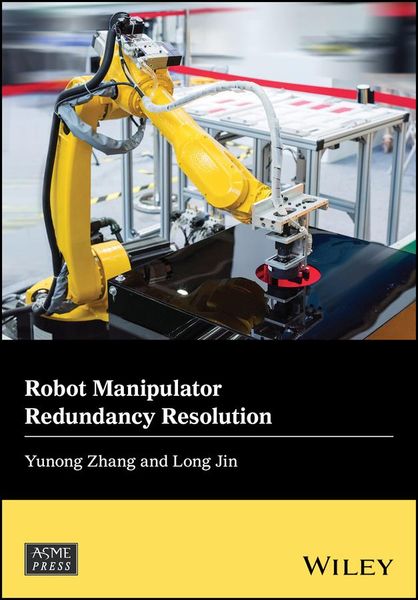
Robot Manipulator Redundancy Resolution
162,99 €
inkl. gesetzl. MwSt.,
Beschreibung
Produktdetails
Einband
Gebundene Ausgabe
Erscheinungsdatum
20.11.2017
Verlag
John Wiley & SonsSeitenzahl
320
Maße (L/B/H)
24,6/17,3/2 cm
Gewicht
816 g
Auflage
1. Auflage
Sprache
Englisch
ISBN
978-1-119-38123-5
This book describes a novel quadratic programming approach to solving redundancy resolutions problems with redundant manipulators. Known as ``QP-unified motion planning and control of redundant manipulators'' theory, it systematically solves difficult optimization problems of inequality-constrained motion planning and control of redundant manipulators that have plagued robotics engineers and systems designers for more than a quarter century.
An example of redundancy resolution could involve a robotic limb with six joints, or degrees of freedom (DOFs), with which to position an object. As only five numbers are required to specify the position and orientation of the object, the robot can move with one remaining DOF through practically infinite poses while performing a specified task. In this case redundancy resolution refers to the process of choosing an optimal pose from among that infinite set. A critical issue in robotic systems control, the redundancy resolution problem has been widely studied for decades, and numerous solutions have been proposed. This book investigates various approaches to motion planning and control of redundant robot manipulators and describes the most successful strategy thus far developed for resolving redundancy resolution problems.
* Provides a fully connected, systematic, methodological, consecutive, and easy approach to solving redundancy resolution problems
* Describes a new approach to the time-varying Jacobian matrix pseudoinversion, applied to the redundant-manipulator kinematic control
* Introduces The QP-based unification of robots' redundancy resolution
* Illustrates the effectiveness of the methods presented using a large number of computer simulation results based on PUMA560, PA10, and planar robot manipulators
* Provides technical details for all schemes and solvers presented, for readers to adopt and customize them for specific industrial applications
Robot Manipulator Redundancy Resolution is must-reading for advanced undergraduates and graduate students of robotics, mechatronics, mechanical engineering, tracking control, neural dynamics/neural networks, numerical algorithms, computation and optimization, simulation and modelling, analog, and digital circuits. It is also a valuable working resource for practicing robotics engineers and systems designers and industrial researchers.
Noch keine Bewertungen vorhanden
Verfassen Sie die erste Bewertung zu diesem Artikel
Helfen Sie anderen Kundinnen und Kunden durch Ihre Meinung.
Kurze Frage zu unserer Seite
Vielen Dank für Ihr Feedback
Wir nutzen Ihr Feedback, um unsere Produktseiten zu verbessern. Bitte haben Sie Verständnis, dass wir Ihnen keine Rückmeldung geben können. Falls Sie Kontakt mit uns aufnehmen möchten, können Sie sich aber gerne an unseren Kund*innenservice wenden.
zum Kundenservice