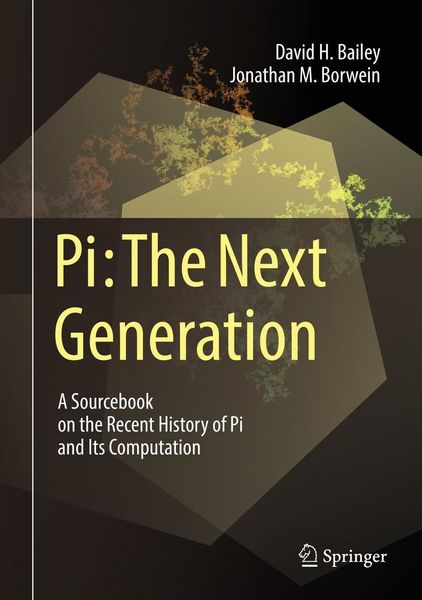
Pi: The Next Generation A Sourcebook on the Recent History of Pi and Its Computation
-
- Hardcover
- Taschenbuch
- eBook ausgewählt
-
Form:Einzelkauf Download
-
Sprache:Englisch
106,99 €
inkl. gesetzl. MwSt.Beschreibung
Produktdetails
Format
Kopierschutz
Nein
Family Sharing
Nein
Text-to-Speech
Nein
Erscheinungsdatum
19.07.2016
Verlag
Springer Nature SwitzerlandSeitenzahl
507 (Printausgabe)
Dateigröße
67375 KB
Auflage
1st ed. 2016
Sprache
Englisch
EAN
9783319323770
This book contains a compendium of 25 papers published since the 1970s dealing with pi and associated topics of mathematics and computer science. The collection begins with a Foreword by Bruce Berndt. Each contribution is preceded by a brief summary of its content as well as a short key word list indicating how the content relates to others in the collection. The volume includes articles on actual computations of pi, articles on mathematical questions related to pi (e.g., "Is pi normal?"), articles presenting new and often amazing techniques for computing digits of pi (e.g., the "BBP" algorithm for pi, which permits one to compute an arbitrary binary digit of pi without needing to compute any of the digits that came before), papers presenting important fundamental mathematical results relating to pi, and papers presenting new, high-tech techniques for analyzing pi (i.e., new graphical techniques that permit one to visually see if pi and other numbers are "normal").
This volume is a companion to Pi: A Source Book whose third edition released in 2004. The present collection begins with 2 papers from 1976, published by Eugene Salamin and Richard Brent, which describe "quadratically convergent" algorithms for pi and other basic mathematical functions, derived from some mathematical work of Gauss. Bailey and Borwein hold that these two papers constitute the beginning of the modern era of computational mathematics. This time period (1970s) also corresponds with the introduction of high-performance computer systems (supercomputers), which since that time have increased relentlessly in power, by approximately a factor of 100,000,000, advancing roughly at the same rate as Moore's Law of semiconductor technology. This book may be of interest to a wide range of mathematical readers; some articles cover more advanced research questions suitable for active researchers in the field, but several are highly accessible to undergraduate mathematics students.
Noch keine Bewertungen vorhanden
Verfassen Sie die erste Bewertung zu diesem Artikel
Helfen Sie anderen Kundinnen und Kunden durch Ihre Meinung.
Kurze Frage zu unserer Seite
Vielen Dank für Ihr Feedback
Wir nutzen Ihr Feedback, um unsere Produktseiten zu verbessern. Bitte haben Sie Verständnis, dass wir Ihnen keine Rückmeldung geben können. Falls Sie Kontakt mit uns aufnehmen möchten, können Sie sich aber gerne an unseren Kund*innenservice wenden.
zum Kundenservice