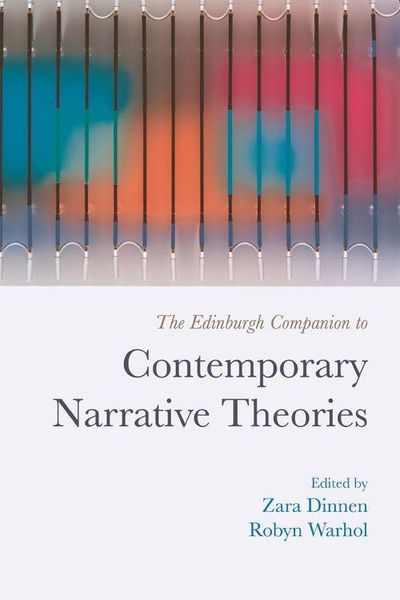
Produktbild: The Edinburgh Companion to Contemporary Narrative Theories

The Edinburgh Companion to Contemporary Narrative Theories

299,99 €

inkl. gesetzl. MwSt., Versandkostenfrei


Beschreibung

Produktdetails

Einband

Gebundene Ausgabe

Erscheinungsdatum

16.05.2018

Abbildungen

13 black and white illustrations

Herausgeber

Zara Dinnen + weitere

Verlag

Edinburgh University Press

Seitenzahl

440

Maße (L/B/H)

24,6/17,5/2,8 cm

Gewicht

914 g

Sprache

Englisch

ISBN

978-1-4744-2474-5

Beschreibung

Produktdetails

Einband

Gebundene Ausgabe

Erscheinungsdatum

16.05.2018

Abbildungen

13 black and white illustrations

Herausgeber

Verlag

Edinburgh University Press

Seitenzahl

440

Maße (L/B/H)

24,6/17,5/2,8 cm

Gewicht

914 g

Sprache

Englisch

ISBN

978-1-4744-2474-5

Herstelleradresse

Libri GmbH
Europaallee 1
36244 Bad Hersfeld
DE

Email: gpsr@libri.de

Noch keine Bewertungen vorhanden

Verfassen Sie die erste Bewertung zu diesem Artikel

Helfen Sie anderen Kundinnen und Kunden durch Ihre Meinung.

Kundinnen und Kunden meinen

Bewertungen (0)

Weitere Artikel finden Sie in

Die Leseprobe wird geladen.
  • Produktbild: The Edinburgh Companion to Contemporary Narrative Theories
  • List of Illustrations; Notes on Contributors; Introduction; Part I. Mind-centred and Cognitive Approaches to Narrative; 1. H. Porter Abbott, 'What Does It Mean to Be Mad? Diagnosis, Narrative, Science, and the DSM'; 2. Marco Caracciolo, 'The Nonhuman in Mind: Narrative Challenges to Folk Psychology'; 3. Suzanne Keen, 'Narrative and the Embodied Reader'; 4. Karin Kukkonen, 'The Fully Extended Mind'; 5. Merja Polvinen, 'Sense-Making and Wonder: An Enactive Approach to Narrative Form in Speculative Fiction'; Part II. Situated Narrative Theories; 6. Claudia Breger, 'Cosmopolitanism, Controversy, and Collectivity: Zadie Smith's Networked Narration'; 7. Sue J. Km, 'Race and Empathy in GB Tran's Vietnamerica'; 8. Susan S. Lanser, 'Till Death Do Us Part: Embodying Narratology'; 9. Sam McBean, 'Digital Intimacies and Queer Narratives'; 10. Valerie Rohy, 'The Cinema of the Impossible: Queer Theory and Narrative'; Part III. Theories of Digital Narrative; 11. Zara Dinnen, 'Cinema and the Unnarratability of Computation'; 12. Rob Gallagher, 'Plotting the Loop: Videogames and Narratability'; 13. Ellen McCracken, 'Serial as Digital Constellation: Fluid Textuality and Semiotic Otherness in the Podcast Narrative'; 14. Daniel Punday, 'UI Time and the Digital Event'; Part IV. Theories of Television, Film, Comics, and Graphic Narrative; 15. Jan Baetens and Hugo Frey, 'Continued Comics: The 'New Blake and Mortimer' as an Example of Continuation in European Series'; 16. Jason Mittell, 'Operational Seriality and the Operation of Seriality'; 17. Katalin Orbán, 'Closer Than They Seem: Graphic Narrative and the Senses'; 18. Sean O'Sullivan, 'Episode Five, or When Does a Narrative Become What It Is?'; 19. Christian Quendler, 'Media Theory as Narrative Theory: Film Narration as a Case Study'; Part V. Anti-Mimetic Narrative Theories; 20. Alice Bell and Astrid Ensslin, 'Digital Fiction and Unnatural Narrative'; 21. Stefan Kjerkegaard, 'Lyric Poetry as Anti-Mimetic Bridging in Narratives and Motion Pictures: A Case Study of Affective Response to Christopher Nolan's Interstellar (2014)'; 22. Brian McHale, 'Speculative Fiction, or, Literal Narratology'; 23. Brian Richardson, 'Unnatural Endings in Fiction and Drama'; Part VI. Philosophical Approaches to Narrative; 24. Mark Currie, 'Narrative and the Necessity of Contingency'; 25. James Phelan, 'Local Nonfictionality within Generic Fiction: Huntington's Disease in McEwan's Saturday and Genova's Inside the O'Briens'; 26. Ruth Ronen, 'The Story of the Law'; 27. Richard Walsh, 'The Centre for Narrative Gravity: Narrative and the Philosophy of Selfhood after Dennett'; 28. Amy Shuman and Katharine Young, 'The Body as Medium: A Phenomenological Approach to the Production of Affect in Narrative'.