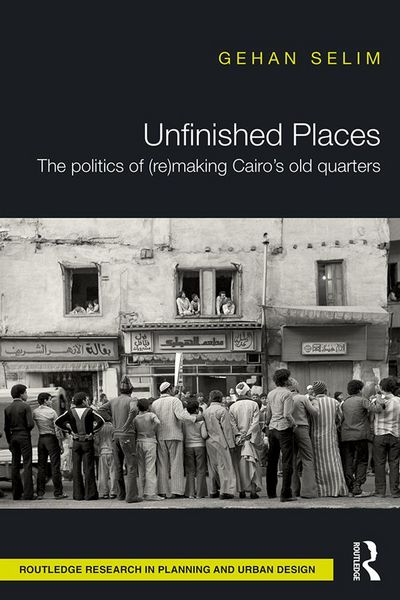
Unfinished Places: The Politics of (Re)making Cairo's Old Quarters
-
Form:Einzelkauf Download
-
Sprache:Englisch
-
eBook Format:PDF
- ePUB 3 74,49 €
- PDF 74,49 € ausgewählt
74,49 €
inkl. gesetzl. MwSt.Beschreibung
Produktdetails
Format
Kopierschutz
Ja
Family Sharing
Nein
Text-to-Speech
Nein
Erscheinungsdatum
10.11.2016
Verlag
Taylor & Francis eBooksSeitenzahl
270 (Printausgabe)
Dateigröße
6030 KB
Sprache
Englisch
EAN
9781317506263
The Emerging Politics of (Re) making Cairo's Old Quarters examines postcolonial planning practices that aimed to modernise Cairo's urban spaces. The author examines the expanding field of postcolonial urbanism by linking the state's political ideologies and systems of governance with methods of spatial representations that aimed to transform the urban realm in Cairo. Adopting an interdisciplinary approach, the study draws on planning, history and politics to develop a distinctive account of postcolonial planning in Cairo following Egypt's 1952 revolution. The book widely connects the ideological role of a different type of politicised urbanism practised during the days of Nasser, Sadat and Mubarak and the overarching policies, institutions and attitudes involved in the visions for (re) building a new nation in Egypt.
By examining the notion of remaking urban spaces, the study interprets the ambitions and powers of state policies for improving the spatial qualities of Cairo's old districts since the early 20th century. These acts are situated in their spatial, political and historical contexts of Cairo's heterogeneous old quarters and urban spaces particularly the remaking of one of the city's older quarts named Bulaq Abul Ela established during the Ottoman rule in the thirteenth century. It therefore writes, in a chronological sequence, a narrative through time and space connecting various layers of historical and contemporary political phases for remaking Bulaq. The endeavor is to explain this process from a spatial perspective in terms of the implications and consequences not only on places, but also on the people's everyday practices. By deeply investigating the problems and consequences; the strengths and weaknesses; and the state's reliability to achieve the remaking objectives, the book reveals evidence that shifting forms of governance had anchored planning practices into a narrow path of creativity and responsive planning.
Noch keine Bewertungen vorhanden
Verfassen Sie die erste Bewertung zu diesem Artikel
Helfen Sie anderen Kundinnen und Kunden durch Ihre Meinung.
Kurze Frage zu unserer Seite
Vielen Dank für Ihr Feedback
Wir nutzen Ihr Feedback, um unsere Produktseiten zu verbessern. Bitte haben Sie Verständnis, dass wir Ihnen keine Rückmeldung geben können. Falls Sie Kontakt mit uns aufnehmen möchten, können Sie sich aber gerne an unseren Kund*innenservice wenden.
zum Kundenservice