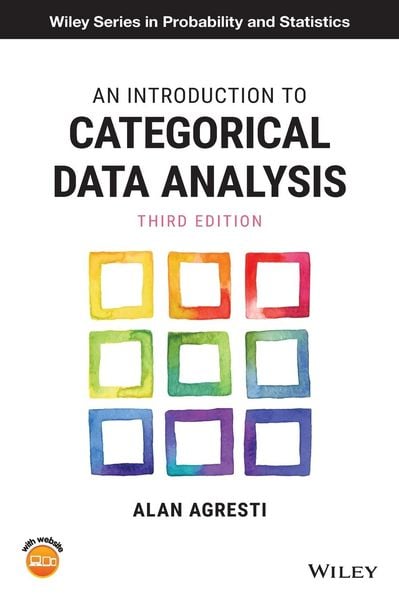
Produktbild: An Introduction to Categorical Data Analysis
Band 423

An Introduction to Categorical Data Analysis

159,99 €

inkl. gesetzl. MwSt., Versandkostenfrei


Beschreibung

Produktdetails

Einband

Gebundene Ausgabe

Erscheinungsdatum

22.01.2019

Verlag

John Wiley & Sons

Seitenzahl

400

Maße (L/B/H)

26/18,3/2,6 cm

Gewicht

1046 g

Auflage

3. Auflage

Sprache

Englisch

ISBN

978-1-119-40526-9

Beschreibung

Produktdetails

Einband

Gebundene Ausgabe

Erscheinungsdatum

22.01.2019

Verlag

John Wiley & Sons

Seitenzahl

400

Maße (L/B/H)

26/18,3/2,6 cm

Gewicht

1046 g

Auflage

3. Auflage

Sprache

Englisch

ISBN

978-1-119-40526-9

Herstelleradresse

Libri GmbH
Europaallee 1
36244 Bad Hersfeld
DE

Email: gpsr@libri.de

Kundinnen und Kunden meinen

0 Bewertungen

Informationen zu Bewertungen

Zur Abgabe einer Bewertung ist eine Anmeldung im Konto notwendig. Die Authentizität der Bewertungen wird von uns nicht überprüft. Wir behalten uns vor, Bewertungstexte, die unseren Richtlinien widersprechen, entsprechend zu kürzen oder zu löschen.

Die Bewertungen sind nach Format, Anzahl Sterne und Datum sortiert.

Verfassen Sie die erste Bewertung zu diesem Artikel

Helfen Sie anderen Kund*innen durch Ihre Meinung

Kundinnen und Kunden meinen

0 Bewertungen filtern

  • Produktbild: An Introduction to Categorical Data Analysis
  • Preface ix

    About the Companion Website xiii

    1 Introduction 1

    1.1 Categorical Response Data 1

    1.2 Probability Distributions for Categorical Data 3

    1.3 Statistical Inference for a Proportion 5

    1.4 Statistical Inference for Discrete Data 10

    1.5 Bayesian Inference for Proportions * 13

    1.6 Using R Software for Statistical Inference about Proportions * 17

    Exercises 21

    2 Analyzing Contingency Tables 25

    2.1 Probability Structure for Contingency Tables 26

    2.2 Comparing Proportions in 2 × 2 Contingency Tables 29

    2.3 The Odds Ratio 31

    2.4 Chi-Squared Tests of Independence 36

    2.5 Testing Independence for Ordinal Variables 42

    2.6 Exact Frequentist and Bayesian Inference * 46

    2.7 Association in Three-Way Tables 52

    Exercises 56

    3 Generalized Linear Models 65

    3.1 Components of a Generalized Linear Model 66

    3.2 Generalized Linear Models for Binary Data 68

    3.3 Generalized Linear Models for Counts and Rates 72

    3.4 Statistical Inference and Model Checking 76

    3.5 Fitting Generalized Linear Models 82

    Exercises 84

    4 Logistic Regression 89

    4.1 The Logistic Regression Model 89

    4.2 Statistical Inference for Logistic Regression 94

    4.3 Logistic Regression with Categorical Predictors 98

    4.4 Multiple Logistic Regression 102

    4.5 Summarizing Effects in Logistic Regression 107

    4.6 Summarizing Predictive Power: Classification Tables, ROC Curves, and Multiple Correlation 110

    Exercises 113

    5 Building and Applying Logistic Regression Models 123

    5.1 Strategies in Model Selection 123

    5.2 Model Checking 130

    5.3 Infinite Estimates in Logistic Regression 136

    5.4 Bayesian Inference, Penalized Likelihood, and Conditional Likelihood for Logistic Regression * 140

    5.5 Alternative Link Functions: Linear Probability and Probit Models * 145

    5.6 Sample Size and Power for Logistic Regression * 150

    Exercises 151

    6 Multicategory Logit Models 159

    6.1 Baseline-Category Logit Models for Nominal Responses 159

    6.2 Cumulative Logit Models for Ordinal Responses 167

    6.3 Cumulative Link Models: Model Checking and Extensions * 176

    6.4 Paired-Category Logit Modeling of Ordinal Responses * 184

    Exercises 187

    7 Loglinear Models for Contingency Tables and Counts 193

    7.1 Loglinear Models for Counts in Contingency Tables 194

    7.2 Statistical Inference for Loglinear Models 200

    7.3 The Loglinear - Logistic Model Connection 207

    7.4 Independence Graphs and Collapsibility 210

    7.5 Modeling Ordinal Associations in Contingency Tables 214

    7.6 Loglinear Modeling of Count Response Variables * 217

    Exercises 221

    8 Models for Matched Pairs 227

    8.1 Comparing Dependent Proportions for Binary Matched Pairs 228

    8.2 Marginal Models and Subject-Specific Models for Matched Pairs 230

    8.3 Comparing Proportions for Nominal Matched-Pairs Responses 235

    8.4 Comparing Proportions for Ordinal Matched-Pairs Responses 239

    8.5 Analyzing Rater Agreement * 243

    8.6 Bradley-Terry Model for Paired Preferences * 247

    Exercises 249

    9 Marginal Modeling of Correlated, Clustered Responses 253

    9.1 Marginal Models Versus Subject-Specific Models 254

    9.2 Marginal Modeling: The Generalized Estimating Equations (GEE) Approach 255

    9.3 Marginal Modeling for Clustered Multinomial Responses 260

    9.4 Transitional Modeling, Given the Past 263

    9.5 Dealing with Missing Data * 266

    Exercises 268

    10 Random Effects: Generalized Linear Mixed Models 273

    10.1 Random Effects Modeling of Clustered Categorical Data 273

    10.2 Examples: Random Effects Models for Binary Data 278

    10.3 Extensions to Multinomial Responses and Multiple Random Effect Terms 284

    10.4 Multilevel (Hierarchical) Models 288

    10.5 Latent Class Models * 291

    Exercises 295

    11 Classification and Smoothing * 299

    11.1 Classification: Linear Discriminant Analysis 300

    11.2 Classification: Tree-Based Prediction 302

    11.3 Cluster Analysis for Categorical Responses 306

    11.4 Smoothing: Generalized Additive Models 310

    11.5 Regularization for High-Dimensional Categorical Data (Large p) 313

    Exercises 321

    12 A Historical Tour of Categorical Data Analysis * 325

    Appendix: Software for Categorical Data Analysis 331

    A.1 R for Categorical Data Analysis 331

    A.2 SAS for Categorical Data Analysis 332

    A.3 Stata for Categorical Data Analysis 342

    A.4 SPSS for Categorical Data Analysis 346

    Brief Solutions to Odd-Numbered Exercises 349

    Bibliography 363

    Examples Index 365

    Subject Index 369