Band 53
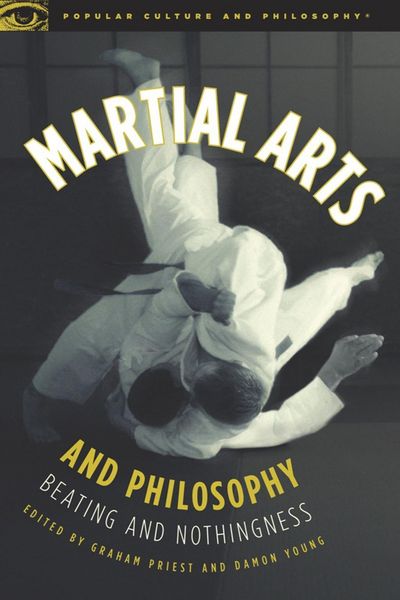
Martial Arts and Philosophy Beating and Nothingness
Aus der Reihe
Popular Culture and Philosophy
-
- Taschenbuch
- eBook ausgewählt
-
Form:Einzelkauf Download
-
Sprache:Englisch
20,49 €
inkl. gesetzl. MwSt.Beschreibung
Produktdetails
Format
ePUB
Kopierschutz
Ja
Family Sharing
Nein
Text-to-Speech
Ja
Erscheinungsdatum
22.10.2010
Verlag
Open CourtSeitenzahl
288 (Printausgabe)
Dateigröße
2971 KB
Sprache
Englisch
EAN
9780812697230
Socrates, an Athenian soldier, was a calmly efficient killing machine. His student Plato was an accomplished and broad-shouldered wrestler. Martial arts and philosophy have always gone hand in hand, as well as fist in throat. Philosophical argument is closely parallel with hand-to-hand combat. And all of today's Asian martial arts-like Karate, Kung-Fu, Judo, or Aikido-were developed to embody and apply philosophical ideas.
The Japanese martial tradition of Budo, for instance, was influenced by the three philosophical traditions of Shinto, Confucianism, and Zen Buddhism, and these philosophies are still taught in Japanese martial arts schools all across the world. As Damon Young explains in his chapter, the Japanese martial arts customs of courtesy are derived from Shinto purity, Confucian virtues, and the loving brutality of Zen.
In his interview with Bodidharma (included in the book), Graham Priest brings out aspects of Buddhist philosophy behind Shaolin Kung-Fu-how fighting monks are seeking Buddhahood, not brawls.
But as Scott Farrell's chapter reveals, Eastern martial arts have no monopoly on philosophical traditions. Western chivalry is an education in and living revival of Aristotelian ethical theories. The Western martial art of fencing is explored by Nick Michaud, who looks at the morality of selfishness in fencing, and Christopher Lawrence and Jeremy Moss, who try to pin down what makes fencing unique: is it the sword, the techniques, the footwork, the aristocratic aura, or something else?
Jack Fuller argues that his training in Karate was an education in Stoicism. Travis Taylor and Sasha Cooper reveal the utilitarian thinking behind Jigoro Kano's Judo. Kevin Krein maintains that the martial arts are a reply to the existentialist's anxiety about the meaninglessness of life. Patricia Peterson examines Karate's contribution to feminism, and Scott Beattie analyzes the role of space in the martial arts school.
Joe Lynch pits the Western ideas of Plato against the Eastern ideas of the Shaolin monks. Bronwyn Finnigan and Koji Tanaka uncover the meaning of human action as it appears in Kendo. Rick Schubert explains the meaning of mastery in the fighting arts.
Moving to ethical issues, Tamara Kohn discovers what we owe to others in Aikido. Chris Mortensen questions whether his own Buddhist pacifism is compatible with being a martial artist. In different ways, Gillian Russell and John Haffner and Jason Vogel assess the ways in which martial arts can morally compromise us.
How can the sweaty and the brutal be exquisitely beautiful? Judy Saltzman looks into the curious charm of fighting and forms, with help from Friedrich Nietzsche.
The Japanese martial tradition of Budo, for instance, was influenced by the three philosophical traditions of Shinto, Confucianism, and Zen Buddhism, and these philosophies are still taught in Japanese martial arts schools all across the world. As Damon Young explains in his chapter, the Japanese martial arts customs of courtesy are derived from Shinto purity, Confucian virtues, and the loving brutality of Zen.
In his interview with Bodidharma (included in the book), Graham Priest brings out aspects of Buddhist philosophy behind Shaolin Kung-Fu-how fighting monks are seeking Buddhahood, not brawls.
But as Scott Farrell's chapter reveals, Eastern martial arts have no monopoly on philosophical traditions. Western chivalry is an education in and living revival of Aristotelian ethical theories. The Western martial art of fencing is explored by Nick Michaud, who looks at the morality of selfishness in fencing, and Christopher Lawrence and Jeremy Moss, who try to pin down what makes fencing unique: is it the sword, the techniques, the footwork, the aristocratic aura, or something else?
Jack Fuller argues that his training in Karate was an education in Stoicism. Travis Taylor and Sasha Cooper reveal the utilitarian thinking behind Jigoro Kano's Judo. Kevin Krein maintains that the martial arts are a reply to the existentialist's anxiety about the meaninglessness of life. Patricia Peterson examines Karate's contribution to feminism, and Scott Beattie analyzes the role of space in the martial arts school.
Joe Lynch pits the Western ideas of Plato against the Eastern ideas of the Shaolin monks. Bronwyn Finnigan and Koji Tanaka uncover the meaning of human action as it appears in Kendo. Rick Schubert explains the meaning of mastery in the fighting arts.
Moving to ethical issues, Tamara Kohn discovers what we owe to others in Aikido. Chris Mortensen questions whether his own Buddhist pacifism is compatible with being a martial artist. In different ways, Gillian Russell and John Haffner and Jason Vogel assess the ways in which martial arts can morally compromise us.
How can the sweaty and the brutal be exquisitely beautiful? Judy Saltzman looks into the curious charm of fighting and forms, with help from Friedrich Nietzsche.
Noch keine Bewertungen vorhanden
Verfassen Sie die erste Bewertung zu diesem Artikel
Helfen Sie anderen Kundinnen und Kunden durch Ihre Meinung.
Kurze Frage zu unserer Seite
Vielen Dank für Ihr Feedback
Wir nutzen Ihr Feedback, um unsere Produktseiten zu verbessern. Bitte haben Sie Verständnis, dass wir Ihnen keine Rückmeldung geben können. Falls Sie Kontakt mit uns aufnehmen möchten, können Sie sich aber gerne an unseren Kund*innenservice wenden.
zum Kundenservice