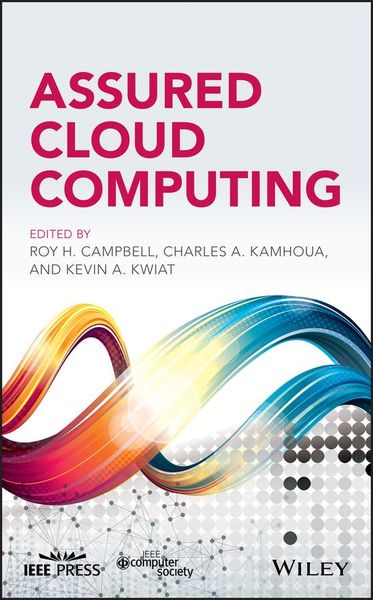
Assured Cloud Computing
168,99 €
inkl. gesetzl. MwSt.,
Beschreibung
Produktdetails
Einband
Gebundene Ausgabe
Erscheinungsdatum
02.10.2018
Herausgeber
Roy H. Campbell + weitereVerlag
John Wiley & Sons IncSeitenzahl
368
Maße (L/B/H)
23,6/15,1/2,5 cm
Gewicht
704 g
Auflage
1. Auflage
Sprache
Englisch
ISBN
978-1-119-42863-3
This book offers readers a comprehensive suite of solutions for resolving many of the key challenges to achieving high levels of assurance in cloud computing. The distillation of critical research findings generated by the Assured Cloud Computing Center of Excellence (ACC-UCoE) of the University of Illinois, Urbana-Champaign, it provides unique insights into the current and future shape of robust, dependable, and secure cloud-based computing and data cyberinfrastructures.
A survivable and distributed cloud-computing-based infrastructure can enable the configuration of any dynamic systems-of-systems that contain both trusted and partially trusted resources and services sourced from multiple organizations. To assure mission-critical computations and workflows that rely on such systems-of-systems it is necessary to ensure that a given configuration does not violate any security or reliability requirements. Furthermore, it is necessary to model the trustworthiness of a workflow or computation fulfillment to a high level of assurance. In presenting the substance of the work done by the ACC-UCoE, this book provides a vision for assured cloud computing illustrating how individual research contributions relate to each other and to the big picture of assured cloud computing. In addition, the book:
* Explores dominant themes in cloud-based systems, including design correctness, support for big data and analytics, monitoring and detection, network considerations, and performance
* Synthesizes heavily cited earlier work on topics such as DARE, trust mechanisms, and elastic graphs, as well as newer research findings on topics, including R-Storm, and RAMP transactions
* Addresses assured cloud computing concerns such as game theory, stream processing, storage, algorithms, workflow, scheduling, access control, formal analysis of safety, and streaming
Bringing together the freshest thinking and applications in one of today's most important topics, Assured Cloud Computing is a must-read for researchers and professionals in the fields of computer science and engineering, especially those working within industrial, military, and governmental contexts. It is also a valuable reference for advanced students of computer science.
Noch keine Bewertungen vorhanden
Verfassen Sie die erste Bewertung zu diesem Artikel
Helfen Sie anderen Kundinnen und Kunden durch Ihre Meinung.
Kurze Frage zu unserer Seite
Vielen Dank für Ihr Feedback
Wir nutzen Ihr Feedback, um unsere Produktseiten zu verbessern. Bitte haben Sie Verständnis, dass wir Ihnen keine Rückmeldung geben können. Falls Sie Kontakt mit uns aufnehmen möchten, können Sie sich aber gerne an unseren Kund*innenservice wenden.
zum Kundenservice