Gutscheinbedingungen

Gültig bis 13.07.2026 | Gültig für Spielzeug (außer Tonieboxen & ausgewählte Tonies), Filme, Musik, Software, Games, Schreibwaren, Hörbücher und Hörbuch-Downloads (außer Abo & Shelfies), gebrauchte Bücher, nicht preisgebundene Bücher und Kalender | Einlösbar unter osiander.de und in der Osiander App | Click & Collect nur mit Online-Zahlung (Paypal/Kreditkarte) vorab | Einzelne Artikel können ausgeschlossen sein | Nicht kombinierbar mit anderen Gutscheinen oder Preisaktionen | Nur einmal pro Einkauf einlösbar | Gutschein wird auf max. 500€ Bestellwert angerechnet | Keine Barauszahlung | Digitale Hörbücher nur für Android | Nicht gültig für preisgebundene Artikel (aufgrund der Buchpreisbindung sind Gutscheine nicht auf Bücher, eBooks, Presse einlösbar), tolino eReader & Zubehör, Elektronik, Geschenke & Trends, Abonnements & Flatrates, Geschenkkarten, Versandkosten und Services

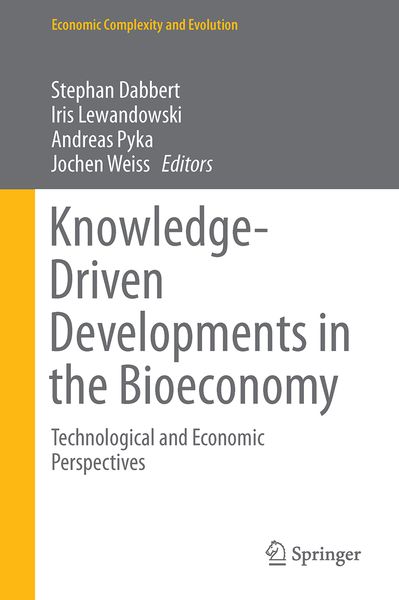
  • Produktbild: Knowledge-Driven Developments in the Bioeconomy
  • Produktbild: Knowledge-Driven Developments in the Bioeconomy
- 10%

Knowledge-Driven Developments in the Bioeconomy Technological and Economic Perspectives

10% sparen

109,99 € UVP 123,04 €

inkl. gesetzl. MwSt., Versandkostenfrei


Beschreibung

Produktdetails

Einband

Gebundene Ausgabe

Erscheinungsdatum

28.09.2017

Abbildungen

XII, 69 illus., 44 illus. in color., farbige Illustrationen, schwarz-weiss Illustrationen

Herausgeber

Stephan Dabbert + weitere

Verlag

Springer

Seitenzahl

341

Maße (L/B/H)

24,1/16/2,5 cm

Gewicht

699 g

Auflage

1st ed. 2017

Sprache

Englisch

ISBN

978-3-319-58373-0

Beschreibung

Portrait

The agricultural economist Prof. Dr. Stephan Dabbert studied agriculture an Chistian-Albrecht University in Kiel, followed by a Master of Science degree in agricultural economics at Pennsylvania State University. He obtained his doctorate from the University of Hohenheim (Germany) in 1990, as well as his professorship in the area of agricultural business management. He led the Institute for Social Economy from 1992 until 1994 at the Centre for Agrarian Landscape and Land Use Research in Muencheberg. He has held the chair and leadership of the Department of Production Theory and Resource Economics in Hohenheim since 1994. From 2002 to 2006 he was Dean of the amalgamated Faculty of Agricultural Science in Hohenheim. He was elected President in 2012.

Prof. Dr. Iris Lewandowski has held the chair and professorship in “Biobased Products and Energy Crops” at the Institute of Crop Science of the University of Hohenheim since 2010. She graduated in Agricultural Sciencewith specialization in Crop Science from the University of Hohenheim. Professor Lewandowski also holds a doctoral and postdoctoral degree in Crop Science. To date, her dedication to sustainable agricultural biomass production has brought her to the universities of Hohenheim and Utrecht (Netherlands). From 2006-2010 she led a research teach at Shell Global Solutions, exploring the practical contribution of research to sustainable bioenergy production. In addition, since 2015 professor Lewandowski has been Vice President for Academic Affairs at the University of Hohenheim.

Prof. Dr. Andreas Pyka has been professor of Innovation Economics at the Economics Institute of the University of Hohenheim in Stuttgart, Germany since 2009. He has an academic background in economics and business administration at the University of Augsburg, Germany, where he completed his PhD on informal networks, absorptive capacities and collective innovation in 1999. His Post Doc period Andreas Pyka spent as a researcher at the INRA Institute in Grenoble, France. After his return to Augsburg, where he was habilitated in 2004 he was doing research and teaching at the Austrian Institute of Technology, Vienna and the Technical University Delft, the Netherlands. His first tenured professorship for economic theory he got in 2006 at the University of Bremen, Germany. Professor Pyka has also been the Vice President for International Affairs of the University of Hohenheim since 2011.

Prof. Dr. Jochen Weiss has been Department head of the Food Physics and Meat Sciences Department at the University of Hohenheim since 2008. After graduating in chemical engineering from the University of Karlsruhe (today known as Karlsruhe Institute of Technology, KIT), he focused on food science during his PhD studies in Massachusetts where he also received his first position as a professor for “food biophysics and nanotechnology”. He was granted with the Journal of Food Science Highest Cited Paper Award. Prof. Weiss has also been the Vice President for Research at the University of Hohenheim since 2011. 

Produktdetails

Einband

Gebundene Ausgabe

Erscheinungsdatum

28.09.2017

Abbildungen

XII, 69 illus., 44 illus. in color., farbige Illustrationen, schwarz-weiss Illustrationen

Herausgeber

Verlag

Springer

Seitenzahl

341

Maße (L/B/H)

24,1/16/2,5 cm

Gewicht

699 g

Auflage

1st ed. 2017

Sprache

Englisch

ISBN

978-3-319-58373-0

Herstelleradresse

Springer-Verlag KG
Sachsenplatz 4-6
1201 Wien
AT

Email: GPSR Kontakt

Noch keine Bewertungen vorhanden

Verfassen Sie die erste Bewertung zu diesem Artikel

Helfen Sie anderen Kundinnen und Kunden durch Ihre Meinung.

Kundinnen und Kunden meinen

Bewertungen (0)

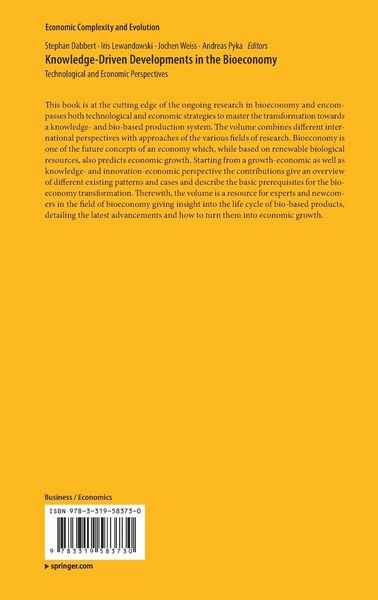
  • Produktbild: Knowledge-Driven Developments in the Bioeconomy
  • Produktbild: Knowledge-Driven Developments in the Bioeconomy
  • Strategies for Knowledge-Driven Developments in the Bioeconomy – an International and Interdisciplinary Perspective.- Part I: Bioeconomy Systems: Theoretical Underpinnings.- Transformation of Economic Systems: The Bio-Economy Case.- Structural Change, Knowledge and the Bioeconomy.- Some thoughts about the bio-economy as intelligently navigated complex adaptive systems.- Part II: Framing the Bioeconomy: Regional and National Approaches.- Varieties of Knowledge-Based Bioeconomies.- International Bioeconomy Innovations in Central America.- Bioeconomy Potential for the Brazilian Innovation System.- Tasmania’s Bioeconomy: Using all Capitals to Sustain Innovative and Entrepreneurial Agrifood Value Chains.- Agricultural Biomass Utilisation as a Key Driver for Malaysian Bioeconomy.- University-Industry  Relationships in the Bioeconomy Innovation System of Denmark.- Part III: Resources of the Bioeconomy: Sustainable Biomass Supply.- Increasing Biomass Production to Sustain the Bioeconomy.- Importance of Sugarcane in Brazilian and World Bioeconomy.- Economic Evaluation of Short Rotation Eucalyptus Plantation Harvesting System: a Case Study.- Technology and Sustainability of Crop Fibre Uses in Bioproducts in Ontario, Canada - Corn Stalk and Cob Fibre Performance in Polypropylene Composites.- Part IV: Bioeconomy Applications: Optimizing Processes and Management of the Bioeconomy.- Strategic Supply Chain Planning in Biomass-Based Industries — a Literature Review of Quantitative Models.- Structuring the Planning Tasks in Biomass-Based Supply Chains.- The Use of Biomass for Energy Production and Organic Fertilizer for Mitigating Climate Change and Improving the Competitiveness of the Agricultural Enterprise: The Case of the UPAP  in Puriscal, Costa Rica.- Bioethanol as the Sole Solvent for Vegetable Oil Extraction and Biodiesel Production.