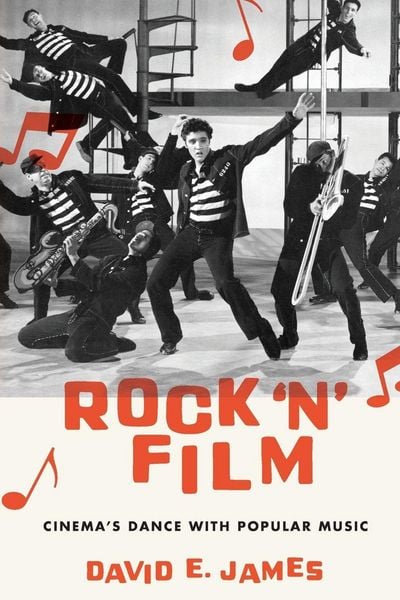
Rock 'n' Film Cinema's Dance with Popular Music
-
- Hardcover
- Taschenbuch ausgewählt
- eBook
-
Sprache:Englisch
66,99 €
inkl. gesetzl. MwSt.,
Beschreibung
Produktdetails
Einband
Taschenbuch
Erscheinungsdatum
01.11.2017
Abbildungen
73 illus.
Verlag
Oxford University PressSeitenzahl
484
Maße (L/B/H)
23,4/15,6/2,7 cm
Gewicht
728 g
Sprache
Englisch
ISBN
978-0-19-084201-7
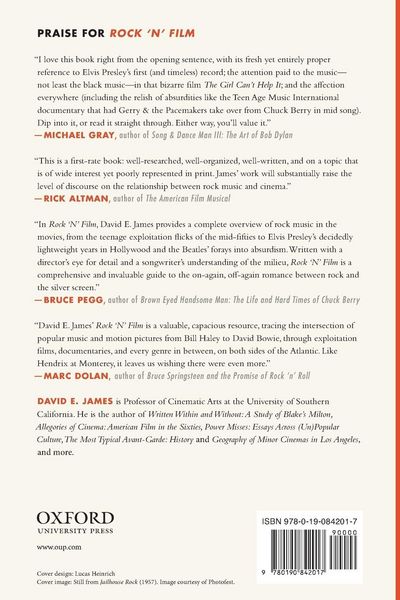
For two decades after the mid-1950s, biracial popular music played a fundamental role in progressive social movements on both sides of the Atlantic. Balancing rock's capacity for utopian popular cultural empowerment with its usefulness for the capitalist media industries, Rock 'N' Film explores how the music's contradictory potentials were reproduced in various kinds of cinema, including major studio productions, minor studios' exploitation projects, independent documentaries, and the avant-garde. These include Rock Around the Clock and other 1950s jukebox musicals; the films Elvis made before being drafted, especially King Creole, as well as the formulaic comedies in which Hollywood abused his genius in the 1960s; early documentaries such as The T.A.M.I. Show that presented James Brown and the Rolling Stones as the core of a black-white, US-UK cultural commonality; A Hard Day's Night that marked the British Invasion; Dont Look Back, Monterey Pop, Woodstock, and other Direct Cinema documentaries about the music of the counterculture; and avant-garde films about the Rolling Stones by Jean-Luc Godard, Kenneth Anger, and Robert Frank. After the turn of the decade, notably Gimme Shelter, in which the Stones appeared to be complicit in the Hells Angels' murder of a young black man, 1960s' music-and films about it-reverted to separate black and white traditions based respectively on soul and country. These produced blaxploitation and Lady Sings the Blues on the one hand, and bigoted representations of Southern culture in Nashville on the other. Ending with the deaths of their stars, both films implied that rock 'n' roll had died or even, as David Bowie proclaimed, that it had committed suicide. But in his documentary about Bowie, Ziggy Stardust and the Spiders from Mars, D.A. Pennebaker triumphantly re-affirmed the community of musicians and fans in glam rock. In analyzing this history, David E. James adapts the methodology of histories of the classic film musical to show how the rock 'n' roll film both displaced and recreated it.
Noch keine Bewertungen vorhanden
Verfassen Sie die erste Bewertung zu diesem Artikel
Helfen Sie anderen Kundinnen und Kunden durch Ihre Meinung.
Kurze Frage zu unserer Seite
Vielen Dank für Ihr Feedback
Wir nutzen Ihr Feedback, um unsere Produktseiten zu verbessern. Bitte haben Sie Verständnis, dass wir Ihnen keine Rückmeldung geben können. Falls Sie Kontakt mit uns aufnehmen möchten, können Sie sich aber gerne an unseren Kund*innenservice wenden.
zum Kundenservice