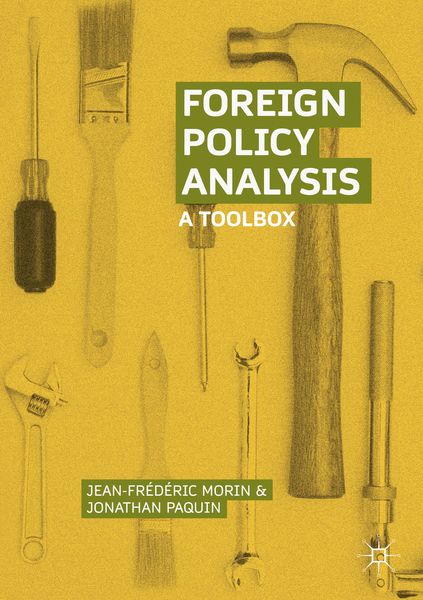
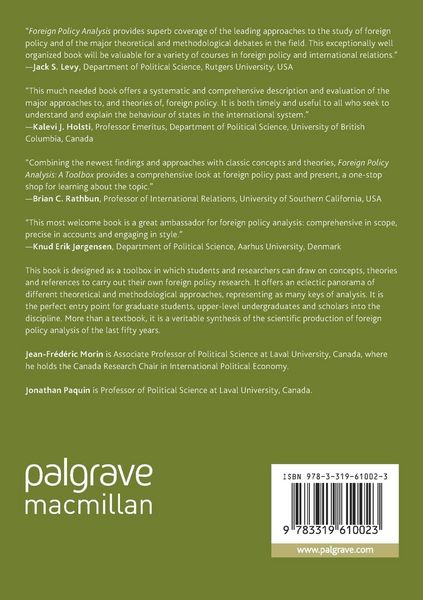
• Produktbild: Foreign Policy Analysis
  • Produktbild: Foreign Policy Analysis

Foreign Policy Analysis A Toolbox

59,99 €

inkl. gesetzl. MwSt., Versandkostenfrei


Beschreibung

Produktdetails

Einband

Taschenbuch

Erscheinungsdatum

05.01.2018

Abbildungen

XIII, 12 illus., schwarz-weiss Illustrationen

Verlag

Springer

Seitenzahl

359

Maße (L/B/H)

21/14,8/2,1 cm

Gewicht

491 g

Auflage

1st ed. 2018

Sprache

Englisch

ISBN

978-3-319-61002-3

Beschreibung

Produktdetails

Einband

Taschenbuch

Erscheinungsdatum

05.01.2018

Abbildungen

XIII, 12 illus., schwarz-weiss Illustrationen

Verlag

Springer

Seitenzahl

359

Maße (L/B/H)

21/14,8/2,1 cm

Gewicht

491 g

Auflage

1st ed. 2018

Sprache

Englisch

ISBN

978-3-319-61002-3

Herstelleradresse

Springer-Verlag GmbH
Tiergartenstr. 17
69121 Heidelberg
DE

Email: ProductSafety@springernature.com

Noch keine Bewertungen vorhanden

Verfassen Sie die erste Bewertung zu diesem Artikel

Helfen Sie anderen Kundinnen und Kunden durch Ihre Meinung.

Kundinnen und Kunden meinen

Bewertungen (0)

  • Produktbild: Foreign Policy Analysis
  • Produktbild: Foreign Policy Analysis
  • 1.What is Foreign Policy Analysis?

    What is a Policy? When a Policy Becomes ForeignAn Array of Explanations The Levels of Analysis and the Evolution in FPAA Toolbox for Studying FPA 

    2. How to Identify and Assess a Foreign Policy?

    The Goals of Foreign Policy--The Goals Communicated  --Doctrine--National Interest--Deducing the Goals Pursued Mobilized Resources--Resources--The Power Paradox--Mobilization and ExploitationInstruments of Foreign Policy--Socialization--Coercion--Interventions--Event-Based DatabasesThe Process of Foreign Policy--Segmentation in Six Phases--A Linear, Cyclical or Chaotic ProcessThe Outcome of Foreign Policy--Measuring Effectiveness--Feedback Effects--Historical Institutionalism--Explaining EffectivenessFrom the Puzzle to the Theoretical Explanations--Theoretical Models

    3. Do Decision-Makers Matter?

    Emotions--From Psychobiography to Statistics--The Middle Way: Affective Dimensions--Typologies Combining the Affective DimensionsCognition--Cognitive Consistency--Operational Codes--Heuristic Shortcuts--Cognitive Mapping--Cognitive Complexity--Schema TheoryPerceptions--Misperception--Attribution Bias--Probabilities

    4. What is the Influence of the Bureaucracy?

    Management Styles--Defining Management Styles--The Most Appropriate Management StyleGroup Dynamics--Groupthink--Defining the PhenomenonThe Organizational Model--Organizational Strategies--The Effects of Standard Operating ProceduresThe Bureaucratic Model--One Game, Several Players--The Interactions between the Players--The Position of the Ministry of Foreign Affairs--The Bureaucratic Model and Its Critics

    5. To What Extent is Foreign Policy Shaped by Institutions?

    Parliamentary and Electoral System--Presidential and Parliamentary Regimes--Parliamentarians and their Preferences--Political Cohabitation and CoalitionsThe Strong State and the Weak State--Determining the Relative Power of the State--The Power of the State and Its Foreign PolicyThe Democratic Peace Proposition--Observing the Democratic Peace--Defining the Variables of the Democratic Peace--The Peaceful Nature of Democracies--Explaining the Democratic Peace Through Norms--The Exchange of Information and CredibilityEconomic Liberalism--From Democracy to Free Trade--From Free Trade to Peace and Vice Versa--Critics of the Liberal Peace

    6. How Influential Are the Social Actors?

    Public Opinion--The Almond-Lippmann Consensus and Its Critics--The Structure of Public Opinion--The Influence of Public Opinion--Audience CostsThe Influence of Leaders on Public Opinion--The Rally Around the Flag--The Temptation of War as a Rallying LeverThe Media--The Media's Influence--How Leaders Influence the Media?--The CNN EffectThe Interest Groups--How Interest Groups Influence Foreign Policy?--Methodological Pitfalls--Case Studies and GeneralizationsThe Experts--Think Tanks--Epistemic Communities--The Experts' Predictions

    7. How Does Rationality Apply to FPA and What Are Its Limitations?

    Rational Choice--From Micro-Economics to Foreign Policy--The Substitutability of Foreign Policies--Rational DeterrenceModelling Rationality--Game Theory--Cybernetic Theory--The Two-Level GameRationality and Cognition--Prospect Theories--Poliheuristic Theory

    8. What Part Does Culture Play in FPA?

    Norms--Norm Compliance--Norm DiffusionNational Identities--The Self and the Other--Evolving Identities--Foreign Policy as Identity Affiliation--Social Identity TheoryNational Roles--Role Conception--Roles as Foreign Policy GuidesGender--Women, Femininity and Feminism--The Nation and the State in the Feminist Grammar--Foreign States and NationsOrganizational and Strategic Cultures--The Stability of Organizational Cultures--Interactions between Organizational Cultures--Strategic Culture--Strategic Cultures and PracticesDiscourse--Discourse as a Field of Interaction--The Methods of Discourse Analysis

    9. Does the International Structure Explain Foreign Policy?

    Structural Theories--The Structural Shift in International Relations--Limits and CriticismCan Structural Theories Inform Foreign Policy?--Structural Assumptions and State UnitsReconciling Agent and Structure--From Structure to Agent--From Agent to Structure

    10. What are the Current Challenges to FPA?

    Challenge 1: Beyond EclecticismChallenge 2: Beyond the American FrameworkChallenge 3: Beyond the State-Centric PrismChallenge 4: Beyond the Ivory Tower