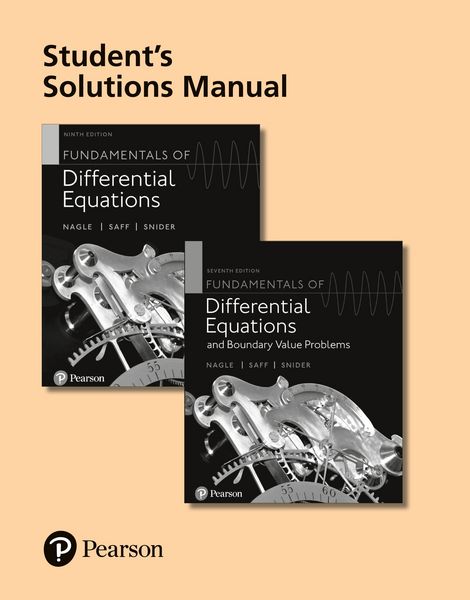
Produktbild: Student Solutions Manual for Fundamentals of Differential Equations and Fundamentals of Differential Equations and Boundary Value Problems
- 15%

Student Solutions Manual for Fundamentals of Differential Equations and Fundamentals of Differential Equations and Boundary Value Problems

15% sparen

74,99 € UVP 88,99 €

inkl. gesetzl. MwSt., Versandkostenfrei


Beschreibung

Produktdetails

Einband

Taschenbuch

Erscheinungsdatum

10.10.2024

Verlag

Pearson Education Limited

Seitenzahl

880

Maße (L/B/H)

27,6/21,6/4,7 cm

Gewicht

1597 g

Auflage

7

Sprache

Englisch

ISBN

978-0-321-97721-2

Beschreibung

Produktdetails

Einband

Taschenbuch

Erscheinungsdatum

10.10.2024

Verlag

Pearson Education Limited

Seitenzahl

880

Maße (L/B/H)

27,6/21,6/4,7 cm

Gewicht

1597 g

Auflage

7

Sprache

Englisch

ISBN

978-0-321-97721-2

Herstelleradresse

Pearson
St.-Martin-Straße 82
81541 München
DE

Email: salesde@pearson.com

Noch keine Bewertungen vorhanden

Verfassen Sie die erste Bewertung zu diesem Artikel

Helfen Sie anderen Kundinnen und Kunden durch Ihre Meinung.

Kundinnen und Kunden meinen

Bewertungen (0)

  • Produktbild: Student Solutions Manual for Fundamentals of Differential Equations and Fundamentals of Differential Equations and Boundary Value Problems

  • 1. Introduction


    • 1.1 Background


    • 1.2 Solutions and Initial Value Problems


    • 1.3 Direction Fields


    • 1.4 The Approximation Method of Euler


    2. First-Order Differential Equations


    • 2.1 Introduction: Motion of a Falling Body


    • 2.2 Separable Equations


    • 2.3 Linear Equations


    • 2.4 Exact Equations


    • 2.5 Special Integrating Factors


    • 2.6 Substitutions and Transformations


    3. Mathematical Models and Numerical Methods Involving First Order Equations


    • 3.1 Mathematical Modeling


    • 3.2 Compartmental Analysis


    • 3.3 Heating and Cooling of Buildings


    • 3.4 Newtonian Mechanics


    • 3.5 Electrical Circuits


    • 3.6 Improved Euler's Method


    • 3.7 Higher-Order Numerical Methods: Taylor and Runge-Kutta


    4. Linear Second-Order Equations


    • 4.1 Introduction: The Mass-Spring Oscillator


    • 4.2 Homogeneous Linear Equations: The General Solution


    • 4.3 Auxiliary Equations with Complex Roots


    • 4.4 Nonhomogeneous Equations: The Method of Undetermined Coefficients


    • 4.5 The Superposition Principle and Undetermined Coefficients Revisited


    • 4.6 Variation of Parameters


    • 4.7 Variable-Coefficient Equations


    • 4.8 Qualitative Considerations for Variable-Coefficient and Nonlinear Equations


    • 4.9 A Closer Look at Free Mechanical Vibrations


    • 4.10 A Closer Look at Forced Mechanical Vibrations


    5. Introduction to Systems and Phase Plane Analysis


    • 5.1 Interconnected Fluid Tanks


    • 5.2 Elimination Method for Systems with Constant Coefficients


    • 5.3 Solving Systems and Higher-Order Equations Numerically


    • 5.4 Introduction to the Phase Plane


    • 5.5 Applications to Biomathematics: Epidemic and Tumor Growth Models


    • 5.6 Coupled Mass-Spring Systems


    • 5.7 Electrical Systems


    • 5.8 Dynamical Systems, Poincaré Maps, and Chaos


    6. Theory of Higher-Order Linear Differential Equations


    • 6.1 Basic Theory of Linear Differential Equations


    • 6.2 Homogeneous Linear Equations with Constant Coefficients


    • 6.3 Undetermined Coefficients and the Annihilator Method


    • 6.4 Method of Variation of Parameters


    7. Laplace Transforms


    • 7.1 Introduction: A Mixing Problem


    • 7.2 Definition of the Laplace Transform


    • 7.3 Properties of the Laplace Transform


    • 7.4 Inverse Laplace Transform


    • 7.5 Solving Initial Value Problems


    • 7.6 Transforms of Discontinuous Functions


    • 7.7 Transforms of Periodic and Power Functions


    • 7.8 Convolution


    • 7.9 Impulses and the Dirac Delta Function


    • 7.10 Solving Linear Systems with Laplace Transforms


    8. Series Solutions of Differential Equations


    • 8.1 Introduction: The Taylor Polynomial Approximation


    • 8.2 Power Series and Analytic Functions


    • 8.3 Power Series Solutions to Linear Differential Equations


    • 8.4 Equations with Analytic Coefficients


    • 8.5 Cauchy-Euler (Equidimensional) Equations


    • 8.6 Method of Frobenius


    • 8.7 Finding a Second Linearly Independent Solution


    • 8.8 Special Functions


    9. Matrix Methods for Linear Systems


    • 9.1 Introduction


    • 9.2 Review 1: Linear Algebraic Equations


    • 9.3 Review 2: Matrices and Vectors


    • 9.4 Linear Systems in Normal Form


    • 9.5 Homogeneous Linear Systems with Constant Coefficients


    • 9.6 Complex Eigenvalues


    • 9.7 Nonhomogeneous Linear Systems


    • 9.8 The Matrix Exponential Function


    10. Partial Differential Equations


    • 10.1 Introduction: A Model for Heat Flow


    • 10.2 Method of Separation of Variables


    • 10.3 Fourier Series


    • 10.4 Fourier Cosine and Sine Series


    • 10.5 The Heat Equation


    • 10.6 The Wave Equation


    • 10.7 Laplace's Equation


    Appendices

    1. Newtons Method

    2. Simpsons Rule


    3. Cramers Rule


    4. Method of Least Squares


    5. Runge-Kutta Procedure for n Equations