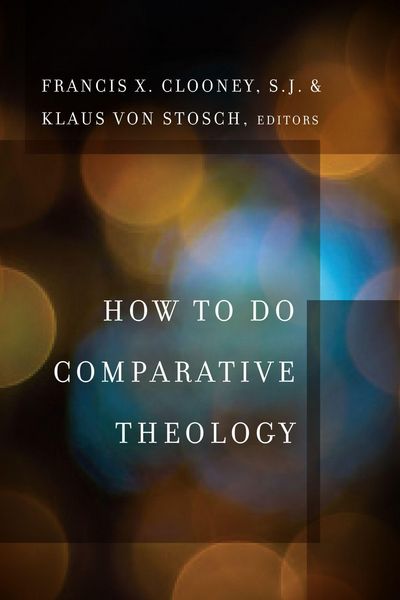
How to Do Comparative Theology
-
- Hardcover
- Taschenbuch ausgewählt
- eBook
-
Sprache:Englisch
41,99 €
UVP
49,00 €
inkl. gesetzl. MwSt.,
Beschreibung
Produktdetails
Einband
Taschenbuch
Erscheinungsdatum
12.12.2017
Herausgeber
Francis X. Clooney + weitereVerlag
Fordham University PressSeitenzahl
344
Maße (L/B/H)
22,6/15,3/2,2 cm
Gewicht
530 g
Sprache
Englisch
ISBN
978-0-8232-7841-1
For a generation and more, the contribution of Christian theology to interreligious understanding has been a subject of debate. Some think of theological perspectives are of themselves inherently too narrow to support interreligious learning, and argue for an approach that is neutral or, on a more popular level, grounded simply open-minded direct experience. In response, comparative theology argues that theology, as faith seeking understanding, offers a vital perspective and a way of advancing interreligious dialogue, aided rather than hindered by commitments; theological perspectives can both complement and step beyond the study of religions by methods detached and merely neutral. Thus comparative theology has been successful in persuading many that interreligious learning from one faith perspective to another is both possible and worthwhile, and so the work of comparative theology has become more recognized and established globally. With this success there has come to the fore new challenges regarding method: How does one do comparative theological work in a way that is theologically grounded, genuinely open to learning from the other, sophisticated in pursuing comparisons, and fruitful on both the academic and practical levels?
How To Do Comparative Theology therefore contributes to the maturation of method in the field of comparative theological studies, learning across religious borders, by bringing together essays drawing on different Christian traditions of learning, Judaism and Islam, Hinduism and Buddhism, the wisdom of senior scholars, and also insights from a younger generation of scholars who have studied theology and religion in new ways, and are more attuned to the language of the "spiritual but not religious." The essays in this volume show great diversity in method, and also-over and again and from many angles-coherence in intent, a commitment to one learning from the other, and a confidence that one's home tradition benefits from fair and unhampered learning from other and very different spiritual and religious traditions. It therefore shows the diversity and coherence of comparative theology as an emerging discipline today.
Noch keine Bewertungen vorhanden
Verfassen Sie die erste Bewertung zu diesem Artikel
Helfen Sie anderen Kundinnen und Kunden durch Ihre Meinung.
Kurze Frage zu unserer Seite
Vielen Dank für Ihr Feedback
Wir nutzen Ihr Feedback, um unsere Produktseiten zu verbessern. Bitte haben Sie Verständnis, dass wir Ihnen keine Rückmeldung geben können. Falls Sie Kontakt mit uns aufnehmen möchten, können Sie sich aber gerne an unseren Kund*innenservice wenden.
zum Kundenservice