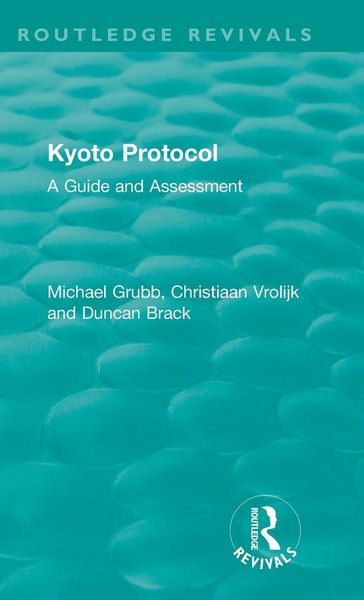

• Produktbild: Routledge Revivals
  • Produktbild: Routledge Revivals

Routledge Revivals Kyoto Protocol (1999): A Guide and Assessment

209,99 €

inkl. gesetzl. MwSt., Versandkostenfrei


Beschreibung

Produktdetails

Einband

Gebundene Ausgabe

Erscheinungsdatum

15.12.2017

Verlag

Taylor and Francis

Seitenzahl

386

Maße (L/B/H)

22,2/14,5/2,4 cm

Gewicht

870 g

Sprache

Englisch

ISBN

978-1-138-50604-6

Beschreibung

Produktdetails

Einband

Gebundene Ausgabe

Erscheinungsdatum

15.12.2017

Verlag

Taylor and Francis

Seitenzahl

386

Maße (L/B/H)

22,2/14,5/2,4 cm

Gewicht

870 g

Sprache

Englisch

ISBN

978-1-138-50604-6

Herstelleradresse

Libri GmbH
Europaallee 1
36244 Bad Hersfeld
DE

Email: gpsr@libri.de

Kundinnen und Kunden meinen

0 Bewertungen

Informationen zu Bewertungen

Zur Abgabe einer Bewertung ist eine Anmeldung im Konto notwendig. Die Authentizität der Bewertungen wird von uns nicht überprüft. Wir behalten uns vor, Bewertungstexte, die unseren Richtlinien widersprechen, entsprechend zu kürzen oder zu löschen.

Die Bewertungen sind nach Format, Anzahl Sterne und Datum sortiert.

Verfassen Sie die erste Bewertung zu diesem Artikel

Helfen Sie anderen Kund*innen durch Ihre Meinung

Kundinnen und Kunden meinen

0 Bewertungen filtern

Die Leseprobe wird geladen.
  • Produktbild: Routledge Revivals
  • Produktbild: Routledge Revivals
  • Foreword, (H.E. Raul & A. Estrada-Oyuela) Preface Acknowledgements About the authors Outline structure of Convention and Protocol Glossary Summary and conclusions Part I: The Making of the Protocol 1. Analytic Foundations: Science, Response Options and IPCC 1.1. Origins and the Intergovernmental Panel on Climate Change 1.2. Scientific Foundations and the First Assessment Report 1.3. Findings of the IPCC Second Assessment Report 1.4. Key Debates and Implications of the Second Assessment Report 1.5. Developments After the Second Assessment Report 1.6. Conclusions 2. Political and Legal Foundations: National Perspectives and the Road to Kyoto 2.1. National Interests, Perspectives and Negotiating Groups 2.2. The UN Framework Convention on Climate Change 2.3. From Rio to the First Conference of Parties at Berlin 2.4. The Shifting Political Foundations 2.5. Milestones to Kyoto 3. Negotiating the Kyoto Protocol 3.1. The Negotiating Process 3.2. Policies and Measures 3.3. Defining Emissions Targets: Time Scales, Gas Coverage and Sinks 3.4. Assigning Emissions Targets: Differentiation and the EU Bubble 3.5. International Flexibility within Annex I: Joint Implementation and Emissions Trading 3.6. International Flexibility with Developing Countries: Objections to JI and the Emergence of the CDM 3.7. Developing-country Concerns and Participation 3.8. Extending Commitments to New Countries: Evolution and Voluntary Accession 3.9. Conclusions 4. The Kyoto Protocol 4.1. Definition of Annex I Commitments 4.2. ‘Bubbling’ and the EU Redistribution of Emission Commitments 4.3. Policies and Measures 4.4. Mechanisms for International Transfer 4.5. Additional Issues Relating to Developing Countries 4.6. Compliance, Future Development and Related Issues: Monitoring Reporting and Review 4.7. Conclusions Part II: Analysis of Commitments, Mechanisms and Prospects 5. Environmental and Economic Implications of the Kyoto Commitments 5.1. Environmental Consequences of the Kyoto Commitments 5.2. Economic Consequences of the Kyoto Commitments 5.3. The Potential Impact of Flexibility within Annex I 5.4. Potential Impact of Sinks and the CDM 5.5. Conclusions: Inflation, Efficiency and Competition Between the Mechanisms 6. Implementing International Transfers under the Kyoto Mechanisms 6.1. General Principles Governing the Creation and Transfer of Emissions Credits and Allowances 6.2. Acquisiton and Trade of Emissions Credits from JI and the CDM 6.3. Governing International Emissions Trading 6.4. Supplementary, Balancing and Charges Under the Kyoto Mechanisms 6.5. Conclusions 7. The Clean Development Mechanism 7.1. Introduction 7.2. A: Additionality, and Adaptation and Administration Charges 7.3. B: Bilateral or Portfolio Structure 7.4. C: Crediting, Certification and the Control of Corruption 7.5. D: Distribution of Activities Under the CDM 7.6. E: Eligibity Criteria 7.7. F: Financing Sources 7.8. G: Governing the CDM 7.9. Conclusions 8. Prospects for the Kyoto Regime 8.1. The Buenos Aires ‘Plan of Action’ 8.2. Prospects for Ratification and Entry Into Force 8.3. Business and Public Involvement in the Kyoto Regime 8.4. First-Period Developing-Country Commitments: Accession, Expansion and Inflation 8.5. Longer-term Approaches: An Overview 8.6. Emissions Convergence: Any Room for Compromise 8.7. Conclusions Part III: Appendices 1. Text of the Kyoto Protocol 2. Key Themes in Economic Debates: Insights From the IPCC Second Assessment Report 3. Analysis of International Trade in Emission Allowances 4. Further Reading and Sources of Information Index