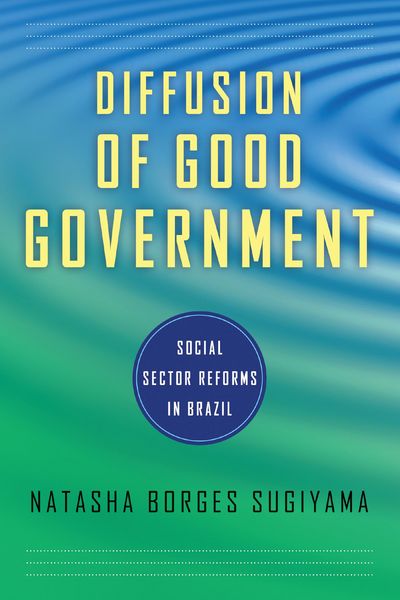
Diffusion of Good Government Social Sector Reforms in Brazil
-
- Taschenbuch
- eBook ausgewählt
-
Form:Einzelkauf Download
-
Sprache:Englisch
31,99 €
inkl. gesetzl. MwSt.Beschreibung
Produktdetails
Format
ePUB
Kopierschutz
Nein
Family Sharing
Nein
Text-to-Speech
Ja
Erscheinungsdatum
15.12.2012
Verlag
University Of Notre Dame PressSeitenzahl
288 (Printausgabe)
Dateigröße
3982 KB
Sprache
Englisch
EAN
9780268092825
One of the most fundamental questions for social scientists involves diffusion events; simply put, how do ideas spread and why do people embrace them? In Diffusion of Good Government: Social Sector Reforms in Brazil, Natasha Borges Sugiyama examines why innovations spread across political territories and what motivates politicians to adopt them.
Sugiyama does so from the vantage point of Brazilian politics, a home to innovative social sector reforms intended to provide the poor with access to state resources. Since the late 1980s, the country has undergone major policy transformations as local governments have gained political, fiscal, and administrative autonomy. For the poor and other vulnerable groups, local politics holds special importance: municipal authorities provide essential basic services necessary for their survival, including social assistance, education, and health care. Brazil, with over 5,000 municipalities with a wide variety of political cultures and degrees of poverty, thus provides ample opportunities to examine the spread of innovative programs to assist such groups.
Sugiyama delves into the politics of social sector reforms by examining the motivations for emulating well-regarded programs. To uncover the mechanisms of diffusion, her analysis contrasts three paradigmatic models for how individuals choose to allocate resources: by advancing political self-interest to gain electoral victories; by pursuing their ideological commitments for social justice; or by seeking to demonstrate adherence to the professional norms of their fields. Drawing on a mixed-method approach that includes extensive field research and statistical analysis on the spread of model programs in education (especially Bolsa Escola, a school grant program) and health (Programa Saúde da Família, a family health program), she concludes that ideological convictions and professional norms were the main reasons why mayors adopted these programs, with electoral incentives playing a negligible role.
Noch keine Bewertungen vorhanden
Verfassen Sie die erste Bewertung zu diesem Artikel
Helfen Sie anderen Kundinnen und Kunden durch Ihre Meinung.
Kurze Frage zu unserer Seite
Vielen Dank für Ihr Feedback
Wir nutzen Ihr Feedback, um unsere Produktseiten zu verbessern. Bitte haben Sie Verständnis, dass wir Ihnen keine Rückmeldung geben können. Falls Sie Kontakt mit uns aufnehmen möchten, können Sie sich aber gerne an unseren Kund*innenservice wenden.
zum Kundenservice