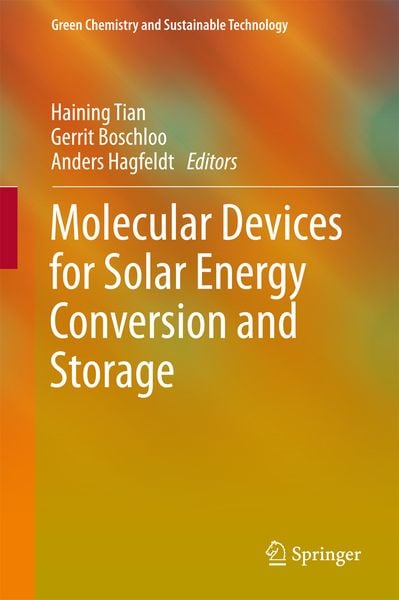
• Produktbild: Molecular Devices for Solar Energy Conversion and Storage
  • Produktbild: Molecular Devices for Solar Energy Conversion and Storage
- 13%

Molecular Devices for Solar Energy Conversion and Storage

13% sparen

185,99 € UVP 213,99 €

inkl. gesetzl. MwSt., Versandkostenfrei


Beschreibung

Produktdetails

Einband

Gebundene Ausgabe

Erscheinungsdatum

02.10.2017

Abbildungen

XIV, 531 p. 261 illus., 182 illus. in color.

Herausgeber

Haining Tian + weitere

Verlag

Springer Singapore

Seitenzahl

531

Maße (L/B/H)

24,1/16/3,5 cm

Gewicht

980 g

Auflage

1st edition 2018

Sprache

Englisch

ISBN

978-981-10-5923-0

Beschreibung

Portrait


Haining Tian obtained his doctorate from Dalian University of Technology (China) in 2009. Then he joined Prof. Licheng Sun’s group as a postdoc/researcher in KTH Royal Institute of Technology, Sweden, from 2009-2014. During that period, he also spent two months as a visiting researcher at Universitat Jaume I, Spain. In 2014, he joined the  Physical Chemistry department at Uppsala University as an assistant professor. In 2016, he became associate professor (Docent). His research interests mainly focus on molecular solar cells and solar fuel devices, particularly on functional organic/inorganic materials synthesis, photoelectrode fabrication, water splitting, carbon dioxide reduction and photosynthesis of organic chemicals. He has published over 50 peer-reviewed articles concentrating on molecular devices for solar energy conversion.


Gerrit Boschloo received his PhD in 1996 from Delft University of Technology, the Netherlands. He pursued postdoctoral research at University College Dublin, Ireland, and at Uppsala University, Sweden. After a research period at the Royal Institute of Technology (Stockholm, Sweden), he is currently an associate professor of Physical Chemistry at Uppsala University. His research focuses on photoelectrochemistry of semiconductors and molecular devices, specifically on dye-sensitized solar cells and perovskite solar cells. He has authored and coauthored over 160 peer-reviewed articles in leading journals.


Anders Hagfeldt is a professor of Physical Chemistry at EPFL, Switzerland. He obtained his Ph.D. at Uppsala University in 1993 and was a post-doc with Prof. Michael Grätzel (1993-1994) at EPFL, Switzerland. His research focuses on the mesoporous dye-sensitized solar cells, specifically on the physical and chemical characterization of mesoporous electrodes for different types of optoelectronic devices. He has published more than 400 scientific papers that have received over 40,000 citations (with an h-index of 100),and holds 8 patents. He was ranked number 46 on a list of the top 100 material scientists of the past decade by Times Higher Education. From 2014 to 2016 he was on Thomson Reuter’s list of Highly Cited Researchers, i.e. among the top 1% most cited in chemistry. He is a member of the Royal Swedish Academy of Sciences, European Academy of Sciences, Royal Society of Sciences in Uppsala, and the Royal Swedish Academy of Engineering Sciences. He is a visiting professor at Uppsala University, Sweden, and Nanyang Technological University, Singapore.

Produktdetails

Einband

Gebundene Ausgabe

Erscheinungsdatum

02.10.2017

Abbildungen

XIV, 531 p. 261 illus., 182 illus. in color.

Herausgeber

Verlag

Springer Singapore

Seitenzahl

531

Maße (L/B/H)

24,1/16/3,5 cm

Gewicht

980 g

Auflage

1st edition 2018

Sprache

Englisch

ISBN

978-981-10-5923-0

Herstelleradresse

Springer-Verlag KG
Sachsenplatz 4-6
1201 Wien
AT

Email: ProductSafety@springernature.com

Noch keine Bewertungen vorhanden

Verfassen Sie die erste Bewertung zu diesem Artikel

Helfen Sie anderen Kundinnen und Kunden durch Ihre Meinung.

Kundinnen und Kunden meinen

Bewertungen (0)

  • Produktbild: Molecular Devices for Solar Energy Conversion and Storage
  • Produktbild: Molecular Devices for Solar Energy Conversion and Storage

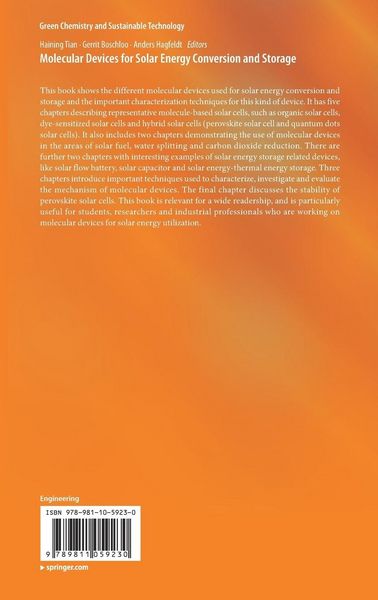
  • Small Molecule Solar Cells.- Polymer solar cells.- Liquid Dye Sensitized Solar Cells.- Solid-state dye-sensitized solar cells.- Hybrid organic/inorganic and perovskite solar cells.- Light-Driven Water-Splitting in the Dye Sensitized Photoelectrosynthesis Cell.- Light-driven carbon dioxide reduction devices.-  Photobatteries and Photocapacitors.- Molecular Solar Thermal Energy Storage: Molecular Design and Functional Devices.- Impedance Spectroscopy in Molecular Devices.- Time-resolved laser spectroscopy in molecular devices for solar energy conversion.- X-ray Photoelectron Spectroscopy for Understanding Molecular and Hybrid Solar Cells.- Stability of Molecular Devices: Halide Perovskite Solar Cells.