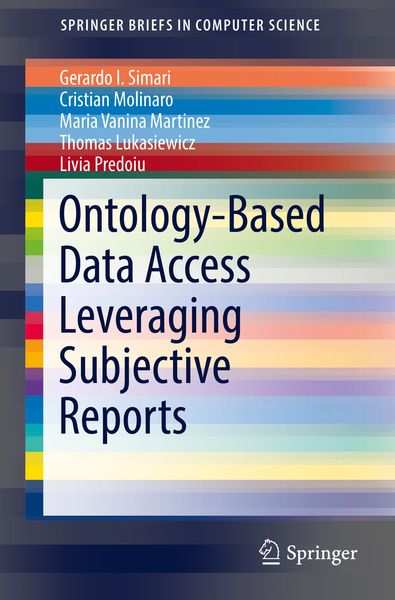
Ontology-Based Data Access Leveraging Subjective Reports
-
- Taschenbuch ausgewählt
- eBook
-
Sprache:Englisch
49,99 €
inkl. gesetzl. MwSt.,
Beschreibung
Produktdetails
Einband
Taschenbuch
Erscheinungsdatum
05.10.2017
Abbildungen
VIII, 32 illus., schwarz-weiss Illustrationen
Verlag
SpringerSeitenzahl
77
Maße (L/B/H)
23,6/15,9/1 cm
Gewicht
149 g
Auflage
1st ed. 2017
Sprache
Englisch
ISBN
978-3-319-65228-3
This SpringerBrief reviews the knowledge engineering problem of engineering objectivity in top-k query answering; essentially, answers must be computed taking into account the user’s preferences and a collection of (subjective) reports provided by other users. Most assume each report can be seen as a set of scores for a list of features, its author’s preferences among the features, as well as other information is discussed in this brief. These pieces of information for every report are then combined, along with the querying user’s preferences and their trust in each report, to rank the query results. Everyday examples of this setup are the online reviews that can be found in sites like Amazon, Trip Advisor, and Yelp, among many others.
Throughout this knowledge engineering effort the authors adopt the Datalog+/– family of ontology languages as the underlying knowledge representation and reasoning formalism, and investigate several alternative ways in which rankings can b
ederived, along with algorithms for top-k (atomic) query answering under these rankings. This SpringerBrief also investigate assumptions under which our algorithms run in polynomial time in the data complexity.
Since this SpringerBrief contains a gentle introduction to the main building blocks (OBDA, Datalog+/-, and reasoning with preferences), it should be of value to students, researchers, and practitioners who are interested in the general problem of incorporating user preferences into related formalisms and tools. Practitioners also interested in using Ontology-based Data Access to leverage information contained in reviews of products and services for a better customer experience will be interested in this brief and researchers working in the areas of Ontological Languages, Semantic Web, Data Provenance, and Reasoning with Preferences.
Noch keine Bewertungen vorhanden
Verfassen Sie die erste Bewertung zu diesem Artikel
Helfen Sie anderen Kundinnen und Kunden durch Ihre Meinung.
Kurze Frage zu unserer Seite
Vielen Dank für Ihr Feedback
Wir nutzen Ihr Feedback, um unsere Produktseiten zu verbessern. Bitte haben Sie Verständnis, dass wir Ihnen keine Rückmeldung geben können. Falls Sie Kontakt mit uns aufnehmen möchten, können Sie sich aber gerne an unseren Kund*innenservice wenden.
zum Kundenservice