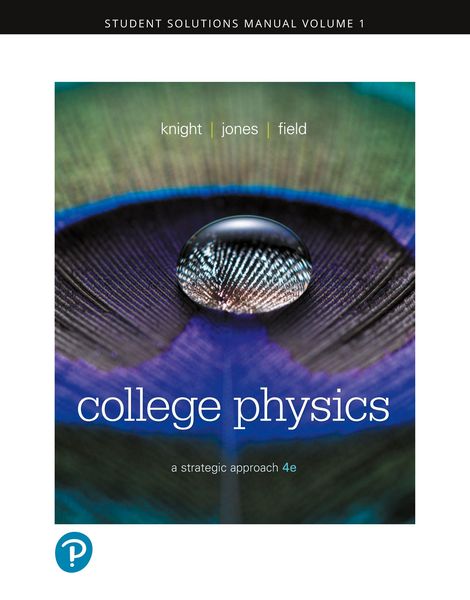
Produktbild: Student Solutions Manual for College Physics: A Strategic Approach, Volume 1 (Chapters 1-16)
- 15%

Student Solutions Manual for College Physics: A Strategic Approach, Volume 1 (Chapters 1-16) A Strategic Approach

15% sparen

74,99 € UVP 88,99 €

inkl. gesetzl. MwSt., Versandkostenfrei


Beschreibung

Produktdetails

Einband

Taschenbuch

Erscheinungsdatum

05.09.2024

Verlag

Pearson Studium

Seitenzahl

352

Maße (L/B/H)

27,6/21,6/2 cm

Gewicht

726 g

Auflage

4

Sprache

Englisch

ISBN

978-0-13-470419-7

Beschreibung

Produktdetails

Einband

Taschenbuch

Erscheinungsdatum

05.09.2024

Verlag

Pearson Studium

Seitenzahl

352

Maße (L/B/H)

27,6/21,6/2 cm

Gewicht

726 g

Auflage

4

Sprache

Englisch

ISBN

978-0-13-470419-7

Herstelleradresse

Pearson
St.-Martin-Straße 82
81541 München
DE

Email: salesde@pearson.com

Noch keine Bewertungen vorhanden

Verfassen Sie die erste Bewertung zu diesem Artikel

Helfen Sie anderen Kundinnen und Kunden durch Ihre Meinung.

Kundinnen und Kunden meinen

Bewertungen (0)

  • Produktbild: Student Solutions Manual for College Physics: A Strategic Approach, Volume 1 (Chapters 1-16)
  • Table of Contents

    PART I Force and Motion OVERVIEW The Science of Physics
    1. Representing Motion
      • 1.1 Motion: A First Look
      • 1.2 Models and Modeling
      • 1.3 Position and Time: Putting Numbers on Nature
      • 1.4 Velocity
      • 1.5 A Sense of Scale: Significant Figures, Scientific Notation, and Units
      • 1.6 Vectors and Motion: A First Look
      • 1.7 Where Do We Go from Here?
      • SUMMARY
      • QUESTIONS AND PROBLEMS
    2. Motion in One Dimension
      • 2.1 Describing Motion
      • 2.2 Uniform Motion
      • 2.3 Instantaneous Velocity
      • 2.4 Acceleration
      • 2.5 Motion with Constant Acceleration
      • 2.6 Solving One-Dimensional Motion Problems
      • 2.7 Free Fall
      • SUMMARY
      • QUESTIONS AND PROBLEMS
    3. Forces and Newton’s Laws of Motion
      • 4.1 Motion and Forces
      • 4.2 A Short Catalog of Forces
      • 4.3 Identifying Forces
      • 4.4 What Do Forces Do?
      • 4.5 Newton’s Second Law
      • 4.6 Free-Body Diagrams
      • 4.7 Newton’s Third Law
      • SUMMARY
      • QUESTIONS AND PROBLEMS
    4. Applying Newton’s Laws
      • 5.1 Equilibrium
      • 5.2 Dynamics and Newton’s
      • Second Law
      • 5.3 Mass and Weight
      • 5.4 Normal Forces
      • 5.5 Friction
      • 5.6 Drag
      • 5.7 Interacting Objects
      • 5.8 Ropes and Pulleys
      • SUMMARY
      • QUESTIONS AND PROBLEMS
    5. Circular Motion, Orbits, and Gravity
      • 6.1 Uniform Circular Motion
      • 6.2 Dynamics of Uniform Circular Motion
      • 6.3 Apparent Forces in Circular Motion
      • 6.4 Circular Orbits and Weightlessness
      • 6.5 Newton’s Law of Gravity
      • 6.6 Gravity and Orbits
      • SUMMARY
      • QUESTIONS AND PROBLEMS
    6. Rotational Motion
      • 7.1 Describing Circular and Rotational Motion
      • 7.2 The Rotation of a Rigid Body
      • 7.3 Torque
      • 7.4 Gravitational Torque and the Center of Gravity
      • 7.5 Rotational Dynamics and Moment of Inertia
      • 7.6 Using Newton’s Second Law for Rotation
      • 7.7 Rolling Motion
      • SUMMARY
      • QUESTIONS AND PROBLEMS
    7. Equilibrium and Elasticity
      • 8.1 Torque and Static Equilibrium
      • 8.2 Stability and Balance
      • 8.3 Springs and Hooke’s Law
      • 8.4 Stretching and Compressing Materials
      • 8.5 Forces and Torques in the Body
      • SUMMARY
      • QUESTIONS AND PROBLEMS
      • PART I SUMMARY Force and Motion
      • ONE STEP BEYOND Dark Matter and the Structure of the Universe
      • PART I PROBLEMS

    Detailed Contents PART II Conservation Laws OVERVIEW Why Some Things Stay the Same
    1. Momentum
      • 9.1 Impulse
      • 9.2 Momentum and the Impulse-Momentum Theorem
      • 9.3 Solving Impulse and Momentum Problems
      • 9.4 Conservation of Momentum
      • 9.5 Inelastic Collisions
      • 9.6 Momentum and Collisions in Two Dimensions
      • 9.7 Angular Momentum
      • SUMMARY
      • QUESTIONS AND PROBLEMS
    2. Energy and Work
      • 10.1 The Basic Energy Model
      • 10.2 Work
      • 10.3 Kinetic Energy
      • 10.4 Potential Energy
      • 10.5 Thermal Energy
      • 10.6 Conservation of Energy
      • 10.7 Energy Diagrams
      • 10.8 Molecular Bonds and Chemical Energy
      • 10.9 Energy in Collisions
      • 10.10 Power
      • SUMMARY
      • QUESTIONS AND PROBLEMS
    3. Using Energy
      • 11.1 Transforming Energy
      • 11.2 Energy in the Body
      • 11.3 Temperature, Thermal Energy, and Heat
      • 11.4 The First Law of Thermodynamics
      • 11.5 Heat Engines
      • 11.6 Heat Pumps
      • 11.7 Entropy and the Second Law of Thermodynamics
      • 11.8 Systems, Energy, and Entropy
      • SUMMARY
      • QUESTIONS AND PROBLEMS
      • PART II SUMMARY Conservation Laws
      • ONE STEP BEYOND Order Out of Chaos
      • PART II PROBLEMS
    PART III Properties of Matter OVERVIEW Beyond the Particle Model
    1. Thermal Properties of Matter
      • 12.1 The Atomic Model of Matter
      • 12.2 The Atomic Model of an Ideal Gas
      • 12.3 Ideal-Gas Processes
      • 12.4 Thermal Expansion
      • 12.5 Specific Heat and Heat of Transformation
      • 12.6 Calorimetry
      • 12.7 Specific Heats of Gases
      • 12.8 Heat Transfer
      • 12.9 Diffusion
      • SUMMARY
      • QUESTIONS AND PROBLEMS
    2. Fluids
      • 13.1 Fluids and Density
      • 13.2 Pressure
      • 13.3 Buoyancy
      • 13.4 Fluids in Motion
      • 13.5 Fluid Dynamics
      • 13.6 Viscosity and Poiseuille’s Equation
      • 13.7 The Circulatory System
      • SUMMARY
      • QUESTIONS AND PROBLEMS
      • PART III SUMMARY Properties of Matter
      • ONE STEP BEYOND Size and Life
      • PART III PROBLEMS
    PART IV Oscillations and Waves OVERVIEW Motion That Repeats Again and Again
    1. OSCILLATIONS
      • 14.1 Equilibrium and Oscillation
      • 14.2 Linear Restoring Forces and SHM
      • 14.3 Describing Simple Harmonic Motion
      • 14.4 Energy in Simple Harmonic Motion
      • 14.5 Pendulum Motion
      • 14.6 Damped Oscillations
      • 14.7 Driven Oscillations and Resonance
      • SUMMARY
      • QUESTIONS AND PROBLEMS
    2. Traveling Waves and Sound
      • 15.1 The Wave Model
      • 15.2 Traveling Waves
      • 15.3 Graphical and Mathematical
      • Descriptions of Waves
      • 15.4 Sound and Light Waves
      • 15.5 Energy and Intensity
      • 15.6 Loudness of Sound
      • 15.7 The Doppler Effect and Shock Waves
      • SUMMARY
      • QUESTIONS AND PROBLEMS
    3. Superposition and Standing Waves
      • 16.1 The Principle of Superposition
      • 16.2 Standing Waves
      • 16.3 Standing Waves on a String
      • 16.4 Standing Sound Waves
      • 16.5 Speech and Hearing
      • 16.6 The Interference of Waves from Two Sources
      • 16.7 Beats
      • SUMMARY
      • QUESTIONS AND PROBLEMS
      • PART IV SUMMARY Oscillations and Waves
      • ONE STEP BEYOND Waves in the Earth and the Ocean
      • PART IV PROBLEMS
    PART V Optics OVERVIEW Light Is a Wave
    1. Wave Optics
      • 17.1 What Is Light?
      • 17.2 The Interference of Light
      • 17.3 The Diffraction Grating
      • 17.4 Thin-Film Interference
      • 17.5 Single-Slit Diffraction
      • 17.6 Circular-Aperture Diffraction
      • SUMMARY
      • QUESTIONS AND PROBLEMS
    2. Ray Optics
      • 18.1 The Ray Model of Light
      • 18.2 Reflection
      • 18.3 Refraction
      • 18.4 Image Formation by Refraction
      • 18.5 Thin Lenses: Ray Tracing
      • 18.6 Image Formation with Spherical Mirrors
      • 18.7 The Thin-Lens Equation
      • SUMMARY
      • QUESTIONS AND PROBLEMS
    3. Optical Instruments
      • 19.1 The Camera
      • 19.2 The Human Eye
      • 19.3 The Magnifier
      • 19.4 The Microscope
      • 19.5 The Telescope
      • 19.6 Color and Dispersion
      • 19.7 Resolution of Optical Instruments
      • SUMMARY
      • QUESTIONS AND PROBLEMS
      • PART V SUMMARY Optics
      • ONE STEP BEYOND Scanning Confocal Microscopy
      • PART V PROBLEMS
    PART VI Electricity and Magnetism OVERVIEW Charges, Currents, and Fields
    1. Electric Fields and Forces
      • 20.1 Charges and Forces
      • 20.2 Charges, Atoms, and Molecules
      • 20.3 Coulomb’s Law
      • 20.4 The Concept of the Electric Field
      • 20.5 The Electric Field from Arrangements of Charges
      • 20.6 Conductors and Electric Fields
      • 20.7 Forces and Torques in Electric Fields
      • SUMMARY
      • QUESTIONS AND PROBLEMS
    2. Electric Potential
      • 21.1 Electric Potential Energy and Electric Potential
      • 21.2 Sources of Electric Potential
      • 21.3 Electric Potential and Conservation of Energy
      • 21.4 Calculating the Electric Potential
      • 21.5 Connecting Potential and Field
      • 21.6 The Electrocardiogram
      • 21.7 Capacitance and Capacitors
      • 21.8 Energy and Capacitors
      • SUMMARY
      • QUESTIONS AND PROBLEMS
    3. Current and Resistance
      • 22.1 A Model of Current
      • 22.2 Defining and Describing Current
      • 22.3 Batteries and emf
      • 22.4 Connecting Potential and Current
      • 22.5 Ohm’s Law and Resistor Circuits
      • 22.6 Energy and Power
      • SUMMARY
      • QUESTIONS AND PROBLEMS
    4. Circuits
      • 23.1 Circuit Elements and Diagrams
      • 23.2 Kirchhoff’s Laws
      • 23.3 Series and Parallel Circuits
      • 23.4 Measuring Voltage and Current
      • 23.5 More Complex Circuits
      • 23.6 Capacitors in Parallel and Series
      • 23.7 RC Circuits
      • 23.8 Electricity in the Nervous System
      • SUMMARY
      • QUESTIONS AND PROBLEMS
    5. Magnetic Fields and Forces
      • 24.1 Magnetism
      • 24.2 The Magnetic Field
      • 24.3 Electric Currents Also Create Magnetic Fields
      • 24.4 Calculating the Magnetic Field Due to a Current
      • 24.5 Magnetic Fields Exert Forces on Moving Charges
      • Detailed Contents
      • 24.6 Magnetic Fields Exert Forces on Currents
      • 24.7 Magnetic Fields Exert Torques on Dipoles
      • 24.8 Magnets and Magnetic Materials
      • SUMMARY
      • QUESTIONS AND PROBLEMS
    6. EM Induction and EM Waves
      • 25.1 Induced Currents
      • 25.2 Motional emf
      • 25.3 Magnetic Flux and Lenz’s Law
      • 25.4 Faraday’s Law
      • 25.5 Electromagnetic Waves
      • 25.6 The Photon Model of Electromagnetic Waves
      • 25.7 The Electromagnetic Spectrum
      • SUMMARY
      • QUESTIONS AND PROBLEMS
    7. AC Electricity
      • 26.1 Alternating Current
      • 26.2 AC Electricity and Transformers
      • 26.3 Household Electricity
      • 26.4 Biological Effects and Electrical Safety
      • 26.5 Capacitor Circuits
      • 26.6 Inductors and Inductor Circuits
      • 26.7 Oscillation Circuits
      • SUMMARY
      • QUESTIONS AND PROBLEMS
      • PART VI SUMMARY Electricity and Magnetism
      • ONE STEP BEYOND The Greenhouse Effect and Global Warming
      • PART VI PROBLEMS
    PART VII Modern Physics OVERVIEW New Ways of Looking at the World
    1. Relativity
      • 27.1 Relativity: What’s It All About?
      • 27.2 Galilean Relativity
      • 27.3 Einstein’s Principle of Relativity
      • 27.4 Events and Measurements
      • 27.5 The Relativity of Simultaneity
      • 27.6 Time Dilation
      • 27.7 Length Contraction
      • 27.8 Velocities of Objects in Special Relativity
      • 27.9 Relativistic Momentum
      • 27.10 Relativistic Energy
      • SUMMARY
      • QUESTIONS AND PROBLEMS
    2. Quantum Physics
      • 28.1 X Rays and X-Ray Diffraction
      • 28.2 The Photoelectric Effect
      • 28.3 Photons
      • 28.4 Matter Waves
      • 28.5 Energy Is Quantized
      • 28.6 Energy Levels and Quantum Jumps
      • 28.7 The Uncertainty Principle
      • 28.8 Applications and Implications of Quantum Theory
      • SUMMARY
      • QUESTIONS AND PROBLEMS
    3. Atoms and Molecules
      • 29.1 Spectroscopy
      • 29.2 Atoms
      • 29.3 Bohr’s Model of Atomic Quantization
      • 29.4 The Bohr Hydrogen Atom
      • 29.5 The Quantum-Mechanical Hydrogen Atom
      • 29.6 Multi-electron Atoms
      • 29.7 Excited States and Spectra
      • 29.8 Molecules
      • 29.9 Stimulated Emission and Lasers
      • SUMMARY
      • QUESTIONS AND PROBLEMS
    4. Nuclear Physics
      • 30.1 Nuclear Structure
      • 30.2 Nuclear Stability
      • 30.3 Forces and Energy in the Nucleus
      • 30.4 Radiation and Radioactivity
      • 30.5 Nuclear Decay and Half-Lives
      • 30.6 Medical Applications of Nuclear Physics
      • 30.7 The Ultimate Building Blocks of Matter
      • SUMMARY
      • QUESTIONS AND PROBLEMS
      • PART VII SUMMARY Modern Physics
      • ONE STEP BEYOND The Physics of Very Cold Atoms
      • PART VII PROBLEMS
    Appendix A Mathematics Review Appendix B Periodic Table of Elements Appendix C Atomic and Nuclear Data Answers to Odd-Numbered Problems