• Produktbild: The Cambridge Handbook of Creativity across Domains
  • Produktbild: The Cambridge Handbook of Creativity across Domains

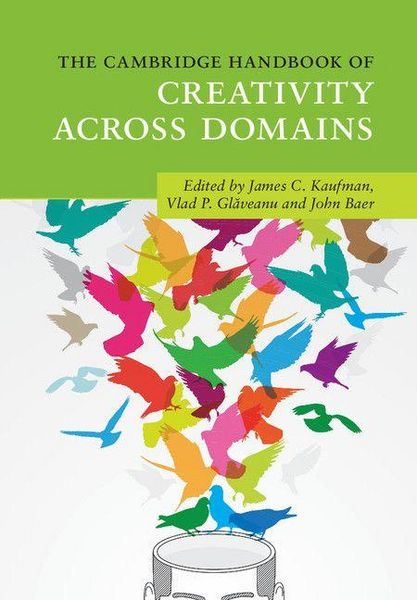
The Cambridge Handbook of Creativity across Domains

264,99 €

inkl. gesetzl. MwSt., Versandkostenfrei


Beschreibung

Produktdetails

Einband

Gebundene Ausgabe

Erscheinungsdatum

10.01.2018

Herausgeber

Kaufman James C. + weitere

Verlag

Cambridge Academic

Seitenzahl

686

Maße (L/B/H)

26/18,3/4,1 cm

Gewicht

1540 g

Sprache

Englisch

ISBN

978-1-107-11018-2

Beschreibung

Produktdetails

Einband

Gebundene Ausgabe

Erscheinungsdatum

10.01.2018

Herausgeber

Verlag

Cambridge Academic

Seitenzahl

686

Maße (L/B/H)

26/18,3/4,1 cm

Gewicht

1540 g

Sprache

Englisch

ISBN

978-1-107-11018-2

Herstelleradresse

Libri GmbH
Europaallee 1
36244 Bad Hersfeld
DE

Email: gpsr@libri.de

Kundinnen und Kunden meinen

0 Bewertungen

Informationen zu Bewertungen

Zur Abgabe einer Bewertung ist eine Anmeldung im Konto notwendig. Die Authentizität der Bewertungen wird von uns nicht überprüft. Wir behalten uns vor, Bewertungstexte, die unseren Richtlinien widersprechen, entsprechend zu kürzen oder zu löschen.

Die Bewertungen sind nach Format, Anzahl Sterne und Datum sortiert.

Verfassen Sie die erste Bewertung zu diesem Artikel

Helfen Sie anderen Kund*innen durch Ihre Meinung

Kundinnen und Kunden meinen

0 Bewertungen filtern

Die Leseprobe wird geladen.
  • Produktbild: The Cambridge Handbook of Creativity across Domains
  • Produktbild: The Cambridge Handbook of Creativity across Domains
  • Part I. Creativity and Domains: 1. Creativity across different domains: an expansive approach James C. Kaufman, Vlad Gl¿veanu and John Baer; 2. The amusement park theoretical model of creativity: an attempt to bridge the domain specificity/generality gap John Baer and James C. Kaufman; 3. Mix and match: opportunities, conditions, and limitations of cross-domain creativity Joanna Szen-Ziemiäska, Izabela Lebuda and Maciej Karwowski; 4. Domain-general creativity: on generating original, useful, and surprising combinations Dean Keith Simonton; Part II. Creativity in the Traditional Arts: 5. The creativity of literary writing Keith Oatley and Maja Djikic; 6. Creativity in the visual arts Matthew Pelowski, Helmut Leder and Pablo Tinio; 7. The creation and aesthetic appreciation of architecture Oshin Vartanian; 8. Photography and creativity Joanna Serafin and Stephen J. Dollinger; 9. The constricted muse: acting Thalia R. Goldstein and Anne G. Levy; 10. Musical creativity Aaron Kozbelt; 11. Dance Paula Thomson; Part III. Creativity in the Sciences: 12. Creativity in the physical sciences Gregory J. Feist; 13. Biomedicine, creativity, and the story of AIDS Mei Tan and Elena L. Grigorenko; 14. Creativity in psychology: finding its niche in the sciences Dean Keith Simonton; 15. Creativity in the engineering domain David H. Cropley, Arthur J. Cropley and Bree L. Sandwith; 16. Creativity in the domain of mathematics Ugur Sak, Ülkü Ayvaz, Bilge Bal-Sezerel and N. Nazl¿ Özdemir; 17. Creativity in computer science Paul Joseph Barnett and Ralf Romeike; Part IV. Creativity in Business: 18. Advertising - generating creative ideas in a complex environment Mark Kilgour; 19. Marketing Marie Taillard and Benjamin G. Voyer; 20. Creative leadership: how problem solving, decision making and organizational context influence leadership creativity Kevin Mitchell and Roni Reiter-Palmon; 21. Creativity in educational technologies Kylie Peppler; 22. Creativity in design Nathalie Bonnardel and Carole Bouchard; 23. A minimalist model for measuring entrepreneurial creativity Elias Carayannis and Phillip Harvard; Part V. Newer Domains for Creativity Research: 24. Intellectual property: does the law influence creativity? Gregory N. Mandel; 25. Gastronomy and culinary creativity Jeou-Shyan Horng and Lin Lin; 26. Tactical creativity in sport Daniel Memmert; 27. Creativity in non-human animals Allison B. Kaufman and William J. O'Hearn; 28. Violent innovation: creativity in the domain of terrorism Gina Scott Ligon, Karyn Sporer and Douglas C. Derrick; Part VI. Creativity in Everyday Life: 29. Creativity in the domain of emotions Zorana Ivcevic, Marina Ebert, Jessica D. Hoffmann and Marc A. Brackett; 30. Creativity in teaching Ronald A. Beghetto; 31. Culture and creativity Rodica Ioana Damian and Reese Tou; 32. The benefits of creativity in therapy: current evidence and future directions Marie J. C. Forgeard and Jeanette G. Elstein; 33. Creativity in the domain of play: product and processes Sandra Russ and Claire Wallace; 34. Creativity in craft Vlad Gl¿veanu; Part VI. Conclusion: 35. Taking a prospective look at creativity domains Molly Holinger, Vlad Gl¿veanu, James C. Kaufman and John Baer.