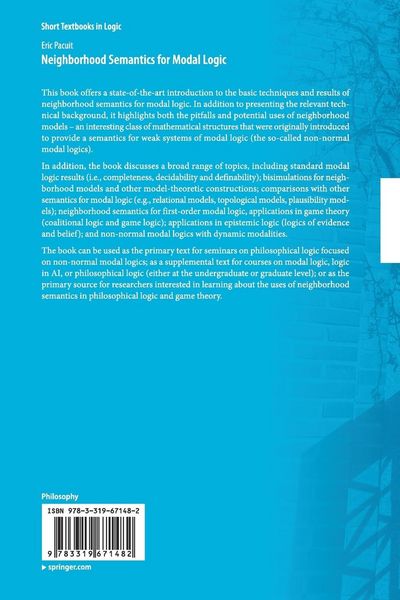
• Produktbild: Neighborhood Semantics for Modal Logic
  • Produktbild: Neighborhood Semantics for Modal Logic

Neighborhood Semantics for Modal Logic

Aus der Reihe Short Textbooks in Logic

44,99 €

inkl. gesetzl. MwSt., Versandkostenfrei


Beschreibung

Produktdetails

Einband

Taschenbuch

Erscheinungsdatum

23.11.2017

Abbildungen

XII, 17 illus., schwarz-weiss Illustrationen

Verlag

Springer

Seitenzahl

154

Maße (L/B/H)

23,5/15,5/1 cm

Gewicht

2642 g

Auflage

1st edition 2017

Sprache

Englisch

ISBN

978-3-319-67148-2

Beschreibung

Rezension

“Neighbourhood frames offer an interpretation to systems of modal logic that generalises the more traditional relational frames. … Complemented with the numerous pointers to the literature that it provides, the book will be a valuable source of information and practice for PhD students.” (Éric Martin, zbMATH 1390.03001, 2018)

“Reading and writing a review of this wonderful book has been a pleasure. Knowing the basics of propositional modal logic may explain why I enjoyed reading it. The author has gathered and surveyed many papers in writing this book. This is a must-read for those who want to do research on neighborhood semantics--after having acquired a basic knowledge of modal logic.” (Manoj K. Raut, Computing Reviews, February, 2019)

Produktdetails

Einband

Taschenbuch

Erscheinungsdatum

23.11.2017

Abbildungen

XII, 17 illus., schwarz-weiss Illustrationen

Verlag

Springer

Seitenzahl

154

Maße (L/B/H)

23,5/15,5/1 cm

Gewicht

2642 g

Auflage

1st edition 2017

Sprache

Englisch

ISBN

978-3-319-67148-2

Herstelleradresse

Springer-Verlag KG
Sachsenplatz 4-6
1201 Wien
AT

Email: GPSR Kontakt

Noch keine Bewertungen vorhanden

Verfassen Sie die erste Bewertung zu diesem Artikel

Helfen Sie anderen Kundinnen und Kunden durch Ihre Meinung.

Kundinnen und Kunden meinen

Bewertungen (0)

  • Produktbild: Neighborhood Semantics for Modal Logic
  • Produktbild: Neighborhood Semantics for Modal Logic
  • 1. Introduction and Motivation 1.1 Subset Spaces 1.2 Language and Semantics 1.3 Why Non-Normal Modal Logic? 1.4 Why Neighborhood Structures? 2. Core Theory 2.1 Expressive Power and Invariance 2.2 Alternative Semantics for Non-Normal Modal Logic 2.3 The Landscape of Non-Normal Modal Logic 2.4 Computational Issues 2.5 Frame Correspondence 2.6 Translations3. Richer Languages 3.1 Universal Modality and Nominals 3.2 First-Order Neighborhood Structures 3.3 Common Belief on Neighborhood Structures 3.4 Dynamics with Neighborhoods: Game Logic 3.5 Dynamics on Neighborhood StructuresA. Relational Semantics for Modal Logic A.1 Definability A.2 Normal Modal Logics