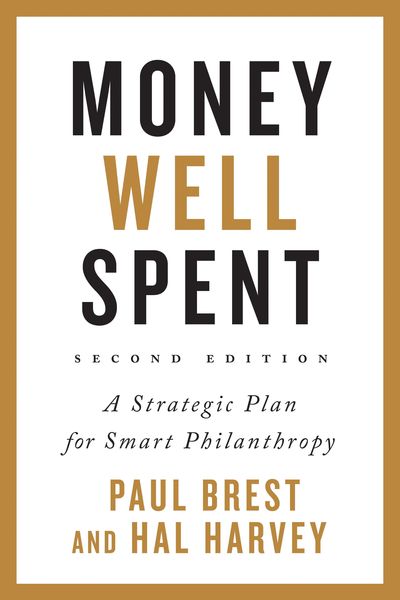
Produktbild: Money Well Spent

Money Well Spent A Strategic Plan for Smart Philanthropy

39,99 €

inkl. gesetzl. MwSt., Versandkostenfrei


Beschreibung

Produktdetails

Einband

Gebundene Ausgabe

Erscheinungsdatum

31.07.2018

Verlag

Stanford University Press

Seitenzahl

392

Maße (L/B/H)

23,6/16,1/3,8 cm

Gewicht

677 g

Auflage

2nd edition

Sprache

Englisch

ISBN

978-1-5036-0261-8

Beschreibung

Produktdetails

Einband

Gebundene Ausgabe

Erscheinungsdatum

31.07.2018

Verlag

Stanford University Press

Seitenzahl

392

Maße (L/B/H)

23,6/16,1/3,8 cm

Gewicht

677 g

Auflage

2nd edition

Sprache

Englisch

ISBN

978-1-5036-0261-8

Herstelleradresse

Libri GmbH
Europaallee 1
36244 Bad Hersfeld
DE

Email: gpsr@libri.de

Kundinnen und Kunden meinen

0 Bewertungen

Informationen zu Bewertungen

Zur Abgabe einer Bewertung ist eine Anmeldung im Konto notwendig. Die Authentizität der Bewertungen wird von uns nicht überprüft. Wir behalten uns vor, Bewertungstexte, die unseren Richtlinien widersprechen, entsprechend zu kürzen oder zu löschen.

Die Bewertungen sind nach Format, Anzahl Sterne und Datum sortiert.

Verfassen Sie die erste Bewertung zu diesem Artikel

Helfen Sie anderen Kund*innen durch Ihre Meinung

Kundinnen und Kunden meinen

0 Bewertungen filtern

  • Produktbild: Money Well Spent
  • Contents and Abstracts Introduction chapter abstract

    The Introduction describes developments since the first edition.

    1The Promise of Strategic Philanthropy chapter abstract

    The chapter introduces the framework for strategic philanthropy and provides guidance for philanthropists' determination of their interests and objectives. It provides five brief case studies of philanthropic successes and failures.

    2Problem Analysis chapter abstract

    This chapter includes defining the problem the philanthropist is trying to solve, identifying intended beneficiaries, and understanding the causes of the problem.

    3Developing Solutions chapter abstract

    Having defined the problem, the authors now consider developing possible solutions. The chosen solution is embodied in a theory of change, or logic model, which describes the activities necessary to achieve the desired outcome. To be successful, a strategy must be grounded in evidence that each step will lead to the next, and ultimately to the desired outcome.

    4From Theory to Action chapter abstract

    Designing a strategy is only the start. This chapter examines the challenges in implementing the strategychallenges sometimes created by the beneficiaries themselves, sometimes by other stakeholders, and sometimes by the external environment. The authors discuss how to identify and address implementation problems.

    5Evaluating the Impact of Your Philanthropy chapter abstract

    To characterize a strategy as "evidence-based" means that there is good reason to believe that it has impactthat it makes a difference compared to what would have occurred had the strategy not been implemented (the "counterfactual"). This chapter describes techniques for evaluating the impact of a program. It also considers the problem of generalizability, or external validitypredicting whether a strategy that worked in one time and place will work in others.

    6Using Outcome Data to Increase Your Impact chapter abstract

    This chapter examines the use of cost-benefit analysis (CBA), which compares the total costs of a program with the benefits it produces, in several contexts: charity evaluation services; a foundation's internal decision making; pay-for-success, or result-based finance, programs, in which an organization is paid for achieving agreed-upon outcomes; and a foundation's consideration of strategies that have a low probability of success.

    7Preparing to Open for Business chapter abstract

    Chapter 7 begins with framework to assist donors in choosing approaches that fit their needs and values in solving social problems and determining a focus for their philanthropy.

    8Inviting Proposals and Conducting Due Diligence chapter abstract

    The chapter focuses on funders' communications and other interactions with potential grantees, beginning with the funder's making its goals and strategies known in advance, and continuing with inviting letters of inquiry and undertaking due diligence, key aspects of which are reviewing applicants' theories of change and proposed action plans. The chapter also discusses the importance of listening, not only to grantees, but to the voices of one's intended beneficiaries.

    9Forms of Philanthropic Engagement and Funding chapter abstract

    Philanthropists can be more or less active in their engagement with grantees, and can fund grants on a spectrum that runs from providing unrestricted general operating support to an organization, to funding specific projects. This chapter proposes criteria for determining the form of support, and argues for a strong presumption favoring general operating support when the funder's interests and the organization's activities are well aligned. The chapter also argues that funders should pay full indirect costs.

    10Impact Investing and Mission Investments chapter abstract

    This chapter explores the realm of socially motivated financial investments, or so-called impact investments, which involve placing capital in enterprises that generate social or environmental goods, services, or ancillary benefits, with the goal of creating beneficial social outcomes. The investors expect financial returns ranging from the highly concessionary to market rate or even above market. For an impact investment to have impact requires that the investee enterprise have impact, along the lines examined in Chapter 5, and also that the investment increases or improves the investee's socially valuable outputs or practices, that is: the investment has "additionality," or create social value. We consider these issues from the perspective of an individual investor as well as that of a foundation making program related investment (PRIs), mission related investment (MRIs), or socially responsible investment (SRIs).

    11Working With Others in the Field chapter abstract

    Philanthropists work with many others-including grantee organizations, governments, businesses and other philanthropists-and, crucially, with the people their programs are intended to help. The chapter considers methods of co-funding and collaborating with other philanthropists, developing and disseminating knowledge, and supporting the field of philanthropy.

    12Principles and Practices of Effective Philanthropy chapter abstract

    The chapter considers philanthropists' roles in supporting the development and dissemination of two fundamentally different forms of knowledge: knowledge that is basic, theoretical, and has no immediate consequence but to satisfy people's eternal curiosity; and practical knowledge that has foreseeable useful applications. With respect to the second, it examines the process of creating knowledge. The chapter also examines the use of prizes to induce and recognize innovation, and the role of philanthropy in building fields.

    13Promoting Knowledge chapter abstract

    The chapter has three major parts, the first two of which consider related ways to improve individuals' welfare: influencing their behavior and providing goods and services. The third part examines philanthropists' support of service-delivery organizations from the start-up phase through so-called "venture philanthropy," to maturity.

    14Improving Individual Lives chapter abstract

    The chapter focuses on efforts to change public policy and business practices, and ends with a section on social movements, including case studies of the advocacy leading to the enactment of the Affordable Care Act ("Obamacare"), of political activism in two states, of the movement for cage-free eggs, and of conservative and progressive social movements. The chapter includes pointers on advocacy.

    15Influencing Policy Makers and Businesses chapter abstract

    This chapter considers the features of various organizational structures-from writing checks at your kitchen table to establishing a foundation staffed with program officers- for undertaking philanthropy, with the goal of contributing to your social impact while meeting other personal and financial needs. It considers four major structures: one's checkbook, limited liability companies (LLCs), donor advised funds (DAFs), and foundations.

    16Structures for Philanthropy chapter abstract

    This chapter examines the considerations that would guide a philanthropist in deciding whether to preserve his or her philanthropic assets for the future or spend them sooner. These include the needs of the present versus those of the future, the growth rate of one's financial assets versus the escalation of the problem one seeks to address, and how much trust one has in future generations

    Afterword: The Responsibilities of Strategic Philanthropy chapter abstract

    A brief afterword argues that the extraordinary freedom enjoyed by philanthropists comes with certain responsibilities. Without shying away from seeking major social change, philanthropists should undertake their work with appreciation of its empirical uncertainties and complexities, with mindfulness of the potential for collateral damage, and with respect for those on the other side of the issue.

    17Principal and Principle: Foundation Spending Policies chapter abstract

    This chapter examines the considerations that would guide a philanthropist in deciding whether to preserve his or her philanthropic assets for the future or spend them sooner. These include the needs of the present versus those of the future, the growth rate of one's financial assets versus the escalation of the problem one seeks to address, and how much trust one has in future generations