Rezension
“
Media and Transnational Climate Justice
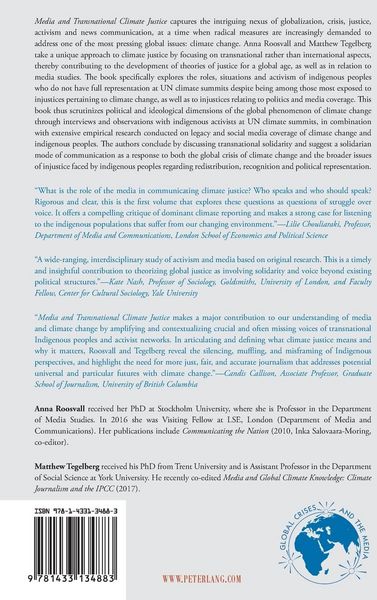
makes a major contribution to our understanding of media and climate change by amplifying and contextualizing crucial and often missing voices of transnational Indigenous peoples and activist networks. In articulating and defining what climate justice means and why it matters, Roosvall and Tegelberg reveal the silencing, muffling, and misframing of Indigenous perspectives, and highlight the need for more just, fair, and accurate journalism that addresses potential universal and particular futures with climate change.”—Candis Callison, Associate Professor, Graduate School of Journalism, University of British Columbia
“
Media and Transnational Climate Justice
puts indigenous voices at the center of how we understand climate justice, offering an expansive analysis of transnational solidarity and the ways that it shapes and is shaped by sophisticated forms and practices of media activism. By combining the experiences of indigenous media activists, analysis of indigenous representations in legacy news, and fresh theoretical insight that challenge dominant climate politics, this exceptionally thoughtful and well researched book offers a blueprint for media justice. It is an essential read not only for those seeking to understand and reform climate politics but also for those interested in the ways media can support rather than undermine justice.”—Adrienne Russell, Mary Laird Wood Professor of Journalism and the Environment, University of Washington
“This is a terrific book, deeply unsettling yet ultimately hopeful. Carefully argued, innovatively researched, and written with fierce optimism, it seeks to reframe and revision a prevailing understanding of climate change. It endeavours to add new and necessary voices to a conversation that has been lopsided and too often has ignored Indigenous input. Read it!”—Mark Cronlund Anderson, Professor in the Department of History, University of Regina
“A wide-ranging, interdisciplinary study of activism and media based on original research. This is a timely and insightful contribution to theorizing global justice as involving solidarity and voice beyond existing political structures.”—Kate Nash, Professor of Sociology, Goldsmiths, University of London, and Faculty Fellow, Center for Cultural Sociology, Yale University
“What is the role of the media in communicating climate justice? Who speaks and who should speak? Rigorous and clear, this is the first volume that explores these questions as questions of struggle over voice. It offers a compelling critique of dominant climate reporting and makes a strong case for listening to the indigenous populations that suffer from our changing environment.”—Lilie Chouliaraki, Professor, Department of Media and Communications, London School of Economics and Political Science