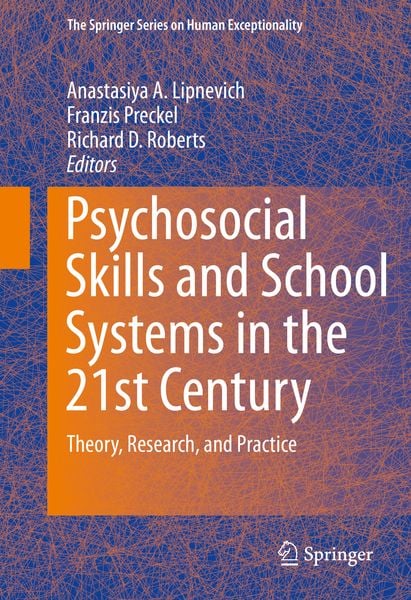
Produktbild: Psychosocial Skills and School Systems in the 21st Century
- 10%

Psychosocial Skills and School Systems in the 21st Century Theory, Research, and Practice

10% sparen

76,99 € UVP 85,59 €

inkl. gesetzl. MwSt., Versandkostenfrei


Beschreibung

Produktdetails

Einband

Taschenbuch

Erscheinungsdatum

15.09.2017

Abbildungen

XXI, 12 illus., 2 illus. in color., farbige Illustrationen, schwarz-weiss Illustrationen

Herausgeber

Anastasiya A. Lipnevich + weitere

Verlag

Springer

Seitenzahl

401

Maße (L/B/H)

23,5/15,5/2,3 cm

Gewicht

639 g

Auflage

1st edition 2016

Sprache

Englisch

ISBN

978-3-319-68036-1

Beschreibung

Portrait

Anastasiya Lipnevich, Ph.D. , is an Associate Professor of Educational Psychology at Queens College and the Graduate Center of the City University of New York. Her research interests include instructional feedback, attitudes toward mathematics, alternative approaches to non-cognitive assessment, academic emotions, and the role of psychosocial characteristics in individuals’ academic and life achievement. Dr. Lipnevich has over 40 publications in refereed journals and edited volumes, has delivered more than 60 conference presentations and invited addresses, has chaired 10 symposia, serves on several editorial boards, and has co-edited several special issues in flagship journals. Dr. Lipnevich’s professional honors include, among others, Excellence in Dissertation Award from Rutgers University, the New Investigator Award 2010 from Division 3 (Experimental Psychology) of the American Psychological Association, and Postdoctoral Fellowship from Educational Testing Service. Franzis Preckel, Ph.D. , is Professor for Giftedness Research and Education at the Department of Psychology of the University of Trier, Germany. Her main research interests are intelligence (assessment and structural analysis), giftedness (fostering options and program evaluation), cognitive motivation (development and predictive validity for academic achievement), self-concept (development and reference group effects), and the influence of chronotypes on student learning and achievement. Dr. Preckel has edited or coauthored 19 books and she published 46 articles in peer-refereed journals as well as 15 book chapters. She is coauthor of 5 intelligence tests and 2 self-report scales on academic anxiety and on cognitive motivation. She has presented her research in more than 80 talks and is on the editorial board of Diagnostica and Gifted and Talented International. 

Richard D. Roberts, Ph.D. , is Vice President and Chief Scientist, Centerfor Innovative Assessments, Professional Examination Service, New York, New York. A former National Research Council Fellow who conducted research at Brooks Air Force Base (1996-1998), he has also been a Senior Lecturer at The University of Sydney (1998-2003), and a Managing Principal Research Scientist at the Educational Testing Service (2003-2014). His main area of specialization is measurement, with a special emphasis on developing and researching innovative new items types for the assessment of both cognitive and noncognitive factors, as well as constructs that have elements that straddle these two domains (e.g., emotional intelligence). Dr. Roberts has co-authored over a dozen books, and about 200 peer-review articles and book chapters on these topics in diverse sub-disciplines (including, education, psychology, business, medicine, health policy, and wind engineering), with nearly 400 presentations across the globe. Among Dr. Roberts’ professional honors are two ETS PresidentialAwards, two PROSE book awards, and various early (and then later) career awards. He is currently Secretary-Treasurer of the International Society for the Study of Individual Differences and serves on the boards of various international journals and organizations.

Produktdetails

Einband

Taschenbuch

Erscheinungsdatum

15.09.2017

Abbildungen

XXI, 12 illus., 2 illus. in color., farbige Illustrationen, schwarz-weiss Illustrationen

Herausgeber

Verlag

Springer

Seitenzahl

401

Maße (L/B/H)

23,5/15,5/2,3 cm

Gewicht

639 g

Auflage

1st edition 2016

Sprache

Englisch

ISBN

978-3-319-68036-1

Herstelleradresse

Springer-Verlag GmbH
Tiergartenstr. 17
69121 Heidelberg
DE

Email: ProductSafety@springernature.com

Kundinnen und Kunden meinen

0 Bewertungen

Informationen zu Bewertungen

Zur Abgabe einer Bewertung ist eine Anmeldung im Konto notwendig. Die Authentizität der Bewertungen wird von uns nicht überprüft. Wir behalten uns vor, Bewertungstexte, die unseren Richtlinien widersprechen, entsprechend zu kürzen oder zu löschen.

Die Bewertungen sind nach Format, Anzahl Sterne und Datum sortiert.

Verfassen Sie die erste Bewertung zu diesem Artikel

Helfen Sie anderen Kund*innen durch Ihre Meinung

Kundinnen und Kunden meinen

0 Bewertungen filtern

  • Produktbild: Psychosocial Skills and School Systems in the 21st Century
  • Part 1: General Background: Theory and Guiding Principles.- Chapter 1. Psychosocial Skills: Psychosocial Skills: Essential Components of Development and Achievement in K-12.- Chapter 2. Test Standards and Psychometric Modeling.- Chapter 3. Aligning Mission and Measurement.- Chapter 4. Personality Development During the School-Aged Years: Implications for Theory, Research, and Practice.- Part 2: Psychosocial Skills: Key Constructs.- Chapter 5. The Need for Cognition: Key Concepts, Assessment, and Role in Educational Outcomes.- Chapter 6. Understanding Creativity in the Schools.- Chapter 7. Conscientiousness in Education: Its Conceptualization, Assessment, and Utility.- Chapter 8. Self-Concept: Determinants and Consequences of Academic Self-Concept in School Concepts.- Chapter 9. Applying Social Cognitive Theory in the Development of Self-Regulated Competencies Throughout K-12 Grades.- Chapter 10. Student Motivation: Current Theories, Constructs, and Interventions within an Expectancy-Value Framework.- Chapter 11. Academic Emotions and Their Regulations via Emotional Intelligence.- Part 3: Psychosocial Skills: Applications.- Chapter 12. Fostering Psychosocial Skills: School-Based Promotion of Resiliency in Children and Adolescents.- Chapter 13. Teaching Emotional Intelligence in Schools: An Evidence-Based Approach.- Chapter 14. Psyhosocial Skills in Large-Scale Assessments: Trends, Challenges, and Policy Implications.- Part 4: Conclusions.- Chapter 15. Psychosocial Constructs: Knowns, Unknowns, and Where do we go From Here?.