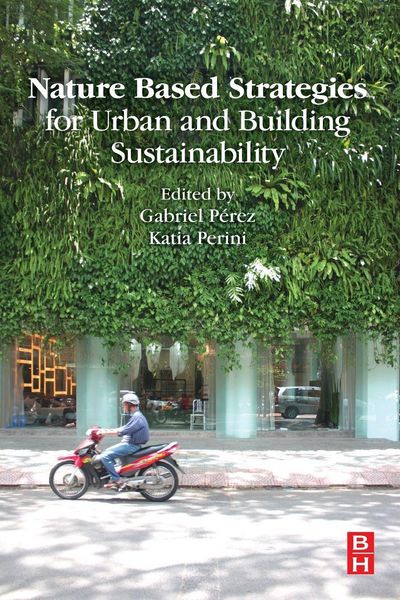
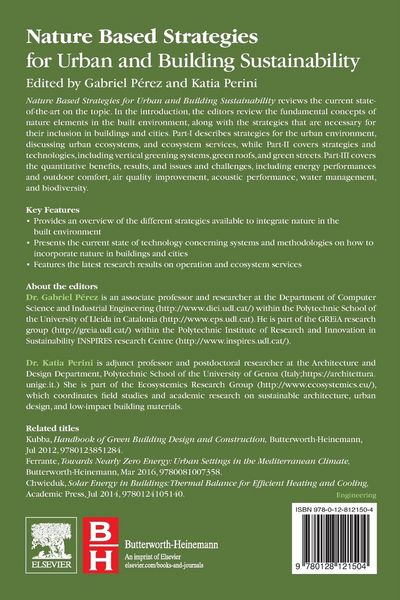
• Produktbild: Nature Based Strategies for Urban and Building Sustainability
  • Produktbild: Nature Based Strategies for Urban and Building Sustainability

Nature Based Strategies for Urban and Building Sustainability

117,99 €

inkl. gesetzl. MwSt., Versandkostenfrei


Beschreibung

Produktdetails

Einband

Taschenbuch

Erscheinungsdatum

16.02.2018

Herausgeber

Gabriel Perez + weitere

Verlag

Elsevier Science & Technology

Seitenzahl

392

Maße (L/B/H)

22,9/15,2/2,1 cm

Gewicht

524 g

Sprache

Englisch

ISBN

978-0-12-812150-4

Beschreibung

Portrait

Dr.

He received his PhD from Polytechnic University of Catalonia (2010), in the PhD program "Research in energy and environment for architecture”, as well degrees from Agronomist engineer University of Lleida (1995) and, Agricultural engineer Polytechnic University of Catalonia (1993).
He has lectured at the University of Lleida (Escola Politècnica Superior de la Universitat de Lleida) for 17 years, providing core information for Master's students working in the areas of Applied Sciences for Engineering as well as in the Building Information Modelling (BIM)

He is currently the Deputy Director of Student, Promotion and Quality within the Polytechnic School of the University of Lleida in Catalonia in the mechanical engineering and technical architecture programs.

His main areas of research that he has been developed during last seven years refer to the use of greenery integrated to buildings, essentially the roofs and green facades, as a tool to provide ecosystem services both at building and urban scales.

He is also involved in research related to sustainable construction and environmental impact in the building sector. He has currently 25 scientific indexed publications, with 658 citations and an index h of 12. Katia Perini is adjunct professor and postdoctoral researcher at the Architecture and Design Department , Polytechnic School of the University of Genoa (Italy). Katia graduated with honours at the Faculty of Architecture of Genoa in March 2008. In 2012, Katia defended with success her PhD dissertation, "The Integration of Vegetation in Architecture. Innovative Methods and Tools”, at the University of Genoa. Katia collaborated with the Delft University of Technology as guest researcher. In 2013, Katia Perini was selected as a Fulbright grantee and completed a research project at the Urban Design Lab of Columbia University, regarding the sustainability of urban areas, focusing on New York City as case study. In 2016, Katia Perini conducted a two-month research period, with a research project entitled: "Climate landscape. A new approach to urban design and landscape architecture” at the Technische Universität München (TUM), Chair of Building Technology and Climate Responsive Design as visiting scholar thanks to a DAAD personal award. Katia Perini research interests include all the effects of vegetation (green infrastructure and green envelopes) in the field of environmental and economic sustainability in (of) urban areas and building/urban design.

Produktdetails

Einband

Taschenbuch

Erscheinungsdatum

16.02.2018

Herausgeber

Verlag

Elsevier Science & Technology

Seitenzahl

392

Maße (L/B/H)

22,9/15,2/2,1 cm

Gewicht

524 g

Sprache

Englisch

ISBN

978-0-12-812150-4

EU-Ansprechpartner

Kolibri 360 GmbH
Ettore-Bugatti-Straße 6-14
51149 Köln
DE
produktsicherheit@kolibri360.de

Herstelleradresse

Elsevier Science & Technology
125 London Wall
EC2Y 5AS London
GB
tradeorders@elsevier.com

Noch keine Bewertungen vorhanden

Verfassen Sie die erste Bewertung zu diesem Artikel

Helfen Sie anderen Kundinnen und Kunden durch Ihre Meinung.

Kundinnen und Kunden meinen

Bewertungen (0)

Die Leseprobe wird geladen.
  • Produktbild: Nature Based Strategies for Urban and Building Sustainability
  • Produktbild: Nature Based Strategies for Urban and Building Sustainability
  • Introduction: scale matters and relevanceSection 1: Nature based strategies for urban environmentSection 2: Nature based strategies and technologiesSection 3: Nature based strategies: benefits and challengesSection 4: Nature based strategies: social, economic and environmental sustainabilitySummary: suggestions for further research and marker development