• Produktbild: Feminist Perspectives on Building a Better Psychological Science of Gender
  • Produktbild: Feminist Perspectives on Building a Better Psychological Science of Gender
- 10%

Feminist Perspectives on Building a Better Psychological Science of Gender

10% sparen

85,99 € UVP 96,29 €

inkl. gesetzl. MwSt., Versandkostenfrei


Beschreibung

Produktdetails

Einband

Taschenbuch

Erscheinungsdatum

29.09.2017

Abbildungen

XIII, 3 illus., schwarz-weiss Illustrationen

Herausgeber

Tomi-Ann Roberts + weitere

Verlag

Springer

Seitenzahl

391

Maße (L/B/H)

23,5/15,5/2,3 cm

Gewicht

616 g

Auflage

1st ed. 2016

Sprache

Englisch

ISBN

978-3-319-68955-5

Beschreibung

Portrait

Tomi-Ann Roberts

Tomi-Ann Roberts is Professor and Chair of Psychology at Colorado College, where she teaches courses on gender, feminist research methodologies, personality and emotions. Her research focuses on the psychological consequences of the sexualization and objectification of girls and women. The first paper she co-authored on this topic is the most cited article in the 35-year history of the journal Psychology of Women Quarterly. She served on the American Psychological Association's Task Force on the Sexualization of Girls, is coauthor of the Sexualization of Girls and Girlhood: Causes, Consequences and Resistance (Oxford), and continues to work on both empirical research, applied consulting work, and advocacy efforts to improve the lives of girls and women by enhancing their relationship to their embodied selves.

Nicola Curtin

Nicola Curtin is an Assistant Professor of Psychology at Clark University and Visiting Research Associate at theWomen’s Studies Research Center at Brandeis University. Her primary line of research examines the roles of life experiences, individual differences, and social identities in commitments to creating social change, with a particular emphasis on ally and coalitional activism. She explores the development of social change attitudes and behaviors across different social contexts, with a focus on United States identity-based rights activism. In a secondary line of research, she examines perceptions of fit and success in academia, focusing on the role of marginal statuses (such as being a working class or international student), advisor support, and academic and professional experiences among graduate students and post-doctoral fellows. In both lines of research she is concerned with how one’s social group membership can combine with other features of the social context to generate positive outcomes.

Lauren E. Duncan

Lauren E. Duncan is Professor of Psychology at Smith College. She earned degrees in Personality Psychology and Women's Studies and teaches courses in the Psychology of Women and Gender, Political Psychology, and the Psychology of Political Activism. Her research interests include understanding how social events shape people’s life outcomes and how individuals become motivated to change society or maintain the status quo. She is teaching a free MOOC (massive open online course) called  Psychology of Political Activism: Women Changing the World  on the edX platform and is currently working on a psychobiography of Gloria Steinem for an Oxford series on Inner Lives. She is a Fellow of the Society for the Psychological Study of Social Issues (APA Division 9).

Lilia M. Cortina

Lilia M. Cortina is Professor of Psychology, Women’s Studies, and (by courtesy) Management & Organizations at the University of Michigan. Her research revolves around workplace victimization, which can range from subtle social slights to general disrespect to blatant harassment and violence. One line of this work addresses harassment based on sex, sexuality, and gender - focusing on the contours and consequences of harassing experiences. In another research stream, Lilia investigates workplace incivility: everyday rude, condescending, and ostracizing acts that violate social norms of respect. In addition, she periodically serves as an expert witness, translating findings from science to inform policy and legal decision-making surrounding sexual harassment. In recognition of unusual and outstanding contributions to the field, Professor Cortina has been named Fellow of the American Psychological Association and the Society for Industrial/Organizational Psychology.

Produktdetails

Einband

Taschenbuch

Erscheinungsdatum

29.09.2017

Abbildungen

XIII, 3 illus., schwarz-weiss Illustrationen

Herausgeber

Verlag

Springer

Seitenzahl

391

Maße (L/B/H)

23,5/15,5/2,3 cm

Gewicht

616 g

Auflage

1st ed. 2016

Sprache

Englisch

ISBN

978-3-319-68955-5

Herstelleradresse

Springer-Verlag KG
Sachsenplatz 4-6
1201 Wien
AT

Email: GPSR Kontakt

Noch keine Bewertungen vorhanden

Verfassen Sie die erste Bewertung zu diesem Artikel

Helfen Sie anderen Kundinnen und Kunden durch Ihre Meinung.

Kundinnen und Kunden meinen

Bewertungen (0)

  • Produktbild: Feminist Perspectives on Building a Better Psychological Science of Gender
  • Produktbild: Feminist Perspectives on Building a Better Psychological Science of Gender
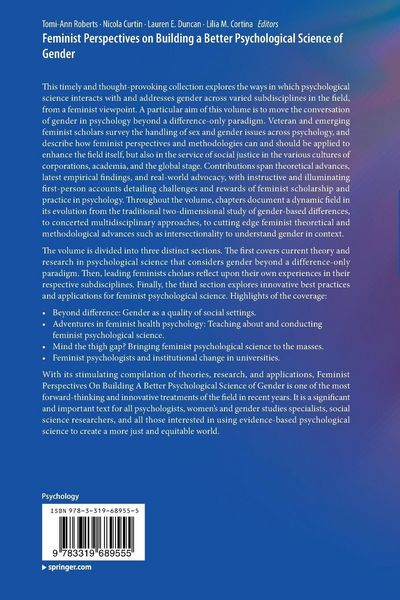
  • Foreword: Feminist Psychological Science and the Future of Gender Research Stephanie A. ShieldsChapter 1: Introduction: Building a Better Psychological Science of Gender: Reflections on Theory, Research and Action Lauren E. Duncan, Tomi-Ann Roberts, Lilia M. Cortina and Nicola CurtinSection I: Theory and Research Taking Gender Beyond DifferenceChapter 2: Scientific Weightism: A View of Mainstream Weight Stigma Research Through a Feminist Lens Rachel M. Calogero, Tracy L. Tylka, and Janell L. MensingerChapter 3: Death and the Real Girl: The Impact of Mortality Salience on Men’s Attraction to Women as Objects Jamie L. Goldenberg and Kasey Lynn MorrisChapter 4: Embodiment and Well Being: The Embodied Journeys of Girls and Women Niva PiranChapter 5: Feminist Perspectives on Gender Development: Contributions to Theory and Practice   Christia Spears Brown and Rebecca S. BiglerChapter 6: Feminism and the Study of Masculinity: Unlikely Bedfellows? Jennifer K. BossonChapter 7: Gendered Autobiographical Memory: Feminist Approaches to Theory and Method Robyn Fivush and Azriel GrysmanChapter 8: The Development of Other-Gender Interactions: Behavioral, Biological, Cognitive, and Contextual Influences< Ryan D. Field and Carol Lynn MartinSection II: Feminist Psychologists Reflect on Research in Their SubdisciplinesChapter 9: Digging Deeper: Research Practices and Recommendations for Exploring Intersectionality and Social and Cultural Influences on Personality, Identity, and Well-Being Natalie J. SabikChapter 10: Adventures in Feminist Health Psychology: Teaching About and Conducting Feminist Psychological Science Joan C. Chrisler and Jennifer A. GormanChapter 11: Intersectionality: Infusing I-O Psychology with Feminist Thought Verónica Caridad Rabelo and Lilia M. CortinaChapter 12: Voicing Academia:  Developmental Psychology and the Loss of Voice Patricia L. WatersChapter 13: New Perspectives on Gender and EmotionKaitlin T. McCormick, Heather J. MacArthur, Stephanie A. Shields, and Elaine C. Dicicco,Chapter 14: Beyond Difference: Gender as a Quality of Social Settings Meg A. Bond and Christopher T. AllenSection III: From Theory and Research to Action: Best Practices in Feminist Psychological ScienceChapter 15:  Replacing Sexy and Skinny with Strong and Powerful: How Feminist Research on Media Depictions of Women can Effect Change Elizabeth A. DanielsChapter 16: Mind the Thigh Gap? Bringing Feminist Psychological Science to the Masses Tomi-Ann RobertsChapter 17: Transnational Feminism in Psychology: Moving Beyond Difference to Investigate Processes of Power at the Intersection of the Global and Local  Shelly GrabeChapter 18: Feminist Psychologists and Institutional Change in Universities Abigail J. StewartChapter 19: Walking The Walk: Conducting Feminist Community-Based Research  Britney G. BrinkmanChapter 20: The Benefits and Risks of Feminist Practice as Early Career Scholars in Social Psychology Nicola Curtin, Laura Ramsey and Julia TranChapter 21: Conclusion: Adventures in Feminist Psychological Science: Lessons Learned and a Look to What Lies Ahead Nicola Curtin, Lilia M. Cortina, Tomi-Ann Roberts and Lauren E. Duncan