• Produktbild: Oxford Textbook of Attention Deficit Hyperactivity Disorder
  • Produktbild: Oxford Textbook of Attention Deficit Hyperactivity Disorder

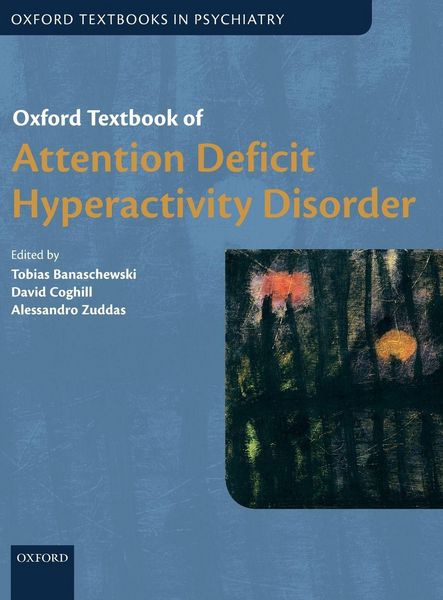
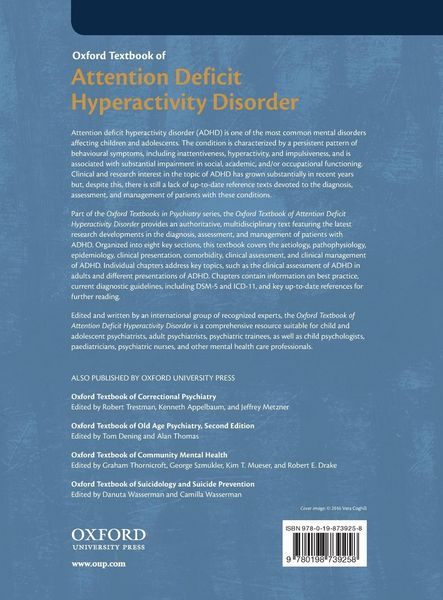
Oxford Textbook of Attention Deficit Hyperactivity Disorder

228,99 €

inkl. gesetzl. MwSt., Versandkostenfrei


Beschreibung

Produktdetails

Einband

Gebundene Ausgabe

Erscheinungsdatum

10.04.2019

Herausgeber

Banaschewski Tobias + weitere

Verlag

Oxford University Press

Seitenzahl

472

Maße (L/B/H)

28,6/22,1/3 cm

Gewicht

1437 g

Sprache

Englisch

ISBN

978-0-19-873925-8

Beschreibung

Rezension

This book is unique in that it comprehensively covers all aspects of ADHD. Any professional could find exactly what they required in this book without having to go to a different resource. BMA reviewing panel, BMA Medical Book Awards 2019

Produktdetails

Einband

Gebundene Ausgabe

Erscheinungsdatum

10.04.2019

Herausgeber

Verlag

Oxford University Press

Seitenzahl

472

Maße (L/B/H)

28,6/22,1/3 cm

Gewicht

1437 g

Sprache

Englisch

ISBN

978-0-19-873925-8

Herstelleradresse

Libri GmbH
Europaallee 1
36244 Bad Hersfeld
DE

Email: gpsr@libri.de

Noch keine Bewertungen vorhanden

Verfassen Sie die erste Bewertung zu diesem Artikel

Helfen Sie anderen Kundinnen und Kunden durch Ihre Meinung.

Kundinnen und Kunden meinen

Bewertungen (0)

Die Leseprobe wird geladen.
  • Produktbild: Oxford Textbook of Attention Deficit Hyperactivity Disorder
  • Produktbild: Oxford Textbook of Attention Deficit Hyperactivity Disorder
    • SECTION I. Introduction
    • 1: Eric Taylor: Development of the concept
    • 2: Stephen P. Hinshaw and Richard M. Scheffler: ADHD in the 21st century: Biology, context, policy, and the need for integrative perspectives
    • SECTION II. Aetiology and pathophysiology
    • 3: Kate Langley: ADHD genetics
    • 4: Edmund-Sonuga-Barke and Gordon Harold: Conceptualizing and investigating the role of the environment in ADHD: Correlate, cause, consequence, context and treatment
    • 5: Barbara Franke and Jan K. Buitelaar: Gene-environment interactions
    • 6: Kerstin Konrad, Adriana di Martino, and Yuta Aoki: Brain volumes and intrinsic brain connectivity in ADHD
    • 7: Katya Rubia: ADHD brain function
    • 8: Philip Shaw and Eszter Szekely: Insights from neuroanatomic imaging into ADHD throughout the lifespan
    • 9: Daniel Brandeis, Sandra Loo, Grainne McLoughlin, Hartmut Heinrich, and Tobias Banaschewski,: Neurophysiology
    • 10: David Coghill, Maggie Toplak, Sinead Rhodes, and Nicoletta Adamo: Cognitive functioning in ADHD: Inhibition, memory, temporal discounting, decision making, timing, and reaction time variability
    • 11: Celine Ryckaert, Jonna Kuntsi, and Philip Asherson: Emotional dysregulation and ADHD
    • 12: Sarah O Neill, Jeffrey M. Halperin, and David Coghill: Neuropsychological functioning and ADHD: A developmental perspective
    • SECTION III. Epidemiology
    • 13: Guilherme V. Polanczyk: Epidemiology
    • SECTION IV. Clinical Presentation
    • 14: Luis Augusto Rohde, Christian Kieling, and Giovanni Abrahão Salum: Current diagnostic criteria: DSM, ICD, and future perspectives
    • 15: Stephen P. Becker and Russell A. Barkley: Sluggish cognitive tempo
    • 16: Corina U. Greven, Jennifer. S. Richards, and Jan K. Buitelaar: Sex differences in ADHD
    • 17: Melissa Mulraney and David Coghill: Quality of life and impairment in ADHD
    • 18: Marios Adamou: Adult ADHD and employment
    • 19: Philip Asherson, Josep Antoni Ramos-Quiroga, and Susan Young: Adult ADHD: Clinical presentation and assessment
    • SECTION V. Comorbidity
    • 20: Anita Thapar and Stephanie van Goozen: Conduct disorder in ADHD
    • 21: Melissa Mulraney, Argyris Stringaris, and Eric Taylor: Irritability, disruptive mood, and ADHD
    • 22: Cristal Oxley and Argyris Stringaris: Comorbidity: Depression and anxiety
    • 23: Timothy Wilens, Nicholas Carrellas, and Joseph Biederman,: ADHD and substance misuse
    • 24: Sven Bölte, Luise Poustka, and Hilde Geurts: Autism spectrum disorder
    • 25: Emily Simonoff: Intellectual impairment and neurogenetic disorders
    • 26: Aribert Rothenberger, Andreas Becker, Lillian-Geza Rothenberger, and Veit Roessner: Influence of tics and/or obsessive-compulsive behaviour on the phenomenology of ADHD
    • 27: Christopher Gillberg, Elisabeth Fernell, I. Carina Gillberg, and Björn Kadesjö: Developmental coordination disorder
    • 28: Rosemary Tannock: ADHD and communication disorders
    • 29: Erik G. Willcutt: ADHD and reading disorder
    • 30: Melissa Mulraney, Emma Sciberras, and Michel Lecendreux: ADHD and sleep
    • 31: Samuele Cortese and Marcel Romanos: The relationship of ADHD to obesity and allergy
    • SECTION VI. Clinical Assessment
    • 32: Marina Danckaerts and David Coghill: Children and adolescents: Assessment in everyday clinical practice
    • 33: Sandra Kooij, Philip Asherson, and Michael Rösler: ADHD in adults, assessment issues
    • SECTION VII. Interventions
    • 34: Jim Swanson: Long-term outcomes in the multimodal treatment study of children with ADHD
    • 35: David Daley and Saskia Van der Oord: Behavioural interventions for preschool ADHD
    • 36: Manfred Döpfner and Saskia van der Oord: Cognitive-behavioural treatment in childhood and adolescence
    • 37: Alexandra Philomena Lam and Alexandra Philipsen: Behavioural (adolescent / adult)
    • 38: Edmund Sonuga-Barke and Samuele Cortese: Cognitive training approaches for ADHD: Can they be made more effective?
    • 39: Martin Holtmann, Björn Albrecht, and Daniel Brandeis: Neurofeedback
    • 40: Jan K. Buitelaar, Nanda Rommelse, Verena Ly, and Julia J. Rucklidge: Nutritional intervention for ADHD
    • 41: Alessandro Zuddas, Tobias Banaschewski, David Coghill, and Mark A. Stein: ADHD treatment: Psychostimulants
    • 42: Ralf W. Dittmann, Alexander Häge, Juan D. Pedraza, and Jeffrey H. Newcorn: Non-stimulants in the treatment of ADHD
    • 43: Chris Hollis: ADHD and transitions to adult mental health services
    • 44: Christine Merrell and Kapil Sayal: ADHD and school
    • SECTION VIII. Clinical Management
    • 45: David Coghill and Marina Danckaerts: Organizing and delivering treatment for ADHD
    • 46: Philip Asherson and Josep Antoni Ramos-Quiroga: Treatment in Adult ADHD
    • 47: David Coghill, Alessandro Zuddas, Luis Augusto Rohde, and Tobias Banaschewski: The next steps: Future clinical and research developments in ADHD