
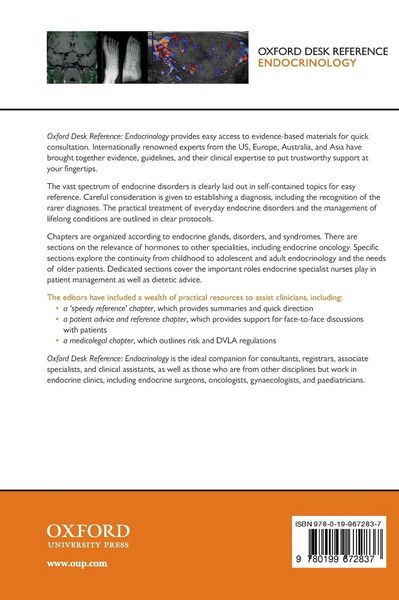
• Produktbild: Oxford Desk Reference
  • Produktbild: Oxford Desk Reference

Oxford Desk Reference Shortlisted for the Internal Medicine category of the British Medical Association Book Awards 2019

157,99 €

inkl. gesetzl. MwSt., Versandkostenfrei


Beschreibung

Produktdetails

Einband

Gebundene Ausgabe

Erscheinungsdatum

29.03.2018

Herausgeber

Helen E. Turner + weitere

Verlag

Oxford University Press

Seitenzahl

544

Maße (L/B/H)

26/18,3/3,4 cm

Gewicht

1254 g

Sprache

Englisch

ISBN

978-0-19-967283-7

Beschreibung

Rezension

This is an excellent book for its selected audience ... I will certainly recommend this to my colleagues and trainees. BMA reviewing panel, BMA Medical Book Awards 2019

Produktdetails

Einband

Gebundene Ausgabe

Erscheinungsdatum

29.03.2018

Herausgeber

Verlag

Oxford University Press

Seitenzahl

544

Maße (L/B/H)

26/18,3/3,4 cm

Gewicht

1254 g

Sprache

Englisch

ISBN

978-0-19-967283-7

Herstelleradresse

Libri GmbH
Europaallee 1
36244 Bad Hersfeld
DE

Email: gpsr@libri.de

Kundinnen und Kunden meinen

0 Bewertungen

Informationen zu Bewertungen

Zur Abgabe einer Bewertung ist eine Anmeldung im Konto notwendig. Die Authentizität der Bewertungen wird von uns nicht überprüft. Wir behalten uns vor, Bewertungstexte, die unseren Richtlinien widersprechen, entsprechend zu kürzen oder zu löschen.

Die Bewertungen sind nach Format, Anzahl Sterne und Datum sortiert.

Verfassen Sie die erste Bewertung zu diesem Artikel

Helfen Sie anderen Kund*innen durch Ihre Meinung

Kundinnen und Kunden meinen

0 Bewertungen filtern

Die Leseprobe wird geladen.
  • Produktbild: Oxford Desk Reference
  • Produktbild: Oxford Desk Reference
    • 1 Principles of Endocrinology

    • 1.1: Hormones, Receptors and signalling

    • 1.2: Hormone measurements: Assays

    • 1.3: Hormone measurements: Hormone Binding Proteins

    • 1.4: Hormone measurements: Biological Matrices for Hormone Measurement

    • 1.5: Autoimmunity and the Endocrine System

    • 1.6: Genetic Endocrine Disorders

    • 1.7: Geographic and Ethnic Variation in Endocrine Disorders

    • 2 Thyroid Hormone Metabolism

    • 2.1: Anatomy and physiology

    • 2.2: Thyroid Investigations

    • 2.3: Imaging and Localisation of the Thyroid

    • 2.4: Approach to the assessment of disorders of thyroid hormone homeostasis

    • 2.5: Hyperthyroidism

    • 2.6: Thyroiditis

    • 2.7: Hypothyroidism

    • 2.8: Thyroid Nodules and Cancer

    • 3 Pituitary Gland

    • 3.1: Anatomy and Physiology

    • 3.2: Genetic testing for pituitary adenomas

    • 3.3: Pituitary Imaging and Localisation

    • 3.4: Approach to the assessment of disorders of pituitary hormone homeostasis

    • 3.5: Prolactinomas

    • 3.6: Acromegaly

    • 3.7: Cushing s disease

    • 3.8: Non-Functioning Pituitary Tumours

    • 3.9: Gonadotroph adenomas

    • 3.10: Thyrotrophinomas

    • 3.11: Pituitary Incidentalomas

    • 3.12: Pituitary Carcinoma

    • 3.13: Craniopharyngioma and Perisellar Cysts

    • 3.14: Pituitary Apoplexy

    • 3.15: Surgical Treatment

    • 3.16: Pituitary Radiotherapy

    • 3.17: Parasellar Pituitary Conditions

    • 4 Posterior Pituitary Gland

    • 4.1: Diabetes Insipidus

    • 4.2: Hyponatraemia

    • 4.3: Syndrome of inappropriate ADH (SIADH)

    • 4.4: Disorders of Hypothalamic Function

    • 5 Pineal Gland

    • 5.1: Melatonin and Pineal Tumours

    • 6 Adrenal Gland

    • 6.1: Adrenal Anatomy and Physiology

    • 6.2: Laboratory Investigation of Adrenal Disease

    • 6.3: Imaging the Adrenal Glands

    • 6.4: Primary Hyperaldosteronism

    • 6.5: Mineralocorticoid Hypertension

    • 6.6: Liddle syndrome

    • 6.7: Bartter and Gitelman syndromes

    • 6.8: Cushing s and Subclinical Cushing s Syndrome

    • 6..9: Adrenal incidentalomas

    • 6.1: Adrenal carcinoma

    • 6.11: Addison s disease

    • 6.12: Glucocorticoid replacement

    • 6.13: Autoimmune Polyglandular Syndrome (APS)

    • 6.14: Phaeochromocytoma

    • 6.15: Adrenal surgery

    • 7 Female Hormone Metabolism

    • 7.1: Anatomy and Physiology

    • 7.2: Investigation

    • 7.3: Imaging of Ovarian Tumours

    • 7.4: Polycystic Ovary Syndrome

    • 7.5: Congenital Adrenal Hyperplasia

    • 7.6: Androgen Secreting Tumours

    • 7.7: Primary Ovarian Failure and Premature Ovarian Insufficiency

    • 7.8: Turner syndrome

    • 7.9: Approach to the assessment of disorders of menstrual function

    • 8 Male Hormone Metabolism

    • 8.1: Anatomy and Physiology

    • 8.2: Investigation

    • 8.3: Primary Hypogonadism

    • 8.4: Secondary Hypogonadism

    • 8.5: Erectile Dysfunction

    • 8.6: Gynaecomastia

    • 9 Disorders of Gender and Fertility

    • 9.1: Disorders of sex development (DSD)

    • 9.2: Gender Dysphoria

    • 9.3: Male and Female infertility

    • 10 Endocrine Disorders in Pregnancy

    • 10.1: Thyroid disorders in pregnancy

    • 10.2: Adrenal Disease in pregnancy

    • 10.3: Pituitary Adenomas in Pregnancy

    • 11 Mineral Metabolism

    • 11.1: Anatomy and physiology

    • 11.2: Investigations

    • 11.3: Hypercalcaemia

    • 11.4: Inherited Primary Hyperparathyroidism

    • 11.5: Hypocalcaemia

    • 11.6: Disorders of phosphate homeostasis: Hypophosphataemia including X-linked hypophosphataemic rickets

    • 11.7: Disorders of phosphate homeostasis: Hyperphosphataemia, including tumoral calcinosis

    • 11.8: Disorders of phosphate homeostasis: Chronic kidney disease mineral and bone disorder (CKD-MBD)

    • 12 Bone

    • 12.1: Anatomy and physiology

    • 12.2: Investigation of metabolic bone disease: Biochemical markers of bone turnover

    • 12.3: Investigation of metabolic bone disease: Dual energy X-ray absorptiometry

    • 12.4: Investigation of metabolic bone disease: Plain radiography

    • 12.5: Investigation of metabolic bone disease: Bone biopsy

    • 12.6: Osteoporosis

    • 12.7: Focal Bone Disorders

    • 12.8: Osteogenesis imperfecta

    • 12.9: Sclerosing bone disorders

    • 12.10: Fibrodysplasia ossificans progressiva

    • 13 Endocrine Oncology and Neuroendocrine Disorders

    • 13.1: General introduction

    • 13.2: Neuroendocrine imaging

    • 13.3: Carcinoids

    • 13.4: Insulinoma

    • 13.5: Gastrinomas

    • 13.6: Glucagonomas

    • 13.7: VIPomas

    • 13.8: Somatostatinomas

    • 13.9: Ectopic Hormone Production

    • 13.10: Endocrine Function Following Chemotherapy and Radiotherapy

    • 14 Inherited Endocrine Syndromes and Multiple Endocrine Neoplasia

    • 14.1: McCune-Albright syndrome

    • 14.2: Endocrine Tumours in Neurofibromatosis type 1

    • 14.3: Von-Hippel Lindau Disease

    • 14.4: Carney Complex

    • 14.5: Cowden syndrome

    • 14.6: POEMS syndrome

    • 14.7: MEN1

    • 14.8: MEN2

    • 15 Endocrinology of Metabolism

    • 15.1: Hypoglycaemia

    • 15.2: Obesity

    • 15.3: Eating disorders and starvation

    • 15.4: Sports and endocrinology

    • 15.5: Possible Endocrine Syndromes

    • 16 Hormone Resistance Syndromes

    • 16.1: Resistance to thyroid hormone

    • 16.2: Androgen Insensitivity Syndromes

    • 16.3: Primary Generalised Gluco-corticoid resistance or Chrousos Syndrome

    • 16.4: Syndromes of hormone resistance: ACTH

    • 16.5: Aldosterone resistance

    • 17 Endocrinology of Different Age-Groups

    • 17.1: Adolescents in Endocrinology

    • 17.2: Endocrinology and Ageing

    • 18 Endocrine Investigation, Nursing And Dietetics

    • 18.1: Laboratory investigations in Endocrine Disorders

    • 18.2: The Role of the Endocrine Specialist Nurse

    • 18.3: Endocrine dietetics

    • 19 Patient Advice and Reference

    • 19.1: Diagrams for explanation to patients

    • 19.2: Bone and mineral metabolism

    • 19.3: Clinical Genetics

    • 19.4: Patient support and information resource

    • 20 Speedy Reference

    • 20.1: Indications for treatment of sub-clinical hyperthyroidism

    • 20.2: Differentiated thyroid cancer follow-up

    • 20.3: Indications for GH treatment

    • 20.4: Follow-up of Pituitary Tumours

    • 20.5: Management of Osteoporosis

    • 20.6: Autoimmune Polyglandular Syndromes (APS) 

    • 20.7: Investigations in patients with existing autoimmune endocrine diseases

    • 20.8: Hyperglycaemia

    • 20.9: Hyperlipidaemia

    • 20.10: Hypertension 

    • 21 Medicolegal Aspects

    • 21.1: Risk explanation

    • 21.2: DVLA regulations