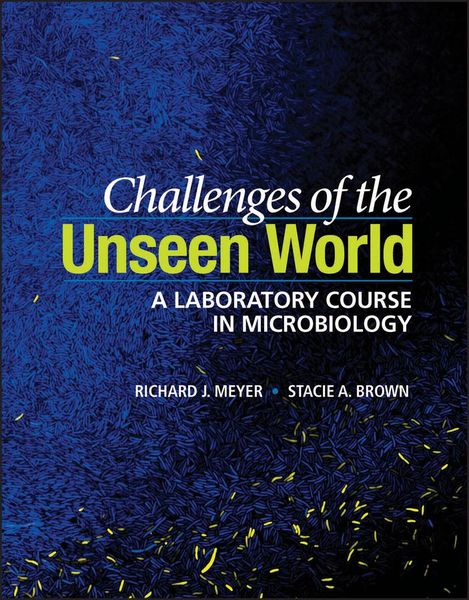
Challenges of the Unseen World A Laboratory Course in Microbiology
-
- Taschenbuch ausgewählt
- eBook
-
Sprache:Englisch
73,99 €
UVP
83,90 €
inkl. gesetzl. MwSt.,
Beschreibung
Produktdetails
Einband
Taschenbuch
Erscheinungsdatum
01.04.2018
Verlag
John Wiley & SonsSeitenzahl
203
Maße (L/B/H)
27,4/21,1/1,3 cm
Gewicht
590 g
Auflage
1. Auflage
Sprache
Englisch
ISBN
978-1-55581-992-7
You are at an exciting gateway into the world of microorganisms. With nothing more than basic lab equipment such as microscopes, Petri dishes, media, and a handful of reagents, you will learn to isolate, grow, and identify bacteria that live all around us. This is no ordinary microbiology laboratory course; not only will you learn how to streak plates, use a microscope, perform a Gram stain, and prepare serial dilutions and spread plates--fundamental skills found in every microbiologist's toolkit--you will solve a series of public health-related challenges that many professional microbiologists encounter in their work.
By the end of this course, you will:
* Determine the origin of a nosocomial infection. Using foundational and molecular methods, you will determine whether the infections occurring in hospitalized patients are the result of contaminated medical items.
* Select the antibiotic to treat a patient with Crohn's disease. You will find minimum inhibitory concentrations of various antibiotics for a Pseudomonas strain associated with Crohn's disease.
* Pinpoint the source of lettuce contaminated with E. coli. Using molecular tools you will investigate a common food safety challenge, antibiotic-resistant E. coli and the potential for spread of this resistance in the environment.
* Find the farm releasing pathogens into a stream used for drinking water. Using bacteriophage load in water samples, you will locate the source of fecal contamination in the water supply of a village in an underdeveloped country.
* Evaluate the potential of bacteria to cause a urinary tract infection. You will test for biofilms, quorum sensing behavior, and chemotaxis and assess which disinfectants would be most effective for sanitizing contaminated surfaces.
Microbiology educators and researchers Richard Meyer and Stacie Brown have created this hands-on, engaging introduction to the essential laboratory skills in the microbial sciences that is sure to change the way you view the world around you.
Noch keine Bewertungen vorhanden
Verfassen Sie die erste Bewertung zu diesem Artikel
Helfen Sie anderen Kundinnen und Kunden durch Ihre Meinung.
Kurze Frage zu unserer Seite
Vielen Dank für Ihr Feedback
Wir nutzen Ihr Feedback, um unsere Produktseiten zu verbessern. Bitte haben Sie Verständnis, dass wir Ihnen keine Rückmeldung geben können. Falls Sie Kontakt mit uns aufnehmen möchten, können Sie sich aber gerne an unseren Kund*innenservice wenden.
zum Kundenservice