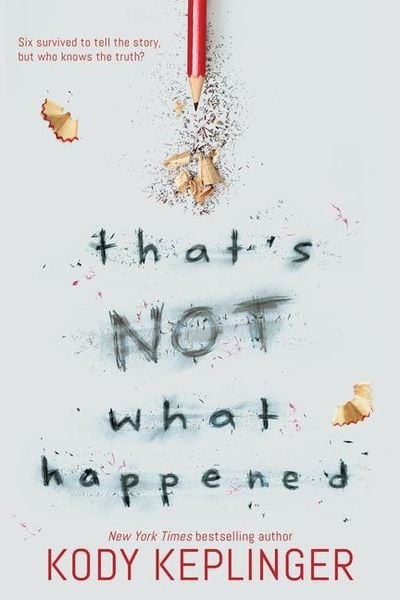
Produktbild: That's Not What Happened

That's Not What Happened

2

17,99 €

inkl. gesetzl. MwSt., Versandkostenfrei


Beschreibung

Produktdetails

Einband

Gebundene Ausgabe

Altersempfehlung

14 - 17 Jahr(e)

Erscheinungsdatum

28.08.2018

Verlag

Scholastic

Seitenzahl

336

Maße (L/B/H)

21,8/15,1/3,5 cm

Gewicht

420 g

Sprache

Englisch

ISBN

978-1-338-18652-9

Beschreibung

Produktdetails

Einband

Gebundene Ausgabe

Altersempfehlung

14 - 17 Jahr(e)

Erscheinungsdatum

28.08.2018

Verlag

Scholastic

Seitenzahl

336

Maße (L/B/H)

21,8/15,1/3,5 cm

Gewicht

420 g

Sprache

Englisch

ISBN

978-1-338-18652-9

Herstelleradresse

Libri GmbH
Europaallee 1
36244 Bad Hersfeld
DE

Email: gpsr@libri.de

Kundinnen und Kunden meinen

2 Bewertungen

Informationen zu Bewertungen

Zur Abgabe einer Bewertung ist eine Anmeldung im Konto notwendig. Die Authentizität der Bewertungen wird von uns nicht überprüft. Wir behalten uns vor, Bewertungstexte, die unseren Richtlinien widersprechen, entsprechend zu kürzen oder zu löschen.

Die Bewertungen sind nach Format, Anzahl Sterne und Datum sortiert.

5 Sterne

(1)

4 Sterne

(1)

3 Sterne

(0)

2 Sterne

(0)

1 Sterne

(0)

Prepare yourself to cry

Bewertung aus Kassel am 31.07.2019

Bewertungsnummer: 1233455

Bewertet: Buch (Taschenbuch)

This book is a masterpiece! The stories told by the high school students are unbelievably powerful and moving! I read this book in one go and immediately felt the urge to start it again. I cannot recommend it enough!

Prepare yourself to cry

Bewertung aus Kassel am 31.07.2019
Bewertungsnummer: 1233455
Bewertet: Buch (Taschenbuch)

This book is a masterpiece! The stories told by the high school students are unbelievably powerful and moving! I read this book in one go and immediately felt the urge to start it again. I cannot recommend it enough!

TW for gun violence, depressio…

Tessa am 22.09.2021

Bewertungsnummer: 2763924

Bewertet: Buch (Taschenbuch)

TW for gun violence, depression, anxiety, alcohol abuse, panic attacks, verbal abuse Let‘s start with the diversity. An asexual MC, a lesbian latina MC with a wlw Asian American girlfriend, a blind black MC, a very young mother and obviously a whole bunch of mental health rep. It‘s just great to have these characters be diverse without that being the main focus of their story at the same time. I loved that the blind MC gets to talk about how his school isn‘t doing enough to actually help him and that no one ever simply asks him what he wants and needs, which is obviously a very big problem for disabled people. I loved that the latina MC got to have issues with Spanish. I loved that all the characters got to tell their version of the story and none of them were judged by the other characters, quite the opposite. These friends were thrown together by a tragedy but they fought hard to stay friends and even though they had fights and not everything is resolved at the end (which felt very realistic), they never judged each other. I absolutely adored the way this book challenged usual retorics, humanizing the shooter, glorifying the dead and either making the survivors out to be heroes or tragedies. The overall story is just so full of emotions and the characters all seem so human, they‘re flawed, they struggle and they can only do what they think is right. I also loved the „truth vs. story“ narrative because it‘s one that‘s especially important in today‘s world where almost everything is filtered through so many kinds of media and biases. Also the narrative about how the truth is always important, it‘s the truth after all, but sometimes it‘s not good for anyone except you and more often than not people don‘t really want to hear the truth, is always an important one to have. I loved that the shooter‘s name is never mentioned, that he‘s actively blacked out of the conversation, that he‘s simply not important in this story. It‘s just a very conscious choice, a deliberate one that is so often taken away from victims. Especially in recent years, how many narratives around shootings were so focused on making the shooter seem human- making him (let‘s just call it the way it is, right?) the victim, the victim of bullying, of mental health, of a bad upbringing, of circumstances, of anything and everything out of his control. But he made the choice to pick up a gun and shoot other people for it, while billions of other people with the same background manage not to make the same decision. He‘s not made out to be a monster, his humanity isn‘t questioned, he‘s just put where he belongs: nowhere. The MC isn‘t the most interesting one in my opinion, but I think she was the safest choice as main character and I liked her well enough. I also really appreciated how guilt was woven into her story because it‘s such a big part of depression and anxiety for me and seeing that represented in a character was comforting and it fit her personality so well. The kinda obituaries for the victims were well done and so heartbreaking, because the characters were once again just so very human and one of the main goals of this was to not make them out to be something holy and unreal. Overall it‘s just such a moving book and it feels like this could be a real story, written by real survivors of a school shooting. Why do we live in a world where this isn‘t horror or speculative fiction? Where a story like this doesn‘t feel so far off?

TW for gun violence, depressio…

Tessa am 22.09.2021
Bewertungsnummer: 2763924
Bewertet: Buch (Taschenbuch)

TW for gun violence, depression, anxiety, alcohol abuse, panic attacks, verbal abuse Let‘s start with the diversity. An asexual MC, a lesbian latina MC with a wlw Asian American girlfriend, a blind black MC, a very young mother and obviously a whole bunch of mental health rep. It‘s just great to have these characters be diverse without that being the main focus of their story at the same time. I loved that the blind MC gets to talk about how his school isn‘t doing enough to actually help him and that no one ever simply asks him what he wants and needs, which is obviously a very big problem for disabled people. I loved that the latina MC got to have issues with Spanish. I loved that all the characters got to tell their version of the story and none of them were judged by the other characters, quite the opposite. These friends were thrown together by a tragedy but they fought hard to stay friends and even though they had fights and not everything is resolved at the end (which felt very realistic), they never judged each other. I absolutely adored the way this book challenged usual retorics, humanizing the shooter, glorifying the dead and either making the survivors out to be heroes or tragedies. The overall story is just so full of emotions and the characters all seem so human, they‘re flawed, they struggle and they can only do what they think is right. I also loved the „truth vs. story“ narrative because it‘s one that‘s especially important in today‘s world where almost everything is filtered through so many kinds of media and biases. Also the narrative about how the truth is always important, it‘s the truth after all, but sometimes it‘s not good for anyone except you and more often than not people don‘t really want to hear the truth, is always an important one to have. I loved that the shooter‘s name is never mentioned, that he‘s actively blacked out of the conversation, that he‘s simply not important in this story. It‘s just a very conscious choice, a deliberate one that is so often taken away from victims. Especially in recent years, how many narratives around shootings were so focused on making the shooter seem human- making him (let‘s just call it the way it is, right?) the victim, the victim of bullying, of mental health, of a bad upbringing, of circumstances, of anything and everything out of his control. But he made the choice to pick up a gun and shoot other people for it, while billions of other people with the same background manage not to make the same decision. He‘s not made out to be a monster, his humanity isn‘t questioned, he‘s just put where he belongs: nowhere. The MC isn‘t the most interesting one in my opinion, but I think she was the safest choice as main character and I liked her well enough. I also really appreciated how guilt was woven into her story because it‘s such a big part of depression and anxiety for me and seeing that represented in a character was comforting and it fit her personality so well. The kinda obituaries for the victims were well done and so heartbreaking, because the characters were once again just so very human and one of the main goals of this was to not make them out to be something holy and unreal. Overall it‘s just such a moving book and it feels like this could be a real story, written by real survivors of a school shooting. Why do we live in a world where this isn‘t horror or speculative fiction? Where a story like this doesn‘t feel so far off?

Kundinnen und Kunden meinen

That's Not What Happened

von Kody Keplinger

0 Bewertungen filtern

Weitere Artikel finden Sie in

Die Leseprobe wird geladen.
  • Produktbild: That's Not What Happened