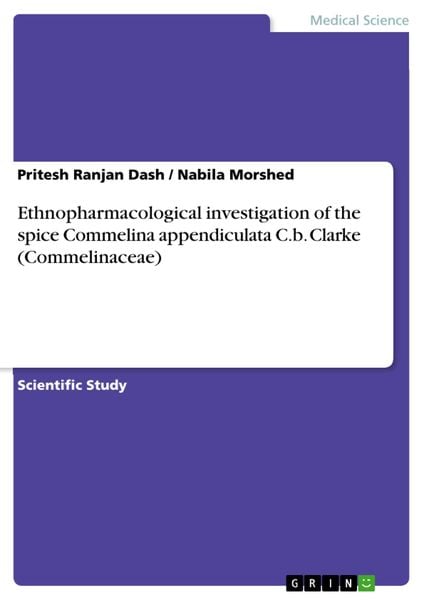
Ethnopharmacological investigation of the spice Commelina appendiculata C.b. Clarke (Commelinaceae)
-
- Taschenbuch
- eBook ausgewählt
-
Form:Einzelkauf Download
-
Sprache:Englisch
29,99 €
inkl. gesetzl. MwSt.Beschreibung
Produktdetails
Format
Kopierschutz
Nein
Family Sharing
Nein
Text-to-Speech
Nein
Erscheinungsdatum
12.01.2018
Verlag
GRINSeitenzahl
75 (Printausgabe)
Dateigröße
2819 KB
Auflage
1. Auflage
Sprache
Englisch
EAN
9783668610743
Scientific Study from the year 2012 in the subject Pharmicology, grade: A, Jahangirnagar University (Department of Pharmacy), language: English, abstract: The present study was intended to assess the plausible pharmacologic properties of the ethanol extract of Commelina appendiculata (EECA) (Family: Commelinaceae).
Our experiments to find out analgesic, central nervous system (CNS) depressant, antidiarrheal and cytotoxic activities of the aforementioned extract. In the analgesic activity, acetic acid-induced writhing, hot plate and tail immersion methods in swiss albino mice were conducted at the doses of 100 and 200 mg/kg body weight, p.o. In retrospective, both doses of the extract produced a noteworthy (p < 0.05 and p <0.001) pain-relieving action in a dose dependent manner.
In acetic acid induced writhing method, EECA (200 mg/kg) resulted in the most significant analgesic activity with writhing inhibition of 76.27%; on the contrary, the standard drug Diclofenac-Na (25mg/kg) and Aspirin (100 mg/kg) showed 80.72% and 61.94% inhibition respectively. In regard to hot plate and tail immersion tests, similarly, inhibitions of nociceptive thermal stimulus by EECA (200 mg/kg) were maximum of 52.56% and 76.58% correspondingly. Morphine (5mg/kg, i.p.) was used as standard in the precedent study. CNS depressant activity of the extract (100 and 200 mg/kg, p.o.) was assessed by employing thiopental sodium-induced sleeping time model to evaluate sedative potential, hole cross to evaluate motor activity and open field test to estimate exploratory behavior. Consequently, the extract resulted in rapid onset and maximized duration of sleeping time when concomitantly administered with thiopental sodium.
In addition, a reduction in motor action and exploratory conduct of mice in hole cross and open field test was found distinctly when treated with the extract (p < 0.05-0.001). In antidiarrheal activity study, the dose (200 mg/kg) likewise associated with most extreme inhibition of defecation (90.64% and 80.95%) in both models independently. Phytochemical screening of ethanol extract of C. appendiculata confirmed the presence of carbohydrates, flavonoids, tannins, glycosides and alkaloids. Notably, substantial level of lethality was found with EECA, involving LC50 value of 26.3 µg/ml, whereas the LC50 of vincristine sulphate was 0.52 µg/ml. The above results from the present study reveal the potential analgesic, CNS depressant, antidiarrheal and cytotoxic properties of ethanol extract of C. appendiculata. As a consequence, the plant may be further examined to refine its pharmacologically active natural ingredients.
Our experiments to find out analgesic, central nervous system (CNS) depressant, antidiarrheal and cytotoxic activities of the aforementioned extract. In the analgesic activity, acetic acid-induced writhing, hot plate and tail immersion methods in swiss albino mice were conducted at the doses of 100 and 200 mg/kg body weight, p.o. In retrospective, both doses of the extract produced a noteworthy (p < 0.05 and p <0.001) pain-relieving action in a dose dependent manner.
In acetic acid induced writhing method, EECA (200 mg/kg) resulted in the most significant analgesic activity with writhing inhibition of 76.27%; on the contrary, the standard drug Diclofenac-Na (25mg/kg) and Aspirin (100 mg/kg) showed 80.72% and 61.94% inhibition respectively. In regard to hot plate and tail immersion tests, similarly, inhibitions of nociceptive thermal stimulus by EECA (200 mg/kg) were maximum of 52.56% and 76.58% correspondingly. Morphine (5mg/kg, i.p.) was used as standard in the precedent study. CNS depressant activity of the extract (100 and 200 mg/kg, p.o.) was assessed by employing thiopental sodium-induced sleeping time model to evaluate sedative potential, hole cross to evaluate motor activity and open field test to estimate exploratory behavior. Consequently, the extract resulted in rapid onset and maximized duration of sleeping time when concomitantly administered with thiopental sodium.
In addition, a reduction in motor action and exploratory conduct of mice in hole cross and open field test was found distinctly when treated with the extract (p < 0.05-0.001). In antidiarrheal activity study, the dose (200 mg/kg) likewise associated with most extreme inhibition of defecation (90.64% and 80.95%) in both models independently. Phytochemical screening of ethanol extract of C. appendiculata confirmed the presence of carbohydrates, flavonoids, tannins, glycosides and alkaloids. Notably, substantial level of lethality was found with EECA, involving LC50 value of 26.3 µg/ml, whereas the LC50 of vincristine sulphate was 0.52 µg/ml. The above results from the present study reveal the potential analgesic, CNS depressant, antidiarrheal and cytotoxic properties of ethanol extract of C. appendiculata. As a consequence, the plant may be further examined to refine its pharmacologically active natural ingredients.
Noch keine Bewertungen vorhanden
Verfassen Sie die erste Bewertung zu diesem Artikel
Helfen Sie anderen Kundinnen und Kunden durch Ihre Meinung.
Kurze Frage zu unserer Seite
Vielen Dank für Ihr Feedback
Wir nutzen Ihr Feedback, um unsere Produktseiten zu verbessern. Bitte haben Sie Verständnis, dass wir Ihnen keine Rückmeldung geben können. Falls Sie Kontakt mit uns aufnehmen möchten, können Sie sich aber gerne an unseren Kund*innenservice wenden.
zum Kundenservice