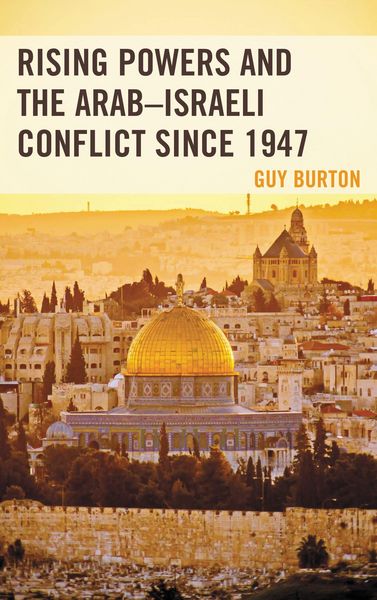
Rising Powers and the Arab-Israeli Conflict since 1947
-
- Hardcover
- Taschenbuch
- eBook ausgewählt
-
Form:Einzelkauf Download
-
Sprache:Englisch
-
eBook Format:ePUB
- PDF 39,49 €
- ePUB 39,49 € ausgewählt
39,49 €
inkl. gesetzl. MwSt.Beschreibung
Produktdetails
Format
ePUB
Kopierschutz
Ja
Family Sharing
Nein
Text-to-Speech
Ja
Erscheinungsdatum
26.02.2018
Verlag
Bloomsbury eBooks USSeitenzahl
206 (Printausgabe)
Dateigröße
3976 KB
Auflage
1. Auflage
Sprache
Englisch
EAN
9781498551960
What has been the role of rising powers in the Arab-Israeli conflict? What does this tell us about rising powers and conflict management as well as rising powers' behavior in the world more generally? This book studies the way that five rising powers-Brazil, Russia, India, China and South Africa, the BRICS countries-have approached the conflict since it first became internationalized in 1947.
Conflict management consists of different methods, from peacekeeping to mediation and the use of economic incentives and sanctions and (non)enforcement of international legal decisions. What distinguishes them is whether they are active or passive: active measures seek to transform a conflict and resolve it; passive measures seek to ameliorate its worst effects, but do not change their underlying causes. Since 1947 rising powers' active or passive use of these methods has coincided with their rise and fall and rise again in the international system. Those rises and falls are tied to global changes, including the Cold War, the emergence of the Third World, economic and ideological retrenchment of the 1980s and 1990s and the shift from unipolarity to multipolarity after 2000.
In summary, rising powers' management of the Arab-Israeli conflict has shifted from active to more passive methods since 1947. Their actions have occurred alongside two key changes within the conflict. One is the shift from a primarily state-based conflict between Israel and the Arabs to one that is more ethnic and territorial in scope, between Israel and the Palestinians. The other the emergence of the Oslo framework which has frozen power imbalance between Israel and the Palestinians since 1993. By pursuing the Oslo process, rising powers have separated conflict management from developing 'normal' diplomatic and economic exchanges with Israel and the Palestinians. In adopting this more passive conflict management approach, rising powers are disregarding both emerging alternatives that may potentially transform the conflict's dynamics (including involvement with civil society actors like the Boycott, Divestment and Sanctions movement) and undertaking more active efforts at conflict resolution-and presenting themselves as global powers.
Conflict management consists of different methods, from peacekeeping to mediation and the use of economic incentives and sanctions and (non)enforcement of international legal decisions. What distinguishes them is whether they are active or passive: active measures seek to transform a conflict and resolve it; passive measures seek to ameliorate its worst effects, but do not change their underlying causes. Since 1947 rising powers' active or passive use of these methods has coincided with their rise and fall and rise again in the international system. Those rises and falls are tied to global changes, including the Cold War, the emergence of the Third World, economic and ideological retrenchment of the 1980s and 1990s and the shift from unipolarity to multipolarity after 2000.
In summary, rising powers' management of the Arab-Israeli conflict has shifted from active to more passive methods since 1947. Their actions have occurred alongside two key changes within the conflict. One is the shift from a primarily state-based conflict between Israel and the Arabs to one that is more ethnic and territorial in scope, between Israel and the Palestinians. The other the emergence of the Oslo framework which has frozen power imbalance between Israel and the Palestinians since 1993. By pursuing the Oslo process, rising powers have separated conflict management from developing 'normal' diplomatic and economic exchanges with Israel and the Palestinians. In adopting this more passive conflict management approach, rising powers are disregarding both emerging alternatives that may potentially transform the conflict's dynamics (including involvement with civil society actors like the Boycott, Divestment and Sanctions movement) and undertaking more active efforts at conflict resolution-and presenting themselves as global powers.
Noch keine Bewertungen vorhanden
Verfassen Sie die erste Bewertung zu diesem Artikel
Helfen Sie anderen Kundinnen und Kunden durch Ihre Meinung.
Kurze Frage zu unserer Seite
Vielen Dank für Ihr Feedback
Wir nutzen Ihr Feedback, um unsere Produktseiten zu verbessern. Bitte haben Sie Verständnis, dass wir Ihnen keine Rückmeldung geben können. Falls Sie Kontakt mit uns aufnehmen möchten, können Sie sich aber gerne an unseren Kund*innenservice wenden.
zum Kundenservice