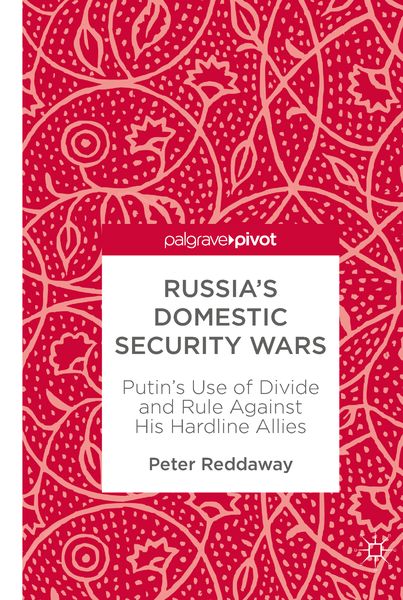
Produktbild: Russia’s Domestic Security Wars

Russia’s Domestic Security Wars Putin’s Use of Divide and Rule Against His Hardline Allies

49,99 €

inkl. gesetzl. MwSt., Versandkostenfrei


Beschreibung

Produktdetails

Einband

Gebundene Ausgabe

Erscheinungsdatum

27.03.2018

Verlag

Springer

Seitenzahl

125

Maße (L/B/H)

37,8/25,5/0,2 cm

Gewicht

280 g

Auflage

1st ed. 2018

Sprache

Englisch

ISBN

978-3-319-77391-9

Beschreibung

Rezension

“This is an excellent little book: deeply researched, insightful and successful in pulling off that great scholarly feat of using a small example to illustrate big truths. … All credit to Peter Reddaway for such a meticulous exploration of an important topic.” (Mark Galeotti, Europe-Asia Studies, Vol. 71 (3), April, 2019)

Produktdetails

Einband

Gebundene Ausgabe

Erscheinungsdatum

27.03.2018

Verlag

Springer

Seitenzahl

125

Maße (L/B/H)

37,8/25,5/0,2 cm

Gewicht

280 g

Auflage

1st ed. 2018

Sprache

Englisch

ISBN

978-3-319-77391-9

Herstelleradresse

Springer Nature Customer Service Center GmbH
Europaplatz 3
69115 Heidelberg
DE
ProductSafety@springernature.com

Kundinnen und Kunden meinen

0 Bewertungen

Informationen zu Bewertungen

Zur Abgabe einer Bewertung ist eine Anmeldung im Konto notwendig. Die Authentizität der Bewertungen wird von uns nicht überprüft. Wir behalten uns vor, Bewertungstexte, die unseren Richtlinien widersprechen, entsprechend zu kürzen oder zu löschen.

Die Bewertungen sind nach Format, Anzahl Sterne und Datum sortiert.

Verfassen Sie die erste Bewertung zu diesem Artikel

Helfen Sie anderen Kund*innen durch Ihre Meinung

Kundinnen und Kunden meinen

0 Bewertungen filtern

  • Produktbild: Russia’s Domestic Security Wars
  • Contents

    Glossary – p.

    I. Introduction – p.

    II. II. The Background and Emergence of the Siloviki War 

    1. Origins of the Cherkesov-Zolotov and Sechin groupings, and of the fierce rivalries between silovik groups – p.

    III. The Intense Years of the Silovik War, 2004-2007

    2. Putin’s re-election in March 2004 and the murder of Tsepov in September; the Sechinites’ all-out assault on Cherkesov and his group – p.

    3. Summary of the argument to date and how it will develop regarding 2005 – 2010 - p.

    4. Spring 2005 – The case of the smuggled Chinese goods rocks the FSS and Patrushev – p. 

    5. November 2005 – early 2006: Putin’s succession-related moves; the silovik war heats up; the Sechinites groom their own presidential candidate, Ustinov – p. 

    6. May-June 2006 – Fight for the Customs Service – Full-scale war between the silovik clans; the fall of Ustinov – a triumph for the Cherkesovites – p. 

    7. November 2006 – The tide turns against the Cherkesov-Zolotov group. as the succession struggle heats up – p. 

    8. 2007 – Putin tells the Sechinites he favours Naryshkin for the presidency; June-September 2007 – new Sechinite offensive rocks the Cherkesovites – p. 

    9. October 2007 – Cherkesov makes his last stand – Putin’s minimal aid to him masks his incipient abandonment of his longstanding associate – p. 

    10. How the war had evolved by mid-October 2007: Putin’s MO in crisis; November 2007 – Sechinites sense betrayal and raise the stakes – p. 

    11. Late 2007 – Difficulty selecting a successor: Medvedev chosen at last minute – p.

    IV. The Silovik War Winds Down: Aftermath and Conclusions

    12. 2007-2008 – War fades, tandem forms, Cherkesov clan dissolves, Sechinites decline; Putin generates new factional wars: General Procuracy vs.  Investigations Committee of the Procuracy (ICP), Medvedev v. Sechin – p.

    13. 2008-2011 – The different fates of the Cherkesov and Sechin groups – p. 


    V. Russian Politics in 2012-2017 and Some General Conclusions 14. Conclusion

    Appendix: Some notes on key players