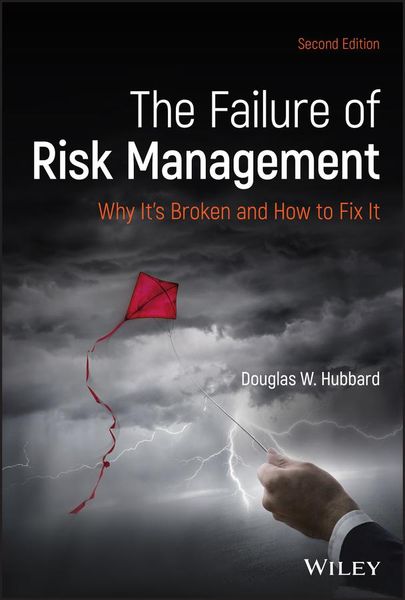
The Failure of Risk Management Why It's Broken and How to Fix It
46,99 €
inkl. gesetzl. MwSt.,
Beschreibung
Produktdetails
Einband
Gebundene Ausgabe
Erscheinungsdatum
23.03.2020
Verlag
John Wiley & SonsSeitenzahl
384
Maße (L/B/H)
23,6/16,1/4 cm
Gewicht
598 g
Auflage
2. Auflage
Sprache
Englisch
ISBN
978-1-119-52203-4
A practical guide to adopting an accurate risk analysis methodology
The Failure of Risk Management provides effective solutionstosignificantfaults in current risk analysis methods. Conventional approaches to managing risk lack accurate quantitative analysis methods, yielding strategies that can actually make things worse. Many widely used methods have no systems to measure performance, resulting in inaccurate selection and ineffective application of risk management strategies. These fundamental flaws propagate unrealistic perceptions of risk in business, government, and the general public. This book provides expert examination of essential areas of risk management, including risk assessment and evaluation methods, risk mitigation strategies, common errors in quantitative models, and more. Guidance on topics such as probability modelling and empirical inputs emphasizes the efficacy of appropriate risk methodology in practical applications.
Recognized as a leader in the field of risk management, author Douglas W. Hubbard combines science-based analysis with real-world examples to present a detailed investigation of risk management practices. This revised and updated second edition includes updated data sets and checklists, expanded coverage of innovative statistical methods, and new cases of current risk management issues such as data breaches and natural disasters.
- Identify deficiencies in your current risk management strategy and take appropriate corrective measures
- Adopt a calibrated approach to risk analysis using up-to-date statistical tools
- Employ accurate quantitative risk analysis and modelling methods
- Keep pace with new developments in the rapidly expanding risk analysis industry
Risk analysis is a vital component of government policy, public safety, banking and finance, and many other public and private institutions. The Failure of Risk Management: Why It's Broken and How to Fix It is a valuable resource for business leaders, policy makers, managers, consultants, and practitioners across industries.
Noch keine Bewertungen vorhanden
Verfassen Sie die erste Bewertung zu diesem Artikel
Helfen Sie anderen Kundinnen und Kunden durch Ihre Meinung.
Kurze Frage zu unserer Seite
Vielen Dank für Ihr Feedback
Wir nutzen Ihr Feedback, um unsere Produktseiten zu verbessern. Bitte haben Sie Verständnis, dass wir Ihnen keine Rückmeldung geben können. Falls Sie Kontakt mit uns aufnehmen möchten, können Sie sich aber gerne an unseren Kund*innenservice wenden.
zum Kundenservice