Gutscheinbedingungen

Gültig bis 13.07.2026 | Gültig für Spielzeug (außer Tonieboxen & ausgewählte Tonies), Filme, Musik, Software, Games, Schreibwaren, Hörbücher und Hörbuch-Downloads (außer Abo & Shelfies), gebrauchte Bücher, nicht preisgebundene Bücher und Kalender | Einlösbar unter osiander.de und in der Osiander App | Click & Collect nur mit Online-Zahlung (Paypal/Kreditkarte) vorab | Einzelne Artikel können ausgeschlossen sein | Nicht kombinierbar mit anderen Gutscheinen oder Preisaktionen | Nur einmal pro Einkauf einlösbar | Gutschein wird auf max. 500€ Bestellwert angerechnet | Keine Barauszahlung | Digitale Hörbücher nur für Android | Nicht gültig für preisgebundene Artikel (aufgrund der Buchpreisbindung sind Gutscheine nicht auf Bücher, eBooks, Presse einlösbar), tolino eReader & Zubehör, Elektronik, Geschenke & Trends, Abonnements & Flatrates, Geschenkkarten, Versandkosten und Services

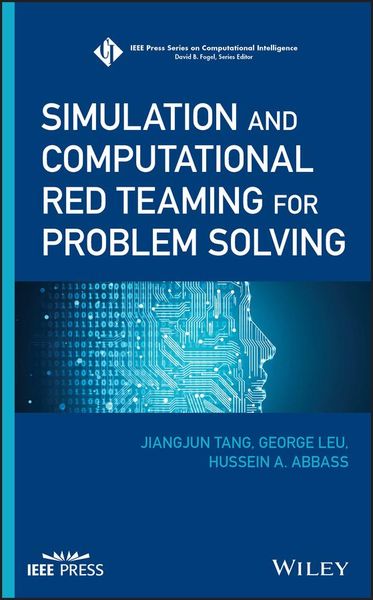
Produktbild: Simulation and Computational Red Teaming for Problem Solving

Simulation and Computational Red Teaming for Problem Solving

174,99 €

inkl. gesetzl. MwSt., Versandkostenfrei


Beschreibung

Produktdetails

Einband

Gebundene Ausgabe

Erscheinungsdatum

19.11.2019

Verlag

John Wiley & Sons Inc

Seitenzahl

496

Maße (L/B/H)

23,1/15,5/2,8 cm

Gewicht

907 g

Auflage

1. Auflage

Sprache

Englisch

ISBN

978-1-119-52717-6

Beschreibung

Produktdetails

Einband

Gebundene Ausgabe

Erscheinungsdatum

19.11.2019

Verlag

John Wiley & Sons Inc

Seitenzahl

496

Maße (L/B/H)

23,1/15,5/2,8 cm

Gewicht

907 g

Auflage

1. Auflage

Sprache

Englisch

ISBN

978-1-119-52717-6

Herstelleradresse

Libri GmbH
Europaallee 1
36244 Bad Hersfeld
DE

Email: gpsr@libri.de

Noch keine Bewertungen vorhanden

Verfassen Sie die erste Bewertung zu diesem Artikel

Helfen Sie anderen Kundinnen und Kunden durch Ihre Meinung.

Kundinnen und Kunden meinen

Bewertungen (0)

Die Leseprobe wird geladen.
  • Produktbild: Simulation and Computational Red Teaming for Problem Solving
  • Preface xi

    List of Figures xv

    List of Tables xxv

    Part I On Problem Solving, Computational Red Teaming, and Simulation 1

    1. Problem Solving, Simulation, and Computational Red Teaming 3

    1.1 Introduction 3

    1.2 Problem Solving 4

    1.3 Computational Red Teaming and Self-'Verification and Validation' 8

    2. Introduction to Fundamentals of Simulation 11

    2.1 Introduction 11

    2.2 System 14

    2.3 Concepts in Simulation 17

    2.4 Simulation Types 21

    2.5 Tools for Simulation 23

    2.6 Conclusion 24

    Part II Before Simulation Starts 25

    3. The Simulation Process 27

    3.1 Introduction 27

    3.2 Define the System and its Environment 27

    3.3 Build a Model 29

    3.4 Encode a Simulator 30

    3.5 Design Sampling Mechanisms 32

    3.6 Run Simulator Under Different Samples 33

    3.7 Summarise Results 33

    3.8 Make a Recommendation 34

    3.9 An Evolutionary Approach 35

    3.10 A Battle Simulation by Lanchester Square Law 35

    4. Simulation Worldview and Conflict Resolution 57

    4.1 Simulation Worldview 57

    4.2 Simultaneous Events and Conflicts in Simulation 64

    4.3 Priority Queue and Binary Heap 68

    4.4 Conclusion 72

    5. The Language of Abstraction and Representation 73

    5.1 Introduction 73

    5.2 Informal Representation 75

    5.3 Semi-formal Representation 76

    5.4 Formal Representation 82

    5.5 Finite-state Machine 86

    5.6 Ant in Maze Modelled by Finite-state Machine 89

    5.7 Conclusion 99

    6. Experimental Design 101

    6.1 Introduction 101

    6.2 Factor Screening 103

    6.3 Metamodel and Response Surface 113

    6.4 Input Sampling 116

    6.5 Output Analysis 117

    6.6 Conclusion 120

    Part III Simulation Methodologies 121

    7. Discrete Event Simulation 123

    7.1 Discrete Event Systems 123

    7.2 Discrete Event Simulation 126

    7.3 Conclusion 142

    8. Discrete Time Simulation 143

    8.1 Introduction 143

    8.2 Discrete Time System and Modelling 145

    8.3 Sample Path 148

    8.4 Discrete Time Simulation and Discrete Event Simulation 149

    8.5 A Case Study: Car-following Model 151

    8.6 Conclusion 154

    9. Continuous Simulation 157

    9.1 Continuous System 157

    9.2 Continuous Simulation 159

    9.3 Numerical Solution Techniques for Continuous Simulation 164

    9.4 System Dynamics Approach 172

    9.5 Combined Discrete-continuous Simulation 174

    9.6 Conclusion 176

    10. Agent-based Simulation 179

    10.1 Introduction 179

    10.2 Agent-based Simulation 181

    10.3 Examples of Agent-based Simulation 185

    10.4 Conclusion 194

    Part IV Simulation and Computational Red Teaming Systems 197

    11. Knowledge Acquisition 199

    11.1 Introduction 199

    11.2 Agent-enabled Knowledge Acquisition: Core Processes 202

    11.3 Human Agents 203

    11.4 Human-inspired Agents 208

    11.5 Machine Agents 211

    11.6 Summary Discussion and Perspectives on Knowledge Acquisition 215

    12. Computational Intelligence 219

    12.1 Introduction 219

    12.2 Evolutionary Computation 223

    12.3 Artificial Neural Networks 232

    12.4 Conclusion 239

    13. Computational Red Teaming 241

    13.1 Introduction 241

    13.2 Computational Red Teaming: The Challenge Loop 242

    13.3 Computational Red Teaming Objects 243

    13.4 Computational Red Teaming Purposes 244

    13.5 Objectives of Red Teaming Exercises in Computational Red Teaming Purposes 245

    13.6 Discovering Biases 246

    13.7 Computational Red Teaming Lifecycle: A Systematic Approach to Red Teaming Exercises 247

    13.8 Conclusion 251

    Part V Simulation and Computational Red Teaming Applications 253

    14. Computational Red Teaming for Battlefield Management 255

    14.1 Introduction 255

    14.2 Battlefield Management Simulation 256

    14.3 Conclusion 261

    15. Computational Red Teaming for Air Traffic Management 263

    15.1 Introduction 263

    15.2 Air Traffic Simulation 263

    15.3 A Human-in-the-loop Application 270

    15.4 Conclusion 271

    16. Computational Red Teaming Application for Skill-based Performance Assessment 273

    16.1 Introduction 273

    16.2 Cognitive Task Analysis-based Skill Modelling and Assessment Methodology 274

    16.3 Sudoku and Human Players 276

    16.4 Sudoku and Computational Solvers 280

    16.5 The Proposed Skill-based Computational Solver 283

    16.6 Discussion of Simulation Results 293

    16.7 Conclusions 300

    17. Computational Red Teaming for Driver Assessment 301

    17.1 Introduction 301

    17.2 Background on Cognitive Agents 303

    17.3 The Society of Mind Agent 306

    17.4 Society of Mind Agents in an Artificial Environment 312

    17.5 Case Study 325

    17.6 Conclusion 330

    18. Computational Red Teaming for Trusted Autonomous Systems 333

    18.1 Introduction 333

    18.2 Trust for Influence and Shaping 334

    18.3 The Model 335

    18.4 Experiment Design and Parameter Settings 342

    18.5 Results and Discussion 344

    18.6 Conclusion 347

    A. Probability and Statistics in Simulation 349

    A.1 Foundation of Probability and Statistics 349

    A.2 Useful Distributions 369

    A.3 Mathematical Characteristics of Random Variables 390

    A.4 Conclusion 396

    B Sampling and Random Numbers 397

    B.1 Introduction 397

    B.2 Random Number Generator 400

    B.3 Testing Random Number Generators 408

    B.4 Approaches to Generating Random Variates 413

    B.5 Generating Random Variates 416

    B.6 Monte Carlo Method 423

    B.7 Conclusion 432

    Bibliography 435

    Index 459