
Ritual, Emotion, Violence Studies on the Micro-Sociology of Randall Collins
-
- Hardcover
- Taschenbuch ausgewählt
- eBook
-
Sprache:Englisch
53,99 €
UVP
61,90 €
inkl. gesetzl. MwSt.,
Beschreibung
Produktdetails
Einband
Taschenbuch
Erscheinungsdatum
19.07.2018
Abbildungen
schwarz-weiss Illustrationen, Zeichnungen, schwarz-weiss, Tabellen, schwarz-weiss
Herausgeber
Elliott B. Weininger + weitereVerlag
Taylor & FrancisSeitenzahl
288
Maße (L/B/H)
22,9/15,2/1,6 cm
Gewicht
416 g
Sprache
Englisch
ISBN
978-1-138-61428-4
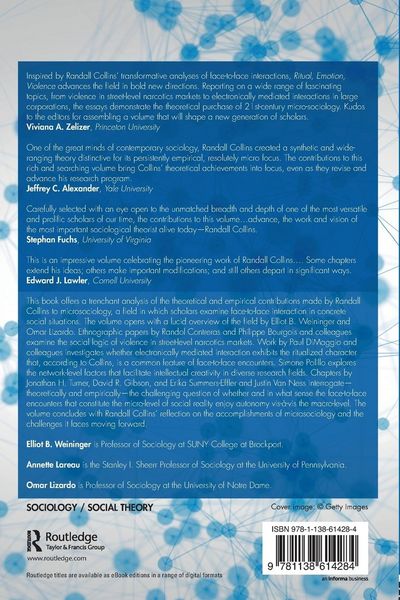
Microsociologists seek to capture social life as it is experienced, and in recent decades no one has championed the microsociological approach more fiercely than Randall Collins. The pieces in this exciting volume offer fresh and original insights into key aspects of Collins' thought, and of microsociology more generally.
The introductory essay by Elliot B. Weininger and Omar Lizardo provides a lucid overview of the key premises this perspective. Ethnographic papers by Randol Contreras, using data from New York, and Philippe Bourgois and Laurie Kain Hart, using data from Philadelphia, examine the social logic of violence in street-level narcotics markets. Both draw on heavily on Collins' microsociological account of the features of social situations that tend to engender violence.
In the second section of the book, a study by Paul DiMaggio, Clark Bernier, Charles Heckscher, and David Mimno tackles the question of whether electronically mediated interaction exhibits the ritualization which, according to Collins, is a common feature of face-to-face encounters. Their results suggest that, at least under certain circumstances, digitally mediated interaction may foster social solidarity in a manner similar to face-to-face interaction. A chapter by Simone Polillo picks up from Collins' work in the sociology of knowledge, examining multiple ways in which social network structures can engender intellectual creativity.
The third section of the book contains papers that critically but sympathetically assess key tenets of microsociology. Jonathan H. Turner argues that the radically microsociological perspective developed by Collins will better serve the social scientific project if it is embedded in a more comprehensive paradigm, one that acknowledges the macro- and meso-levels of social and cultural life. A chapter by David Gibson presents empirical analyses of decisions by state leaders concerning whether or not to use force to deal with internal or external foes, suggesting that Collins' model of interaction ritual can only partially illuminate the dynamics of these highly consequential political moments. Work by Erika Summers-Effler and Justin Van Ness seeks to systematize and broaden the scope of Collins' theory of interaction, by including in it encounters that depart from the ritual model in important ways.
In a final, reflective chapter, Randall Collins himself highlights the promise and future of microsociology. Clearly written, these pieces offer cutting-edge thinking on some of the crucial theoretical and empirical issues in sociology today.
Noch keine Bewertungen vorhanden
Verfassen Sie die erste Bewertung zu diesem Artikel
Helfen Sie anderen Kundinnen und Kunden durch Ihre Meinung.
Kurze Frage zu unserer Seite
Vielen Dank für Ihr Feedback
Wir nutzen Ihr Feedback, um unsere Produktseiten zu verbessern. Bitte haben Sie Verständnis, dass wir Ihnen keine Rückmeldung geben können. Falls Sie Kontakt mit uns aufnehmen möchten, können Sie sich aber gerne an unseren Kund*innenservice wenden.
zum Kundenservice