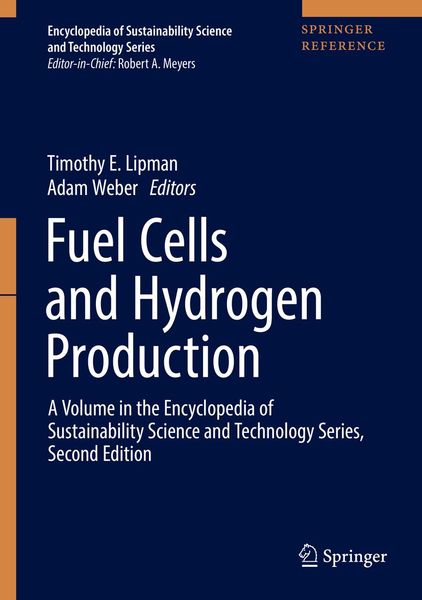
Produktbild: Fuel Cells and Hydrogen Production
- 41%

Fuel Cells and Hydrogen Production A Volume in the Encyclopedia of Sustainability Science and Technology, Second Edition

41% sparen

622,99 € UVP 1.069,99 €

inkl. gesetzl. MwSt., Versandkostenfrei


Beschreibung

Produktdetails

Einband

Set mit diversen Artikeln

Erscheinungsdatum

06.10.2018

Herausgeber

Timothy E. Lipman + weitere

Verlag

Springer Us

Seitenzahl

1179

Maße (L/B)

23,5/15,5 cm

Auflage

2019

Sprache

Englisch

ISBN

978-1-4939-7790-1

Beschreibung

Portrait

Timothy E. Lipman is an energy and environmental technology, economics, and policy researcher and lecturer with the University of California - Berkeley. He is serving as Co-Director for the campus' Transportation Sustainability Research Center (TSRC), based at the Institute of Transportation Studies, and also as Director of the Northern California Center for Alternative Transportation Fuels and Advanced Vehicle Technologies (NorthCAT -- see "northcat.org") effort. Tim's research focuses on electric-drive vehicles, fuel cell technology, combined heat and power systems, biofuels, renewable energy, and electricity and hydrogen energy systems infrastructure.Lipman received his Ph.D. degree in Environmental Policy Analysis with the Graduate Group in Ecology at UC Davis (1999). He also has received an M.S. degree in the technology track of the Graduate Group in Transportation Technology and Policy, also at UC Davis (1998), and a B.A. from Stanford University (1990). His Ph.D. dissertation titled "Zero-Emission Vehicle Scenario Cost Analysis Using A Fuzzy Set-Based Framework" received the University of California Transportation Center's 'Charlie Wootan' Ph.D. dissertation award for 1999. He is also a 2005 Climate Change Fellow with the Woods Institute at Stanford University, and he also received a 2004 Institute of Transportation Engineers service award, a 1998 NSF IGERT teaching fellowship, a 1997 University of California Transportation Center Dissertation Grant, a 1996 ENO Foundation Fellowship, a 1995 University of California Transportation Center Dissertation Grant, and a 1994 Chevron Foundation Fellowship. A native of Golden, Colorado, he graduated Cum Laude from Colorado Academy in 1986.Most of his research projects are related to the transformation of energy systems to support motor vehicles and buildings, examining how both incremental and "leap frog" technologies can be applied to reduce greenhouse gas emissions and other negative environmental and social impacts of energy use. A central concept for his research is that the electrification of the transportation sector can realize synergy with a concentrated effort to reduce the carbon intensity of the electrical grid, yielding benefit for the electricity sector as well as the expanded use of electricity, hydrogen, and biofuels.Adam Z. Weber holds B.S. and M.S. degrees from Tufts University, the latterunder the guidance of Professor Maria Flytzani-Stephanopoulos. Next, heearned his Ph.D. at University of California, Berkeley, in Chemical Engineeringunder the guidance of John Newman. His dissertation work focused on thefundamental investigation and mathematical modeling of water managementin polymer-electrolyte fuel cells.Dr. Weber continued his study of water and thermal management inpolymer-electrolyte fuel cells at Lawrence Berkeley National Laboratory,where he is now a staff scientist and program manager for Hydrogen andFuel Cell Technologies. His current research involves understanding andoptimizing fuel-cell performance and lifetime including component andionomer structure/function studies using advanced modeling and diagnostics,understanding flow batteries for grid-scale energy storage, and analysis ofsolar-fuel generators where he is a Thrust coordinator at the Joint Center forArtificial Photosynthesis (JCAP).Dr. Weber has coauthored over 110 peer-reviewed articles and 10 bookchapters on fuel cells, flow batteries, and related electrochemical devices;developed many widely used models for fuel cells and their components;and has been invited to present his work at various international and nationalmeetings. He is the recipient of a number of awards including a Fulbrightscholarship to Australia, the 2008 Oronzio and Niccolò De Nora FoundationPrize on Applied Electrochemistry of the International Society of Electrochemistry,the 2012 Supramaniam Srinivasan Young Investigator Award of theEnergy Technology Division of the Electrochemical Society, a 2012 PresidentialEarly Career Award for Scientists and Engineers (PECASE), the 2014CharlesW. Tobias Young Investigator Award of the Electrochemical Society, aKavli Fellow in 2014, and the 2016 Sir William Grove Award from theInternational Association for Hydrogen Energy. He is a Fellow of The ElectrochemicalSociety.

Produktdetails

Einband

Set mit diversen Artikeln

Erscheinungsdatum

06.10.2018

Herausgeber

Verlag

Springer Us

Seitenzahl

1179

Maße (L/B)

23,5/15,5 cm

Auflage

2019

Sprache

Englisch

ISBN

978-1-4939-7790-1

Herstelleradresse

Libri GmbH
Europaallee 1
36244 Bad Hersfeld
DE

Email: gpsr@libri.de

Kundinnen und Kunden meinen

0 Bewertungen

Informationen zu Bewertungen

Zur Abgabe einer Bewertung ist eine Anmeldung im Konto notwendig. Die Authentizität der Bewertungen wird von uns nicht überprüft. Wir behalten uns vor, Bewertungstexte, die unseren Richtlinien widersprechen, entsprechend zu kürzen oder zu löschen.

Die Bewertungen sind nach Format, Anzahl Sterne und Datum sortiert.

Verfassen Sie die erste Bewertung zu diesem Artikel

Helfen Sie anderen Kund*innen durch Ihre Meinung

Kundinnen und Kunden meinen

0 Bewertungen filtern

  • Produktbild: Fuel Cells and Hydrogen Production
  • Part I: Fuel Cells

    1. Fuel Cells, Introduction

    2. Alkaline Membrane Fuel Cells

    3. Direct Hydrocarbon Solid Oxide Fuel Cells

    4. Fuel Cell Comparison to Alternate Technologies

    5. Fuel Cell Types and Their Electrochemistry

    6. Fuel Cells (SOFC): Alternative Approaches (Electroytes, Electrodes, Fuels)

    7. Membrane Electrolytes, from Perfluoro Sulfonic Acid (PFSA) to Hydrocarbon Ionomers

    8. Molten Carbonate Fuel Cells

    9. PEM Fuel Cell Materials: Costs, Performance and Durability

    10. PEM Fuel Cells and Platinum-Based Electrocatalysts

    11. PEM Fuel Cells, Materials and Design Development Challenges

    12. Phosphoric Acid Fuel Cells for Stationary Applications

    13. Polybenzimidazole Fuel Cell Technology

    14. Polymer Electrolyte (PE) Fuel Cell Systems

    15. Polymer Electrolyte Membrane (PEM) Fuel Cells, Automotive Applications

    16. Polymer Electrolyte Membrane Fuel Cells (PEM-FC) and Non-noble Metal Catalysts for Oxygen Reduction

    17. Proton Exchange Membrane Fuel Cells: High-Temperature, Low-Humidity Operation

    18. Solid Oxide Fuel Cell Materials: Durability, Reliability and Cost

    19. Solid Oxide Fuel Cells

    20. Solid Oxide Fuel Cells, Marketing Issues

    21. Solid Oxide Fuel Cells, Sustainability Aspects

    Part II: Hydrogen Production Science and Technology

    22. Advances on Inorganic Membrane Reactors for Production of Hydrogen

    24. Biohydrogen Production

    25. Biohydrogen Production from Agricultural Residues

    26. Electrochemical Hydrogen Production

    27. Genetic Optimization of Microalgae for Hydrogen Production

    28. Hydrogen Production from Biological Sources

    29. Hydrogen Production from High-Temperature Fuel Cells

    30. Hydrogen Production Science and Technology

    31. Hydrogen Production through Pyrolysis

    32. Hydrogen via Direct Solar Production

    33. Hydrogen Production through Electrolysis

    34. Photo-catalytic Hydrogen Production

    Index